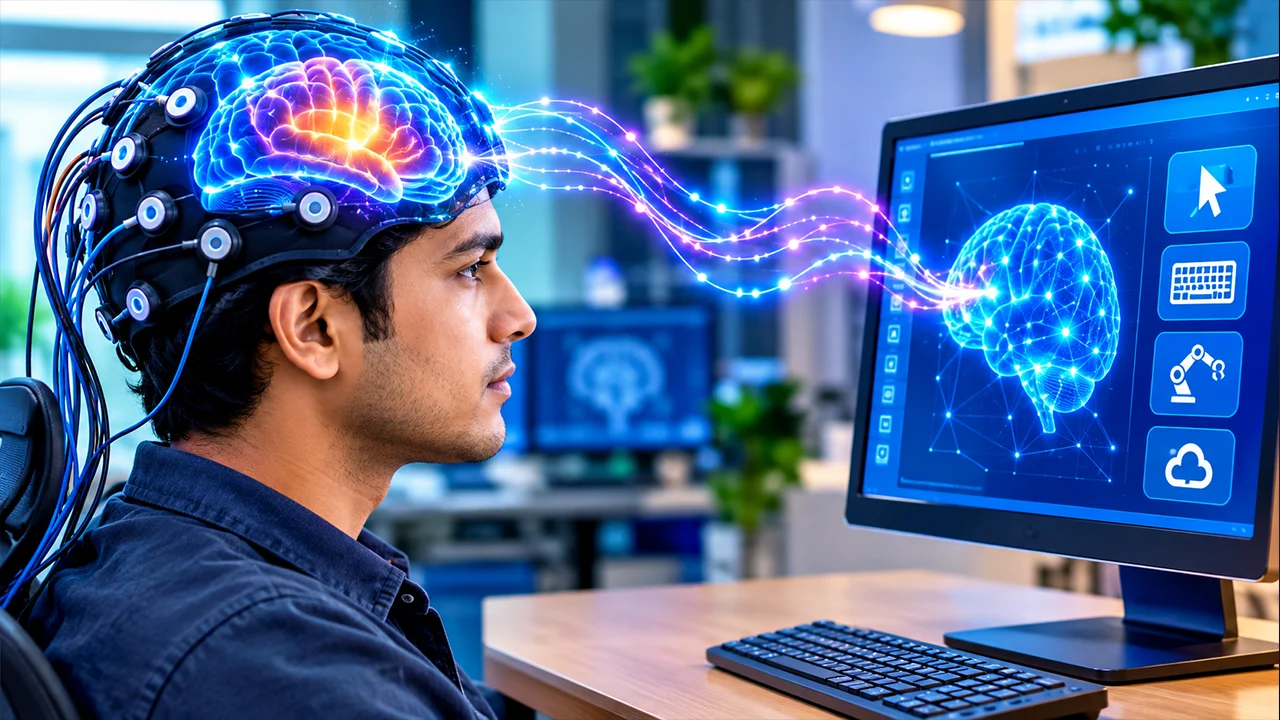
Imagine for a moment: you’re sitting in front of a computer, but you’re not touching the keyboard, not using the mouse. You simply think of a sentence in your mind. And it appears written on the screen. Or a person sitting in a wheelchair moves it purely through thought, then picks up a glass with a robotic arm to drink water. Just a few years ago, these were the stuff of science fiction. Today, they are technologies being tested in real laboratories. A brain-computer interface (BCI) is a technology that can establish direct communication between the human brain and a computer. Technology experts believe it could be one of the biggest revolutions in computing over the coming decade.
The human brain constantly generates countless electrical signals. When we think about something, see something, or decide to move a body part, neurons in the brain exchange electrical signals with one another. The core function of BCI technology is to detect these signals, analyze them, and convert them into digital instructions a computer can understand. In other words, instead of typing on a keyboard, brain signals themselves could become the input device of the future.
Research into this technology isn’t new. For decades, scientists have been trying to control computers by analyzing signals from the human brain. But thanks to advances in artificial intelligence (AI), improved sensors and miniaturized electronics, research has progressed considerably in recent years. Various research institutions and technology companies around the world are now developing technology that allows paralyzed individuals to type on a computer or control a robotic arm using thought alone.
BCI technology holds the greatest potential in health care. For people who cannot speak or move because of an accident or illness, it offers a new ray of hope. A paralyzed patient could write messages on a computer, communicate with family members, or control a wheelchair using only brain signals. In medical science, this is seen as one of the most important assistive technologies of the future.
It isn’t just medicine — the very way we use computers in the future could change. Today we use keyboards, mice, touchscreens or voice commands. But if BCI develops successfully, it may become possible to operate a computer through thought alone. Writing emails, playing games, controlling a smart home, or experiencing virtual reality could all become more natural and faster.
However, the biggest challenge for this technology is accuracy. The human brain is extremely complex. Every thought or feeling generates a distinct electrical signal, which isn’t easy to identify correctly. In addition, brain data is extremely personal. If this data is collected without authorization or misused, it could create major risks to personal privacy and security. As a result, strong cybersecurity and ethical guidelines are just as important as the BCI technology itself.
Many people wonder: will this technology one day be able to read human thought? In the current reality, the answer is “no.” Modern BCI can analyze certain types of brain signals to perform specific tasks, but it cannot read all of a person’s thoughts, memories or feelings. However, as research advances, the technology’s capabilities are gradually increasing.
Several technology companies and research organizations around the world are working on BCI technology. The goal is the same: to make communication between humans and computers more natural, faster and more effective. Experts believe that over the next 10 to 20 years, this technology will play an important role not just in medicine, but also in education, industry, gaming and everyday technology use.
It can therefore be said that the brain-computer interface isn’t just a new technology — it’s a new chapter in the relationship between humans and machines. Just as touchscreen technology once changed our lives, BCI may take that transformation one step further in the future. Then, perhaps, operating a computer will require neither hands nor voice — just a thought will be enough.