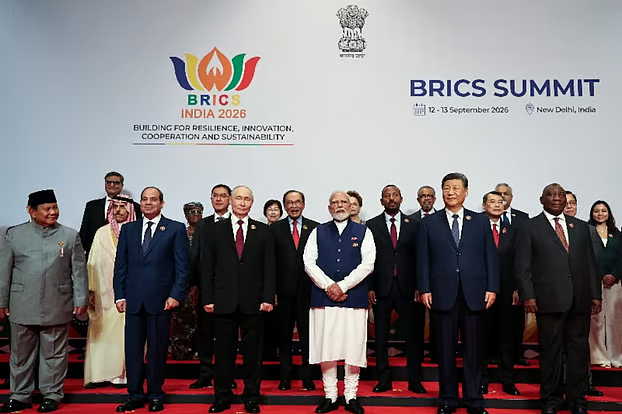
Some of the world’s most powerful leaders gathered around a huge round table in Delhi this weekend. Indian Prime Minister Narendra Modi declared there that the leaders sitting beside him must unite to become, in the future, not “rule followers” but “rule makers.”
Among those beside Modi were Chinese President Xi Jinping, Russian President Vladimir Putin, Iranian President Masoud Pezeshkian, Abu Dhabi Crown Prince Sheikh Khaled bin Mohamed bin Zayed Al Nahyan, and South African President Cyril Ramaphosa.
These countries are not exactly close allies — rather, they have a long history of border disputes, and have even been drawn into military conflict with each other.
India and China clashed fatally along their disputed border in 2020. And in the ongoing Middle East war, Iran and the United Arab Emirates (UAE) hold opposing positions. When that war sent shockwaves through the global economy, Tehran had launched missile and drone strikes targeting fellow BRICS member the UAE.
That India managed to bring these leaders physically together at such a time is no small achievement. It demonstrates India’s diplomatic clout. Against the backdrop of the Iran war, this summit also gave various countries an opportunity to reassess their mutual relationships.
The 18th BRICS summit was held in India’s capital, New Delhi, this past Saturday and Sunday. For members like China, Russia and Iran, BRICS serves as a platform through which the influence of the United States and Western Europe can be reduced.
India, however, is reluctant to present BRICS as an anti-Western bloc. At the summit, Modi himself said the group is “against no one.”
Drawing this distinction matters for Delhi, because India wants to maintain relationships even with countries that are in conflict with each other.
Despite clear divisions among members, this year’s BRICS summit still managed to produce a joint declaration.
Earlier this year, two BRICS ministerial-level meetings ended without any joint statement at all. This time, consensus was reached on the summit’s very first day. However, that consensus was reached by sidestepping the issues on which members hold sharply differing views — with barely any mention of how those problems might actually be resolved.
The joint declaration called for “maximum restraint” over the Middle East war. It also condemned “attacks on civilian infrastructure and peaceful nuclear facilities.” None of this, however, assigned blame to anyone specific.
The declaration also reaffirmed support for a two-state solution to the Israel-Palestine crisis. It opposed the forced displacement of Palestinians, alongside opposing any steps that could “legitimise or prolong the occupation.” This was presented very carefully, in keeping with existing UN resolutions.
The joint declaration made no mention whatsoever of Russia’s war in Ukraine — an exception compared with previous BRICS declarations.
A similarly cautious stance was seen on trade. The declaration expressed concern over “indiscriminately rising tariffs” and condemned unilateral sanctions, without directly naming the United States. This is thought to be intended to avoid provoking Washington’s anger.
Adjusting to a world order that has begun shifting under the impact of Trump’s trade threats and the Middle East war has now become urgent for the economies of many member states. In this context, one of the summit’s notable developments was the face-to-face meeting between Iran’s President Pezeshkian and Abu Dhabi’s crown prince. Such a meeting would have been hard to imagine just a few months ago. It is thought to be the highest-level direct meeting between the two countries since the Iran war began.
The summit also created an opportunity for Tehran to present itself to the world. It demonstrated that, despite US and Israeli military strikes and economic pressure, Iran has not become isolated from the rest of the world.
Washington is running “Operation Economic Outcast” against Iran, imposing various sanctions on the country and blockading its sea ports. Despite this, in his own remarks at the BRICS summit, Pezeshkian emphasised building deeper economic ties with BRICS members including Malaysia, India and Ethiopia.
For China, this marked President Xi Jinping’s first visit to Delhi in seven years. Deep distrust had developed between China and India following the 2020 border dispute, though that tension has eased somewhat since. The two countries also have a large trade deficit, weighted heavily in China’s favour.
The state of relations between Asia’s two great powers, China and India, became fairly clear through the exchange of greetings between Xi Jinping and Modi. The two leaders shared a cordial handshake, but Modi’s well-known embrace was notably absent. Xi Jinping also spent less than 24 hours in Delhi and did not attend the dinner Modi hosted Saturday night.
Even so, for these two countries with strained relations, the weekend’s gathering was still significant. An official statement said the two leaders agreed to further strengthen business ties and connectivity, and to remove obstacles to trade.
Above all, the summit demonstrated that even outside Western-dominated institutions, BRICS can create space for rival nations to talk and align their positions.