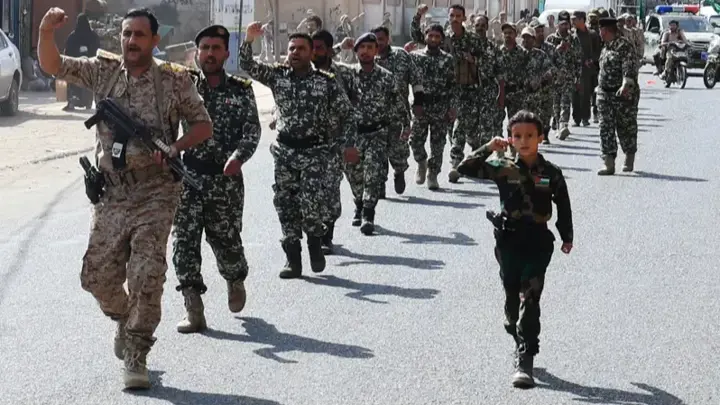
The Houthis’ rapid advance across the southern part of Yemen’s coastal plain, Tihamah, has stunned most analysts. Until recently, the anti-Houthi coalition known as the National Resistance controlled significant territory along Yemen’s Red Sea coast.
Within just a few days, a large part of that has fallen into Houthi hands.
By some estimates, the Iran-backed rebels have seized about 130 kilometres (81 miles) of the country’s strategically important coastline. This is the group’s most significant military success in years. It demonstrates that despite 12 years of civil war, devastating Saudi air strikes, and attacks by US, Israeli and British forces, the Houthis remain a significant force.
“With their opponents stunned and demoralised, it seems unlikely the Houthis can be dislodged in the near future. They have now taken position there and will consolidate it,” Hisham al-Omeisy, a senior analyst at the Brussels-based European Institute of Peace, told the BBC. “And it will cost a great deal to remove them from there.”
The Houthis, of course, are not alone.
Yemen’s Houthis receive support from Iran, and this backing has become even more important to Tehran following the setbacks and defeats experienced by other parts of the so-called Axis of Resistance — namely Hezbollah in Lebanon, Hamas in Gaza, and the Assad government in Syria.
“So they have reaffirmed their support for the Houthis,” al-Omeisy said.
And they certainly need that support.
Most analysts agree it would be a mistake to describe the Houthis simply as Iran’s puppet. However, the events of the past few days have exposed an uncomfortable new reality.
Seven months after the United States and Israel launched a major joint strike against Iran, Tehran’s rulers now exert direct or indirect influence over two of the world’s most important maritime routes. One is the Strait of Hormuz at the mouth of the Persian Gulf; the other is Bab al-Mandeb, the gateway to the Red Sea (and the Suez Canal).
“Iran is now controlling, directly and through its allied groups, two of the most strategic maritime chokepoints in the Middle East and the world,” said Fareha al-Muslimi, a research fellow at London-based Chatham House.
“More than 35 percent of global energy and oil trade is controlled through this,” she said. “This could have an impact on the scale of a nuclear bomb’s disruption.”
If the Houthis also take control of several key Red Sea islands — including Perim, which sits at the narrowest point of Bab al-Mandeb — their ability to interfere with international shipping would increase substantially.
Houthi actions targeting Israel since the Gaza war have already shown that ships transiting the Red Sea are highly vulnerable to Houthi missiles, drones and small attack boats.
“Even without this geographic advance, they were able to control shipping heading to and from Suez via Bab al-Mandeb,” Yemen expert Iona Craig told BBC Radio 4’s Today programme on Friday.
“But now they control an area with direct oversight of Bab al-Mandeb, which gives them even greater influence.” In a statement issued Friday afternoon, Houthi military forces said shipping would be safe for companies whose vessels are not Saudi-owned, though Saudi vessels remain under blockade. It is only natural that shipping companies would be sceptical of the sincerity of that statement.
In previous attacks, the Houthis said they were only targeting Israel-linked vessels. But in practice, they also struck ships with no connection to Israel, including a Norwegian-flagged oil tanker.
Craig said, however, that the Houthis might refrain from indiscriminate attacks, as they would not want a repeat of “Operation Rough Rider,” the six-week major US air and naval campaign in spring 2025.
“They have already felt the United States’ strong response,” she said.
But would the United States want to get involved again?
President Donald Trump’s war with Iran has already become unpopular.
With oil prices starting to rise again, a new confrontational situation seems unlikely to strengthen his public support or the Republican Party’s prospects in the midterm elections in November.
According to Axios, requests from Saudi Crown Prince Mohammed bin Salman for US intervention have so far gone unanswered.
Axios wrote that the United States is concerned about the escalating conflict in Yemen and is trying to strengthen support for Saudi Arabia on one hand, while seeking to avoid direct military involvement on the other.
But Saudi Arabia’s concerns are not limited to the potential threat at Bab al-Mandeb.
Satellite imagery of potential Houthi missile and drone threats to Saudi Arabia’s East-West pipeline suggests the route — a critical alternative for oil exports should the Strait of Hormuz close — has been targeted.
This is believed to be an attempt by Iran’s Yemeni allies to further increase economic pressure on the United States, Israel and their allies.
Even if Iran has not directly ordered the attacks, it is clear that it stands to benefit from them.
Baraa Shiban, a researcher and analyst at the London-based Royal United Services Institute, said this escalation — the largest since the UN-brokered ceasefire of 2022 — began in July, when a Houthi delegation returned from the state funeral of Iran’s Supreme Leader Ayatollah Ali Khamenei.
“Tensions began rising immediately after that,” he said. “And it seemed quite clear that [Iran] was now determined to secure a larger presence in the Red Sea.”
With Yemen once again on the brink of full-scale war, Saudi Arabia anxious about protecting its economic lifeline in the Red Sea, and Donald Trump apparently reluctant to get drawn into this conflict, the US confrontation with Iran has taken on a new and potentially dangerous dimension.
And for the people of Yemen — displaced, devastated, hungry and impoverished by 12 years of civil war — recent events will make their lives even harder.