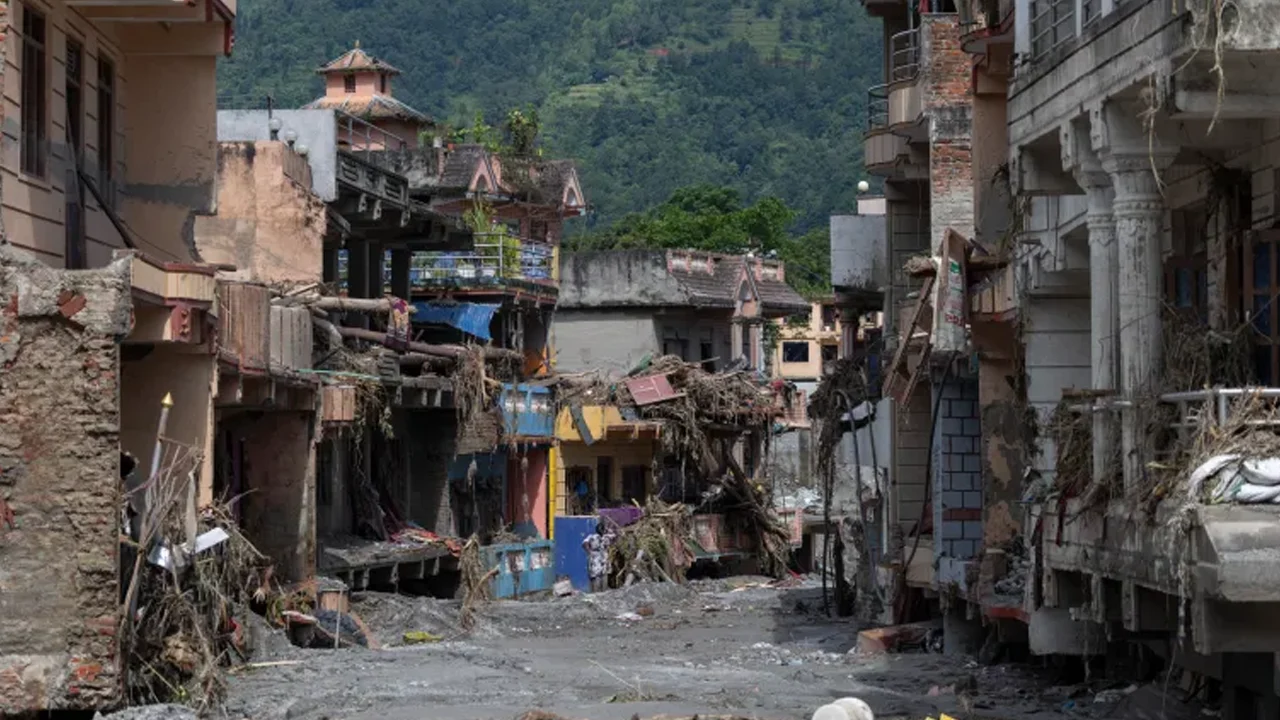
Nepal’s finance minister, Swarnim Wagle, says the country may need $4 billion to $5 billion to rebuild after the devastating flood.
In an interview with the British news agency Reuters on Saturday, Wagle said: “Preliminary estimates suggest reconstruction could require $4 billion to $5 billion. This is still just an estimate. Work to determine the extent of the damage is under way.”
The finance minister said the amount needed this time could be lower than what was required to rebuild after the devastating 2015 earthquake. However, he did not explain in detail why this time’s requirement might be comparatively lower.
Glacial collapse triggers devastating flood
A glacier in the Himalayan region collapsed last Wednesday. This sent a massive volume of rock, ice, mud and debris rushing downstream with the river’s current. This triggered a devastating flood in Nepal and Tibet, China.
The disaster has killed more than 600 people across the two countries. More than 2,000 people remain missing.
The powerful floodwaters damaged several towns and settlements in the border area. Bridges and roads were washed away. Several important hydropower stations were also damaged.
A full accounting of the disaster’s damage is not yet complete. As a result, it is not yet possible to say with certainty how much money will ultimately be needed for reconstruction.
2015 earthquake cost $9 billion
The magnitude-7.8 earthquake of 2015 was the most devastating natural disaster in Nepal’s history. That earthquake killed roughly 9,000 people. More than 500,000 homes were destroyed.
The earthquake damaged roughly one-third of Nepal’s economy. The country’s reconstruction afterward cost roughly $9 billion.
This time, preliminary estimates suggest $4 billion to $5 billion may be needed, the finance minister said. However, he did not explain why this reconstruction might require less money than in 2015.
Major damage to hydropower sector too
The impact of the flood was not limited to infrastructure alone. The country’s important hydropower projects were also damaged. These projects account for more than 12 percent of Nepal’s total power generation capacity.
As a result, alongside recovering from the flood damage, normalizing power generation has also become a major challenge for Nepal.
The country’s economy is largely dependent on remittances, tourism and hydropower. As a result, the impact of the recent flood is not expected to be limited to the affected areas or infrastructure alone.
Securing the necessary funds for reconstruction, rebuilding damaged infrastructure, and normalizing power generation and economic activity are now the major challenges facing Nepal.