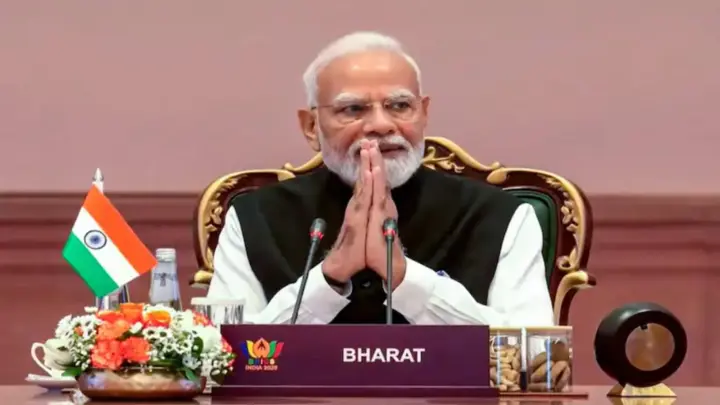
Questions are being raised over how far the idea Indian Prime Minister Narendra Modi presented at the BRICS summit through the Sanskrit phrase “Vasudhaiva Kutumbakam” — “the whole world is one family” — actually holds up in the reality of international politics. If the world is truly to be considered one family, the most mature path to resolving disputes with neighbouring states is bilateral dialogue and understanding.
At the 18th BRICS summit held in Delhi, Modi put forward the concept of “Vasudhaiva Kutumbakam” as a basis for unity. It means “the world is one family.” But while quoting an ancient phrase at an international summit is easy, applying that philosophy to actual state behaviour is far harder.
The BRICS summit has raised some questions about running the world like a family. Given the disputes, conflicts and distrust between various states around the world, realising this idea remains a distant prospect. At the same time, certain positions in India’s own foreign policy do not sit easily alongside the “world is one family” concept.
The question of India-Pakistan relations also came up at the BRICS summit. If India views the world as one family, then sitting down for bilateral talks to resolve disputes with a neighbour is the mature state behaviour to match. If the two countries take the initiative to resolve their issues through bilateral dialogue, the wider international community would welcome it too.
The Delhi summit can be compared with earlier BRICS gatherings. At China’s Xiamen summit in 2017, a firm position was taken that even named certain armed groups. This time, rather than that kind of direct positioning, the emphasis was more on preserving consensus — seen as part of BRICS’s shifting political reality.
The “world is one family” concept becomes meaningful only when a state takes a humane, justice-based position rather than siding with another state’s aggression or repressive policy. At the same time, it requires ending incidents of violence and mob lynching occurring in various parts of the world. Human dignity and equality are essential parts of the “world family” concept.
Chinese President Xi Jinping’s remarks at the BRICS summit are particularly significant. BRICS, he said, should take a leading role in preserving peace and stability and address not just the symptoms but the root causes of conflicts around the world. Peaceful coexistence in West Asia, respect for national sovereignty, adherence to international law, and regional development all matter.
Xi also reiterated the need for a swift ceasefire in West Asia and progress toward a two-state solution for a lasting resolution of the Palestinian crisis. Such positions create the possibility for BRICS to play an active role not just as an economic bloc, but in international peace and stability as well.
The “world is one family” idea has also been compared with South Africa’s “ubuntu” philosophy. During the dismantling of South Africa’s apartheid system, Nelson Mandela and Desmond Tutu emphasised the philosophy of “ubuntu” — “I am, because we are.” It carries the same underlying idea of human interdependence, equality and respect.
The idea of human unity found in the Bible and the Indian Upanishads is also significant. Various religious and civilisational traditions carry the idea of viewing humanity as part of a greater unity. But in real-world politics, conflicts of nation, religion, state interest and power repeatedly weaken that ideal.
To truly turn the world into one family, it is not enough to speak of unity from a summit stage — that ideal must also be reflected in states’ actual behaviour. Where disputes exist with neighbours, states must pursue dialogue instead of a show of force, understanding instead of conflict, and equality instead of dominance.
If the world is truly one family, the first condition for resolving division within that family is talking to one another. In international politics too, resolving disputes between neighbouring states through bilateral dialogue is the mature and responsible path. At the same time, alliances like BRICS must take a more active role in establishing peace by addressing the root causes of global conflict.