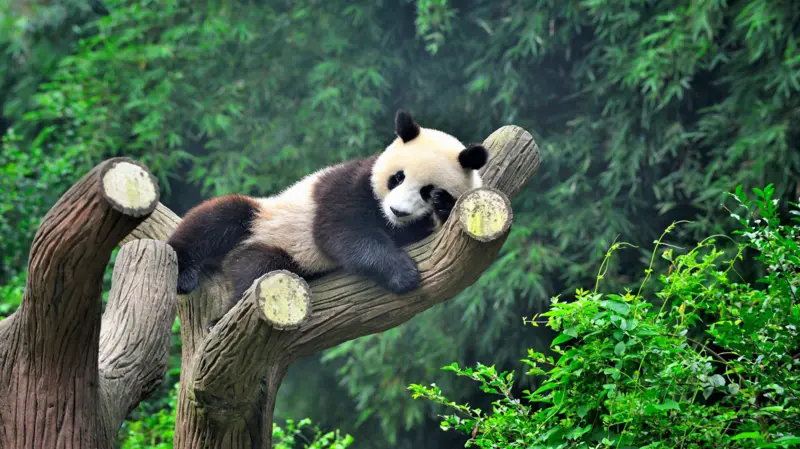
A black-and-white animal walks silently through a fog-covered mountain forest. All around, there is only the soft rustle of bamboo. There is no human noise anywhere, no sign of modern civilisation. It is in this quiet environment that one of the world’s rarest mammals, the giant panda, is born. And this creature is deeply woven into the life, culture and emotions of the Chinese people. In China, the panda is not just an animal — it is a symbol of good fortune, peace and the balance of nature. Children there grow up looking at panda images, conservation workers dedicate their lives to protecting them, and at the state level too, the panda is viewed as a national heritage. An animal once on the brink of extinction has been brought back not through science alone, but through human love, commitment and a long struggle. Yet a puzzle remains: with so many forests, mountains and protected areas across countries worldwide, why is the giant panda’s natural birth and habitat confined only to China?
Giant panda: numbers, build, habitat and diet
A member of the bear family, the giant panda is black and white in colour and large in size. It is found only in China. Being confined solely to China has made it internationally synonymous with the country itself. Giant pandas have black fur around their eyes, ears, nose, legs and shoulders, while their thick, wool-like fur across the rest of the body helps them stay warm in the cold mountain environment. An adult panda is roughly 1.5 metres long and stands about 90 centimetres tall at the shoulder, weighing up to 150 kilograms. Male pandas tend to be slightly larger and heavier than females. A newborn panda cub, meanwhile, is about the size of a corn cob — no other mammal gives birth to young so tiny relative to the mother’s own size.
Although their digestive system resembles that of a carnivore, pandas have, through evolution, become almost entirely herbivorous, relying overwhelmingly on bamboo. A giant panda must eat around 12 to 38 kilograms of bamboo every day. This heavy reliance on bamboo is their biggest vulnerability, since destruction of their habitat — the bamboo forests — directly threatens their survival. They do not eat only bamboo, though; around one percent of their diet consists of other plants and, occasionally, small animals. They have a broad, sturdy set of teeth and a special wrist bone that functions like a thumb, allowing them to grip and eat bamboo with remarkable efficiency.
Determining exactly how many pandas exist in the wild is no easy task. The World Wide Fund for Nature (WWF) has long worked jointly with China on giant panda conservation. The organisation says finding signs of panda presence is a laborious process. Research teams often have to painstakingly examine every metre of forest over several consecutive days. In remote, mountainous bamboo forests, they walk for hours simply hoping to find panda droppings. When droppings are found, they are sifted to separate out the “undigested” bamboo fragments, which are then analysed for bite marks to determine which panda they came from — because every panda’s bite pattern is unique, much like a human fingerprint. A panda defecates around 50 times a day, since bamboo has very low nutritional value and most of it passes through undigested. This is why pandas eat so much bamboo and also excrete it so quickly. A panda has been observed to spend fully 12 hours of the day simply eating.
According to the organisation, which is active in panda-protection efforts, the most recent survey, conducted in 2014, found 1,864 giant pandas living in the wild. Although this number remains relatively small, it is still seen as a major success, since by the late 1970s the number of pandas had fallen to fewer than 1,000. Notably, outside the wild, there are around 600 pandas in zoos and breeding centres, though the vast majority of these captive giant pandas are in China. A handful of pandas exist in a few countries in the United States and Europe, but all of them are on loan from the Chinese government. WWF says that while wild giant pandas typically live 14 to 20 years, good care in zoos or conservation centres can extend their lifespan up to 30 years.
Why do giant pandas occur naturally only in China?
The fact that giant pandas today are confined naturally to China alone is no coincidence — it is the result of thousands of years of ecological history. They once ranged well beyond southern and eastern China, extending into Myanmar and northern Vietnam. But as human populations grew and agricultural and settlement pressures increased, the giant panda’s once-widespread habitat gradually shrank. In the end, they survived only in China’s remote mountain forests, where nature could still provide the food and shelter they needed. According to WWF figures, giant pandas now exist in only around 20 isolated bamboo forest patches, spread across six mountain regions in China’s Sichuan, Shaanxi and Gansu provinces. Most wild pandas now live in the Minshan and Qinling mountain ranges.
Since habitat destruction is the greatest threat to pandas, the Chinese government has established 67 panda reserves, where more than two-thirds of wild pandas now live safely, protecting more than half of their natural habitat. Special bamboo corridors have also been created to connect isolated forest patches, allowing pandas to move into new areas, access more food, find mates and increase breeding. As noted, bamboo, the panda’s main food, grows most densely and diversely in precisely these mountain forest regions of China. According to the UN Food and Agriculture Organization, China ranks first in the world for bamboo species diversity. Pandas also cannot tolerate heat, so China’s high mountains, misty valleys and consistently cool climate are ideal for their bodies and way of life.
How the panda returned from the brink of extinction
The giant panda first came to the attention of the Western world in March 1869, when a hunter delivered a panda pelt to French missionary and naturalist Armand David. This introduced the panda to the scientific world in Europe. In the early 20th century, Western hunters and collectors gradually brought the panda further into global attention. In 1929, two brothers from the Roosevelt family became the first foreigners to hunt a panda, which brought the animal further into discussion in the Western world at the time.
The real explosion of public emotion and popularity around pandas, however, came in 1936. That year, American explorer Ruth Harkness brought a live baby panda to the United States, instantly capturing media attention. Panda images began appearing regularly in newspapers and magazines. With its cute face, large eyes, round features and gentle, calm nature, the panda carved out a special place in people’s hearts, giving rise to the “panda cult.” Over the following decade, foreigners took at least 14 giant pandas out of China, sometimes for exhibition, sometimes for private collections. At the time, pandas were a rare novelty. But in 1946, the Chinese government closed the door on taking pandas out of the country, completely banning foreign possession of pandas. This was the first major state decision to protect pandas.
Meanwhile, behind the popularity, the panda’s forest habitat was being rapidly destroyed. So, in the early 1960s, China declared its first panda reserve and banned hunting. Surveys in the 1970s revealed the wild panda population had fallen alarmingly — in Sichuan province in particular, more than half of the forest suitable for pandas had already been lost by then. This reality prompted much stricter panda conservation policies worldwide. In the 1990s, a large portion of panda habitat was brought under protected status. As a result, pandas gradually began to recover. Successive national surveys showed their numbers rising back from the brink of extinction — from around 1,600 in the wild in 2004 to around 1,864 by 2014.
“Panda diplomacy” — when pandas become a language of diplomacy
According to WWF figures, between 1957 and 1983, China gifted 24 pandas to various countries as tokens of diplomatic goodwill. This practice of gifting pandas came to be known, from 1960 onward, as “panda diplomacy.” This was particularly during a period of intense tension between the United States and the then-Soviet Union. Against that backdrop, then-Chinese leader Mao Zedong gifted pandas to the Soviet Union and the United States during state visits in the 1960s, and to the United Kingdom in the 1970s. But in the 1980s, China declared the giant panda a state asset, moving away from its policy of gifting pandas and instead introducing a loan system. Since then, every living panda anywhere in the world is, legally, owned solely by China. Which country receives a panda depends entirely on China’s own decision. China only loans pandas to countries with which it wants to build strong commercial ties.
Paul Jepson, a conservation expert at Oxford University who has researched “panda diplomacy,” notes that when China loans a panda to another country, ownership of that panda remains with China throughout. Even cubs born abroad are legally treated as China’s property. Zoos in those countries must meet strict conditions to keep pandas, and the entire process of feeding and caring for them is extremely costly. For instance, countries housing pandas loaned by China must pay China around $1 million (roughly £790,000) per year for each panda pair. A panda-loan agreement typically runs for 10 years, though it can be extended if needed and both sides agree.
In recent years, major trade deals have often lain behind China’s panda-loan decisions. For example, behind the sending of two giant pandas to Edinburgh Zoo in Scotland in 2011 was a trade agreement with China, under which Scotland sold salmon, Land Rover vehicles and offshore oil-extraction technology to China. Behind the pandas sent to Belgium in 2014 was likewise a trade agreement involving advanced pollution-control technology.
In recent years, many pandas have also been returned to China. The most recent example is Japan. As part of panda diplomacy, China first gifted a panda to Japan in 1972. Xiao Xiao and Lei Lei were born at Tokyo’s Ueno Zoo in 2021. Their mother, Shin Shin, and father, Ri Ri, had been loaned to Japan as part of breeding research.
It is worth noting that, for centuries, many countries around the world have gifted rare wildlife to other nations as tokens of friendship. This practice is far less common today, since most rare animals are now bred within zoos and exchanged between them. But the panda’s case is entirely different — because of China’s declaration in the 1980s, no one other than the Chinese government can own a giant panda.