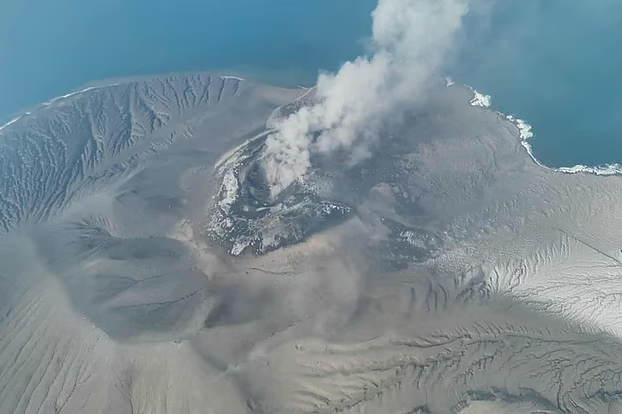
Volcanic ash has led to the suspension of 301 flights at five airports in Indonesia, including the country’s main international gateway, Soekarno-Hatta International Airport. Flight operations were halted Sunday after ash from the Anak Krakatau volcano spread into the airspace near Jakarta, disrupting more than 22,000 travelers.
Authorities said the flights were suspended after volcanic ash was detected in the airspace near Soekarno-Hatta International Airport on Sunday morning local time. Of these, 58 were international flights.
The country’s Transport Ministry said flights to and from Singapore were the most affected. Flights on other international routes, including to Doha, Sydney and Kuala Lumpur, were also disrupted by the suspension.
The Anak Krakatau eruption began late Friday night. Continuous tremors, fountains of lava and loud sounds were heard afterward. Authorities said two more eruptions occurred from the volcano early Sunday as well.
Anak Krakatau is located in the Sunda Strait, between the islands of Java and Sumatra. Authorities confirmed no tsunami warning was issued over the recent eruption.
Due to the health risk posed by the volcanic ash, the health minister has advised residents of affected areas to stay indoors, and has urged the use of face masks to protect the respiratory system, eyes and skin.
According to a report in the local newspaper Kompas, several schools canceled classes Saturday after complaints of eye irritation from the ash. Several fishermen also canceled their sea trips after reporting eye pain and irritation.
Local resident Aldi Chandra Prayogi told Kompas that since Friday evening, it had felt as though “tiny grains of sand” had gotten into his eyes. He has had to use eye drops to relieve the irritation.
Aldi said the layer of dust is so thick that he has had to sweep the yard in front of his house every five minutes.
Passengers stranded by canceled flights due to the volcanic eruption are now waiting for ticket refunds.
Anak Krakatau, ‘child of Krakatoa’
The name Anak Krakatau means “child of Krakatoa.” The volcano, which emerged from the sea in the early 20th century, becomes active from time to time. It formed in the crater created after the eruption of Mount Krakatoa in 1883.
In December 2018, Anak Krakatau collapsed, triggering a massive tsunami that killed more than 400 people. Thousands of people in coastal areas near Java and Sumatra were displaced or injured.
Scientists later found that some of the rock fragments displaced during the volcano’s collapse were roughly 70 to 90 meters tall.
Indonesia sits on the Pacific “Ring of Fire,” a region prone to frequent volcanic eruptions and earthquakes that encircles nearly the entire rim of the Pacific Ocean.