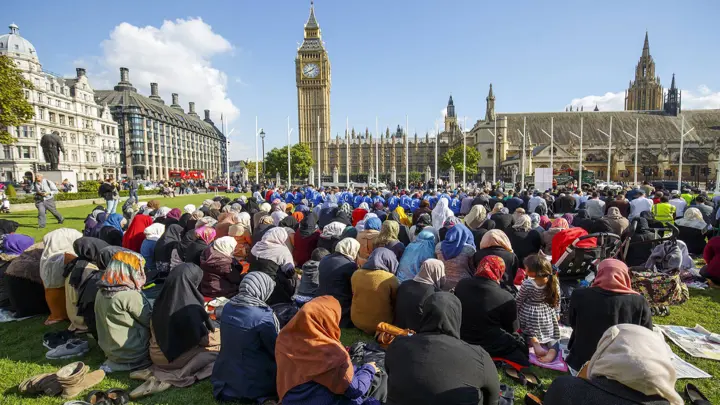
Fear surrounding Islam is steadily growing in Europe. In several European countries, nearly half the population now believes Islam is incompatible with Western values. In Germany’s Saxony-Anhalt state election on September 6, the populist right-wing party Alternative for Germany, or AfD, won 44 percent of the vote. The party warned against “Islamisation” and promised mass deportations of immigrants. Around the same time, hundreds of masked people in Dover, Britain, chanted “stop the boats” and “Christ is king.” In France, Marine Le Pen’s call to ban the Islamic hijab in public spaces has also won significant public support.
This fear over Islam is not confined to Europe alone; it has spread to the United States as well. But where the dominant fear after September 11, 2001, centred on terrorism, a newer idea is now gaining more traction — that Islam is trying to take over Europe from within. Some members of the Donald Trump administration have used language such as “civilisational erasure.” This idea does not match reality. In practice, there is no “takeover” of Europe by Islam under way, nor are Muslims becoming radicalised on a mass scale. European culture is not disappearing either. Claims that “no-go zones” have taken hold in Europe, that sharia is creeping into national law, or that a planned “great replacement” of the population is under way, have no basis in fact.
This does not mean Islamists are free of fault. The real risks in Europe come from two directions — on one side, a political ideology seeking to subordinate the state to Islamic policy, and on the other, a social-media-driven, far-right Islamophobia. Europe’s leftists, by denying the real but limited threat of Islamism, end up making the problem more complicated. Similarly, centrist politicians often stay silent out of fear of being accused of racism.
Europe’s own population figures cast doubt on the idea of an “Islamic takeover.” Although immigration from majority-Muslim countries has increased, Muslims still make up only about 6 percent of Europe’s population of more than 500 million. While recent immigrants tend to have more children than the native population, their birth rates typically converge toward local levels within a generation or two. So fears that European civilisation or culture will disappear are not realistic. Nor is there support for the idea that most Muslim immigrants want to reshape their new country into the kind of society they left behind — in many cases, their children are outperforming their parents academically. British students of Bangladeshi origin are cited as an example: in 2021, 67 percent of Bangladeshi-origin students in Britain who sat standardised exams had enrolled in university by age 19, compared with 38 percent among white British students.
Muslim participation in British politics has also grown — Muslims hold important positions such as home secretary and mayor of London. Many of Muslims’ social attitudes are also broadly in line with other European populations; a survey of British Muslims reportedly found no major opposition to women’s participation in the workforce. In other words, the simplistic idea that having a Muslim identity necessarily conflicts with mainstream European values does not hold up.
That raises the question of why so many people in Europe are taking a stand against Islam. Social media plays a significant role here. In particular, Elon Musk has used his social media platform to influence global attitudes toward Islam and has encouraged Europe’s anti-Islam right-wing forces. British anti-Islam activist Tommy Robinson is also notable in this context.
The solutions proposed by the populist right could themselves make the problem worse. Measures such as mass deportation of immigrants, social exclusion and dress bans risk instilling fear among Muslims, pushing them further from the social mainstream, and driving some toward extremism. In other words, the fight against Islamism should not adopt policies that ultimately deepen the very divisions they claim to address. For that reason, the advice to Europe’s mainstream political parties is to enforce strict laws against violence and threats of violence, but not to place any subject off-limits for discussion in the name of cultural sensitivity. Freedom of expression is not the enemy of tolerance — it is, in fact, a precondition for it. At the same time, any covert infiltration or influence-seeking by a political or social group should be brought into the open, just as religious or ethnic hatred must also be confronted.
The importance of reliable information has also been stressed. Governments need reliable data on immigration, population and social change, and need to publish it. When governments are reluctant to collect or release such data, that vacuum gets filled instead by speculation, exaggeration and various conspiracy theories.
Europe’s Muslims are gradually integrating into society. In the past, Europe saw similar waves of social panic over Catholic, Jewish and Caribbean immigrants, with questions raised over whether they would ever find their place in their new societies. Over time, those communities became part of European society. The same process could unfold with Muslims too — provided division, extremism and unfounded fear do not stand in its way. Islam itself is not an existential threat to Europe; but both the extreme political form of Islamism and unfounded Islam-based fear can pose real problems for Europe’s liberal democratic system. At the same time, exaggerated notions of a “takeover of Europe,” a “great replacement,” or “the fall of Europe through sharia” need to be rejected on the basis of the facts.