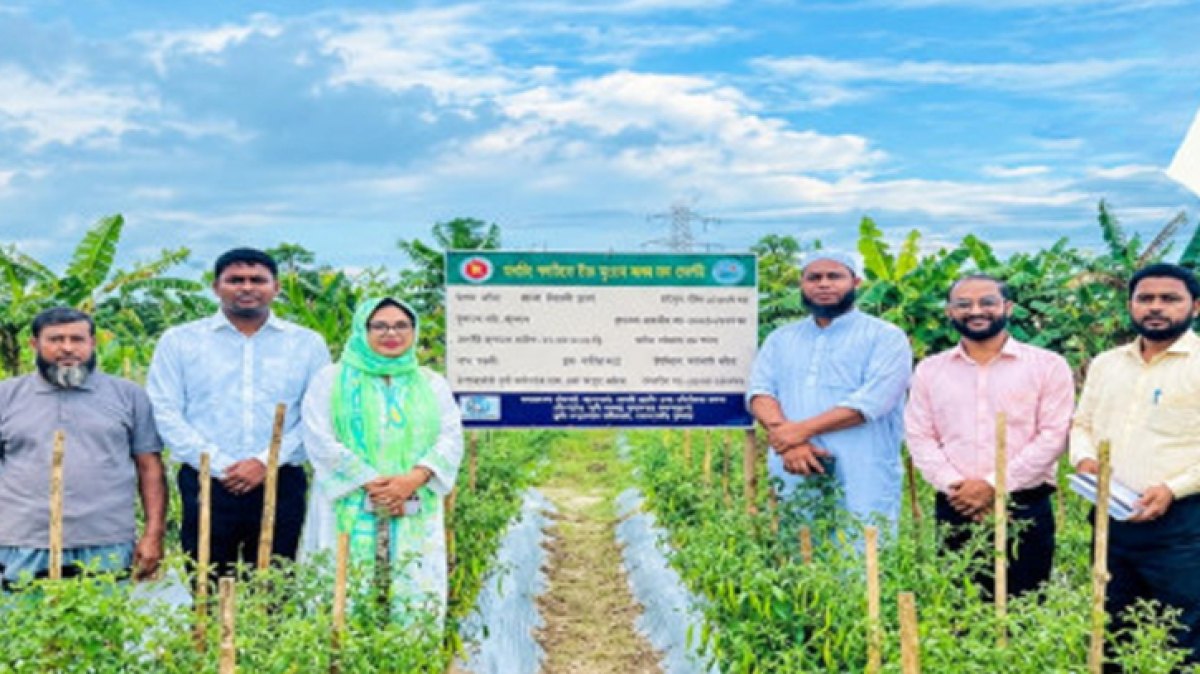
A project to make farming in eastern Bangladesh more resilient to climate disasters, flash floods and crop losses is under way. The Bangladesh Sustainable Recovery, Emergency Preparedness and Response (B-STRONG) project, financed by the World Bank with a matching grant from the government, is restoring agriculture in flood-hit areas while expanding climate-resilient technology, farm mechanisation, improved seed production and water-saving irrigation.
The project is running in 40 upazilas of Cumilla, Brahmanbaria, Feni, Laxmipur and Noakhali. It aims to reach about 65,000 farmers through training and other activities. Last fiscal year it carried out 6,740 demonstrations, and it is working towards another 10,000 this fiscal year.
It is also bringing farmers’ yards, fallow land, pond banks, unused ground at schools and abandoned roadside plots into production. Those involved hope the work will help agriculture recover after disasters, reduce farmers’ losses in future and make production more stable.
Mulching pays off for chilli
Hasan, a farmer from Montoli village in Nangalkot upazila of Cumilla, grew chillies with mulching for the first time this year. In the past he did not consider chillies in the monsoon, fearing heavy rain and waterlogged fields. With support from B-STRONG he adopted a new method to manage that risk.
Hasan said that on the advice of agriculture officers he built raised beds, laid mulching sheets and planted seedlings in them. This made it easier to drain excess water, kept moisture in the soil and cut down weeds. He used pheromone traps and yellow sticky traps to control insects. Agriculture officers visited his field regularly and advised him on fertiliser, irrigation, disease and pest control. He says the plants stayed healthy through the monsoon and he has harvested chillies several times.
By Hasan’s own account, he sold 490 kg of chillies from 33 decimals of land: 200 kg in the first picking and 290 kg in the second. Selling at Tk 120 to Tk 140 a kilogram, he said he has earned about Tk 70 to 80 thousand so far, against total costs of about Tk 24,000. The plants are still bearing, and he hopes to sell Tk 1.3 lakh to Tk 1.5 lakh worth of chillies in all.
Hasan’s experience suggests that the right technology and care can make vegetable growing possible even in a difficult season. The real profit of the method, however, can only be judged by checking production costs, yields and sales.
Not only recovery after disaster
Sabina Yasmin, director of the B-STRONG project, said quick recovery of agriculture after a disaster is not the project’s only aim; building farmers’ capacity to reduce losses in similar disasters in future is another.
She said the flash floods of 2024 caused heavy damage to agriculture in the east of the country, especially in Feni and Noakhali. The project was started to restore farming after those losses and to prepare farmers for future disasters.
The project runs from April 2025 to June 2028, and field work began in July 2025. The Department of Agricultural Extension is the lead implementing agency and the Bangladesh Agricultural Development Corporation (BADC) the co-lead. The Local Government Engineering Department, water development agencies, disaster management offices and the Social Development Foundation are among the other government bodies involved.
Technology and mechanisation to raise output
One of the project’s main goals is to raise output and reduce climate risk through technology and farm mechanisation. It also plans to bring more women and young people into farming, with targets of 30 per cent women and 20 per cent young people aged 18 to 35.
Sabina Yasmin said farmers are being connected with modern technology so that, rather than staying with traditional methods, they can produce more with less water, less time and lower costs.
After a disaster, one of farmers’ biggest problems is getting good seed. To address this, the project is focusing on improved technology for rice, wheat, pulses, oilseeds and spice crops and on seed production by farmers. It is also increasing seed storage capacity, strengthening BADC’s warehousing and supporting local seed production. Project officials expect this to reduce delays and shortages caused by bringing seed from distant areas after a disaster.
From pulses and oilseeds to onions and chillies
Crops suited to the local soil and environment, such as grass pea, black gram, lentil, mustard, sunflower and soybean, are being expanded. Demonstrations of improved wheat varieties are under way, onions are being grown on a trial basis in Noakhali, and farmers are being drawn into high-value crops including chillies.
To reduce the risk of growing horticultural crops in the monsoon, the project is demonstrating mulching and raised-bed cultivation. For tomatoes, chillies and bitter gourd, the focus is on quick drainage and keeping the base of the plants raised, and farmers receive regular technical advice.
To make use of empty space around homesteads, 50,000 grow bags have been distributed to farmers for growing ginger and chillies in small spaces.
“If even the bits of land lying around a farmer’s house can be brought into production, it can meet the family’s nutrition needs and bring in extra income,” project director Sabina Yasmin said.
Mustard before the Aman harvest
To save on ploughing costs, time and water, the project is spreading zero-tillage mustard, grown without ploughing. Mustard seed is broadcast in the field about 10 days before the Aman rice is harvested, so the land does not need to be prepared again for mustard after the rice is cut.
Rather than growing the same crop on the same land again and again, the project is also encouraging short-duration crops such as mustard or grass pea to keep the soil healthy and fertile.
Alternative irrigation to save water
To ease pressure on groundwater, the alternate wetting and drying (AWD) method is being used in rice, in which fields are irrigated as needed rather than kept flooded all the time. Farmers are also being given low-lift pumps free of charge, and irrigation channels are being built and repaired.
There are plans to expand solar-powered drip irrigation in orchards, which will let trees get the water they need using less of it.
Community gardens on fallow land
Several steps have been taken to bring fallow and unused land into production: trellised crops on pond banks and fallow plots, a community garden run jointly by three farmers on abandoned roadside land, and cultivation on unused ground at schools, colleges and madrasas.
To protect soil quality, the project is supporting the production of vermicompost and trichocompost. Trichocompost is being used to keep soil healthy and to help manage fungal diseases.
To cut production costs, summer tomatoes have been demonstrated without shade structures. The project plans to expand poly-shade technology in future once farmers are selected and the technical groundwork is in place.
Sabina Yasmin said the whole project team has been working regularly in the field for the past few months, and field visits have been a priority from the start. In her words, plans on paper alone do not show the real picture of a project; what matters most is how well the work is doing in farmers’ fields. Describing her role as project director as a big challenge, she said she had been involved since the project was first drawn up, so she understands its aims, plans and field needs. The main goal now, she said, is to complete the work on schedule and deliver its benefits to farmers.
বাংলায় মূল প্রতিবেদন পড়ুন · Read the original Bengali report