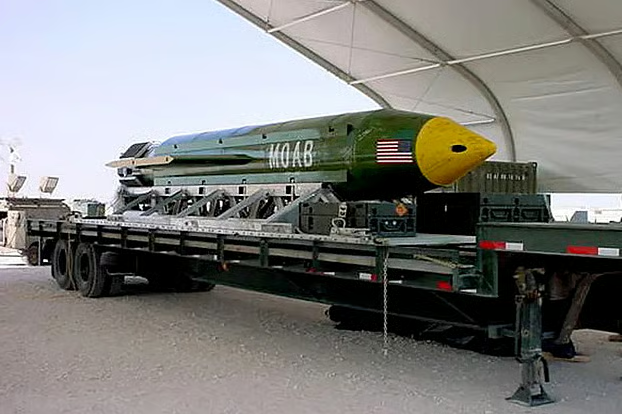
The United States has drawn up plans to attack Iran’s energy infrastructure and nuclear projects with its largest non-nuclear bomb, CNN reported, citing US officials.
Military experts say that at a time when the fighting has eased somewhat, using the GBU-43/B Massive Ordnance Air Blast (MOAB) bomb, known as the “mother of all bombs”, could inflame the conflict on a much larger scale.
Elijah Magnier, a military expert based in Brussels, Belgium, told Al Jazeera there is no guarantee that even this bomb would destroy Iran’s nuclear facilities deep underground, so such an attack would amount to little more than staging “political theatre”.
What is the MOAB?
The MOAB is a huge weapon packed with 8,500 kg (18,000 pounds, or eight and a half tonnes) of high explosive. Weighing 9,800 kg (21,605 pounds, or nearly 10 tonnes), it is as heavy as four ordinary cars, and at a little over 9 metres (about 30 feet) long it is comparable in size to a small yacht.
It is so large that it does not fit in any stealth bomber, so it is usually dropped from a Lockheed C-130 Hercules cargo plane.
First built in 2002-03, the bomb has been test-detonated 12 times.
The United States has used it only once before, in 2017 in Afghanistan, to destroy cave and tunnel networks of the Islamic State Khorasan Province (ISKP).
What damage can it do?
The MOAB is designed to explode just a few feet above the ground. When it goes off it sends a deadly wave of fire in all directions and can flatten buildings, cave mouths and other structures on hard surfaces.
According to Magnier, the bomb’s main purpose is to produce an extremely powerful blast over a wide surface area.
Another military expert, Colonel Nidal Abu Zaid, told Al Jazeera the bomb does not need to hit the ground to detonate. Its blast wave can destroy everything on the surface within a radius of 1 km (0.6 miles).
Magnier believes, however, that the bomb’s destructive power and reach depend largely on the terrain and how densely populated the area is. It may not be very effective against targets hidden deep underground, he noted.
The Iranian nuclear sites the United States wants to target include the Fordow project and a facility under construction at Pickaxe Mountain. They are heavily fortified and lie deep underground.
As noted, the United States used the bomb in Afghanistan in 2017. But Magnier said that besides the uncertainty of hitting underground targets, it could be hard to deploy aircraft able to carry the bomb over the parts of Iran where the nuclear sites are, because the stealth bombers suited to that terrain cannot carry a bomb this large.
He added that even if the bomb destroyed infrastructure, it might not force Iran to make concessions. In his view, using it could produce a “spectacular event” that in the end brings Washington very little politically.
“My question to any commander arguing for this bomb would be very simple,” Magnier said. “What will this weapon achieve that no other weapon can, and how will the result of using it advance a political settlement?”
Trump is reported to be seeking, in private discussions, a “decisive” end to the war that would show Washington has ultimately remained undefeated.
Iran’s possible response
Experts say an attack with the MOAB could bring a major response from Iran. They warn that Tehran could retaliate by attacking neighbouring countries that host US military bases.
Iranian security officials have for several months been talking about possible operations in countries such as Kuwait, with the main aim of capturing US troops to force Washington to surrender.
Reza Naqdi said: “If the United States starts a ground attack, so many of its soldiers will be captured that it will in the end be forced to raise the white flag.”
Experts say Iran is preparing for the next round of war by building up its weapons stocks, further protecting key nuclear and defence sites and uniting its allies.
In a televised speech last Sunday, Mohsen Rezaei, head of Iran’s Supreme National Security Council, threatened that if US attacks resume, Iran will strike digital infrastructure in the region, including in the United Arab Emirates. Communication cables, data centres and artificial intelligence facilities could be the main targets.
বাংলায় মূল প্রতিবেদন পড়ুন · Read the original Bengali report