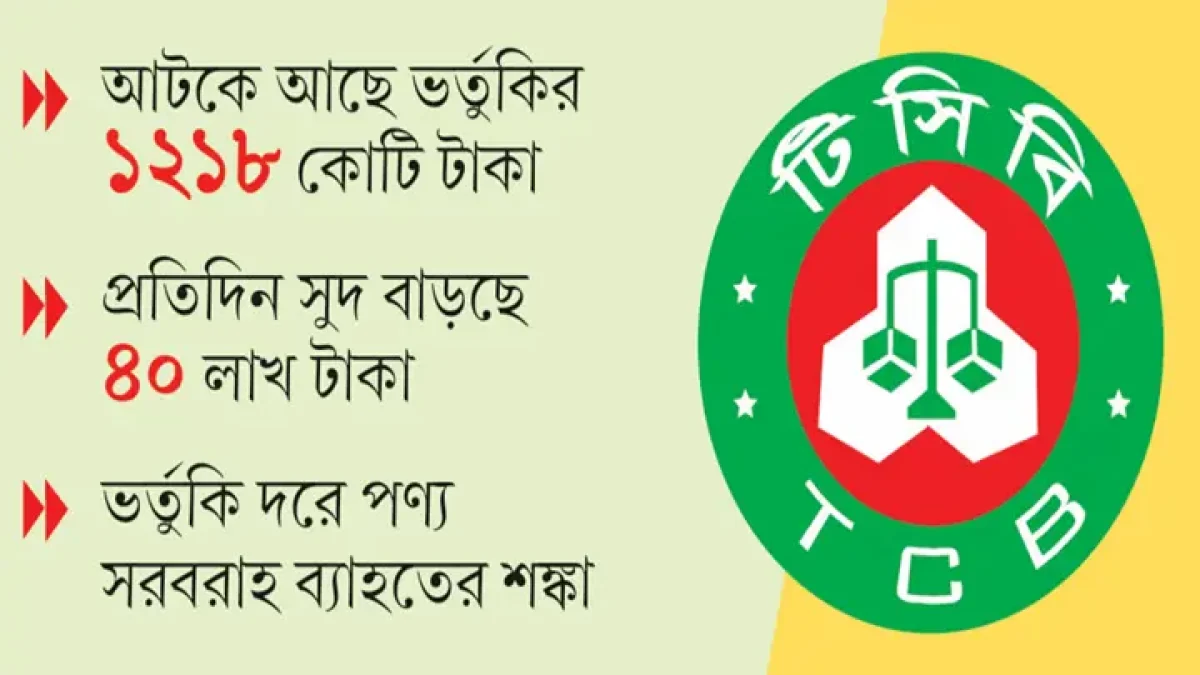
The state-run Trading Corporation of Bangladesh (TCB) has run into a funding crisis from selling goods at subsidised prices. Tk 1,218 crore owed in subsidy is stuck with the government, and its applications for release have drawn no positive response.
According to information from the finance and commerce ministries, loans taken from various banks against letters of credit (LCs) for importing goods are not being repaid on time, so the interest owed to the banks keeps growing. By the latest count, interest is being added to the banks’ total dues at a rate of Tk 40 lakh a day, raising the government’s liability. TCB says its low-price sales are also under pressure for lack of money, and there are fears of a fresh supply problem.
By TCB’s count it continues, as before, to supply goods at subsidised prices to 10 million families holding smart cards. To make sure this is not disrupted in any way, TCB has written to the commerce ministry asking for urgent steps to release the subsidy quickly. The commerce ministry has said it will send a recommendation to the finance ministry for the matter to be given greater priority.
TCB currently sells edible oil, lentils and sugar at subsidised prices every month. The main aim of the programme is to hold down the cost of living for low-income people somewhat by supplying these goods below market prices.
People involved say that if the subsidy is not released on time, TCB’s regular supply and sales may be disrupted, which could hurt the millions of low-income families who benefit.
At the same time, with the subsidy rising steadily, questions are being raised about the programme’s long-term financial viability. To keep supplying goods below market prices to low-income people, it has become urgent for the government to ensure regular and adequate funding.
Interest burden grows by Tk 40 lakh a day
Because of the delay in receiving the subsidy, TCB’s liabilities to commercial banks are growing exponentially. Daily bank interest on the large outstanding amount now stands at Tk 40,51,230. TCB said that if the subsidy is not released in time the interest will rise further, and will in the end fall on the government as an extra financial liability.
Banks reluctant, supply at risk
Because the money has not come in time, loans against trust receipts (LTRs) taken from banks are expiring. As a result, banks are not giving new trust receipts or loans to pay bills for goods TCB imports or buys locally, so LCs cannot be opened for new purchases of rice, lentils, oil or sugar. TCB gave this information in its letter to the commerce ministry and warned that its future operations could be seriously disrupted.
What TCB says
TCB spokesman Shahadat Hossain said TCB has no fund of its own. Goods are sold at low prices with government subsidy, and the government pays that subsidy. A letter has been sent to the government seeking the subsidy against losses in the first six months of this year, he said.
What the ministry says
Mohammad Faruk-uz-Zaman, joint secretary of Budget-1 at the finance ministry, said the government subsidises TCB and necessary steps will be taken to release its subsidy.
বাংলায় মূল প্রতিবেদন পড়ুন · Read the original Bengali report