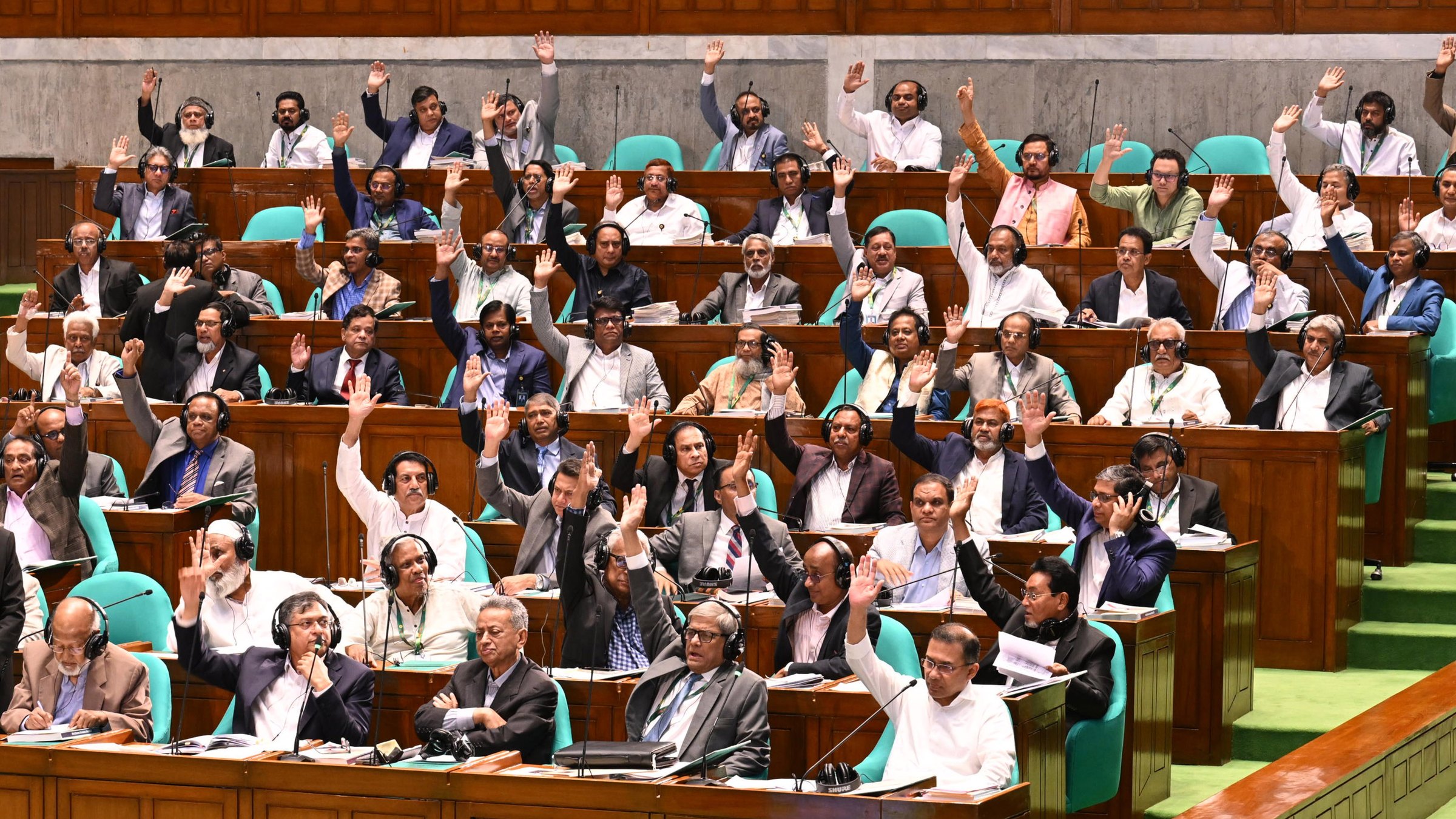
Dr M Jashim Ali Chowdhury is a Lecturer in Law at the University of Hull and, this Michaelmas term, the Baxandall Visiting Fellow at Robinson College, Cambridge. His research covers comparative public law, constitutionalism, human rights and environmental law. He is the author of five books; the most recent, Fifty Years of Bangladesh Parliament: A Critical Evaluation (Brill Nijhoff, 2025), analyses the parliament’s historical development, institutional limits and democratic accountability. On 8 October he emailed BD Global Times written answers, in English, to eight questions on the new parliament’s work, the constitutional standing of the July Charter, Article 70, the proposed upper house, political pluralism and the role of the Supreme Court. His answers appear below in his own words; the questions have been condensed and some passages cut for length.
If concentrated authority merely passes from one political group to another, Bangladesh will have changed its rulers without overcoming its Eastminster system.
Dr M. Jashim Ali Chowdhury
Q: Your book calls Bangladesh’s parliament “Eastminster”: Westminster in form, but marked by executive dominance and antagonism between the two main parties. How much of that pattern do you see in the new parliament’s first months, and is anything changing?
A: In my assessment, the underlying pattern has largely continued. I would, however, question the premise that Bangladesh now has a democratically legitimate Parliament with a properly constituted opposition. The February 2026 election excluded the Awami League, one of the country’s principal political forces. Millions of its traditional supporters were consequently unable to participate through their preferred party, and the election became predominantly a contest among the BNP, Jamaat-e-Islami and their associated political blocs.
This does not require defending the previous government’s conduct of the 2014, 2018 or 2024 elections. It simply recognises that alleged wrongdoing by a government or particular individuals cannot, by itself, justify excluding a substantial liberal, secular and centre-left constituency from political competition.
The present Parliament also retains the principal “Eastminster” characteristics identified in my book: selective leadership, internally undemocratic and dynastic parties, and an antagonistic political culture that struggles to recognise opponents’ legitimate right to exist.
Nor should visible disagreement between the BNP and Jamaat-e-Islami necessarily be understood as evidence of a fully institutionalised government-opposition relationship. Both operate within a post-2024 political settlement from which the largest competing secular political force was excluded.
Q: In February, 68 percent of those voting approved the July Charter. The government wants to move the amendments through a special parliamentary committee while the opposition calls for a constitution reform council; constitutionally, which route is proper?
A: The dispute cannot be resolved satisfactorily without first addressing the contested legitimacy of the election and referendum from which both institutions claim authority.
Approximately 68 per cent of valid votes were officially recorded in favour of the July Charter, but the published figures generated controversy and required correction. More fundamentally, a numerical majority does not necessarily amount to an inclusive constituent mandate.
The referendum’s constitutional basis was disputed. The interim government’s authority to establish the July Charter process was uncertain, while important elements of the Charter remained contested even among the principal post-2024 political forces. The referendum was also held alongside an election from which the Awami League was excluded. Its activities and communications were restricted and its registration suspended.
Against that background, both proposed routes are problematic. The special parliamentary committee operates within a Parliament whose representative legitimacy is contested. The Constitution Reform Council, meanwhile, is not contemplated by the Constitution under which that Parliament was elected. The governing party’s departure from the referendum framework also sits uneasily with its stated commitment to the July Charter.
Neither route can supply the missing inclusivity. A legitimate process would remove unnecessarily broad political restrictions, permit all peaceful democratic forces to participate, publish competing proposals and seek meaningful cross-party agreement.
Only then should Parliament exercise its formal amendment power under Article 142.
Q: Article 70 bars MPs from voting against their party, and the July Charter promised to ease it. What is your expert view, and what would a workable reform look like?
A: Article 70 remains a serious constitutional impediment, but discussing it in isolation risks understating the wider problem. The provision has historically converted legitimate party discipline into leadership command. It is not, however, the sole cause of parliamentary subordination. Centralised candidate selection, dynastic leadership, clientelism and MPs’ dependence upon party leaders are equally important.
The current ruling party, like its predecessors, does not offer a convincing model of internal democracy. Relaxing Article 70 without reforming these practices would therefore produce only limited parliamentary independence.
Nevertheless, Article 70 should be narrowed. It should apply only to expressly designated confidence and no-confidence motions and the final approval of supply. MPs should be free to vote independently on ordinary legislation, committee reports, private members’ business and constitutional amendments. Party leaders should not be permitted to designate every disputed measure as a confidence matter. Any disqualification should also follow an independent procedure, with notice, a hearing and judicial review.
Q: The Charter proposes a 100-member upper house elected by proportional representation. Would it help cure the problems your book identifies, or risk another institution controlled by the same parties?
A: A second chamber could improve Bangladesh’s Parliament, but only if it introduces a genuinely different representative principle rather than duplicating the lower house. The proposal for a 100-member upper house allocated according to national vote shares could moderate some of the distortions created by first-past-the-post elections.
My book shows that Bangladesh’s electoral system has repeatedly produced very large parliamentary majorities that bear little relation to the winning party’s share of the national vote. Those majorities have facilitated executive dominance, marginalisation of the opposition and unilateral constitutional amendment. A genuinely proportional upper house could represent smaller parties and dispersed political viewpoints, encourage negotiation and restrain the constitutional ambitions of temporary majorities.
The design is therefore crucial. If upper-house representation is calculated according to lower-house seats rather than national vote share, the second chamber may simply reproduce the governing party’s dominance. Similarly, if Article 70 applies without modification, upper-house members will remain delegates of party leadership.
I would support an upper house subject to several safeguards: allocation by national vote share; transparent and democratic party nominations; meaningful inclusion of women and under-represented communities; carefully designed terms; and powers focused on constitutional amendments, legislative reconsideration and important institutional appointments.
Q: Opposition boycotts have a long history, and the Charter offers the opposition the deputy speakership and committee chairs. What would it take, from government and opposition alike, for parliament to become a place of effective scrutiny?
A: Giving the opposition the deputy speakership and important committee chairs would be valuable, but these must become institutional entitlements rather than concessions from the governing party. My book shows that previous improvements were often introduced through the goodwill of party leaders.
The government must recognise scrutiny as a constitutional service rather than political obstruction. The Speaker should relinquish active party affiliation and administer parliamentary time impartially. The opposition should receive guaranteed business days, while its leader should have a structured role in Prime Minister’s Questions. Opposition members should chair the Public Accounts Committee and other major financial oversight committees.
Committees also require independent staff, research assistance, access to government documents and effective authority to summon officials. Their reports should receive timely government responses and scheduled debate. At present, partisan appointments, ministers’ continuing ex officio membership and weak follow-up mechanisms limit their effectiveness.
The opposition has corresponding responsibilities. Although boycotts frequently reflect genuine exclusion, their repeated use has normalised extra-parliamentary opposition. A walkout may communicate protest, but it also leaves the majority in control. Opposition parties should ordinarily remain in Parliament, propose alternative texts, demand recorded votes and publish reasoned dissents.
Q: The Awami League’s activities are banned by law, and human rights groups call the ban overbroad. How can the trials for the July 2024 killings be assured while political pluralism is protected, and what does the Constitution permit?
A: Accountability for the deaths and serious violations of July and August 2024 is essential, but any credible inquiry must consider violence by all relevant actors. International investigations found reasonable grounds to believe that the former government, security bodies and some violent elements associated with the then governing party committed serious violations. The same investigations also documented retaliatory killings and violence against Awami League officials and perceived supporters, police personnel, government establishments and public properties, and media organisations, together with attacks affecting religious and indigenous communities.
The events should therefore not be reduced to a simple confrontation between an entirely peaceful movement and an exclusively violent state. The extent to which organised political groups or destructive actors entered or exploited the protests requires independent investigation. Allegations of broader coordination must be established through evidence, not political assertion. Retaliatory killings, arson and attacks upon police deserve scrutiny alongside unlawful shootings, arbitrary arrests and torture by state personnel.
Responsibility should be determined person by person and act by act. Political leaders, public officials, police officers and protesters should be prosecuted where reliable evidence establishes individual criminal liability. Where one side of the conflict has been offered a blanket immunity, accountability cannot be presented as a collective guilt imposed on those on the opposite.
The comprehensive prohibition of the Awami League is therefore difficult to reconcile with constitutional pluralism. The party is not reducible to particular office-holders or violent affiliates. Its constituency includes many people who supported, and in some instances participated in, the 2024 protests.
Bangladesh should prosecute proven crimes, restrict demonstrably violent organisations or conduct where strictly necessary, and protect witnesses. It should not extinguish an entire political constituency’s right to organise, reform and compete peacefully in elections.
Q: Your forthcoming book argues for collaborative dialogue between the judicial and political branches. With major constitutional change possible, how should the Supreme Court and parliament relate to each other?
A: Bangladesh should reject both judicial supremacy and unrestricted parliamentary majoritarianism. Parliament has sometimes disregarded judicial boundaries and the sub judice principle, while the Supreme Court has occasionally adopted an expansive and self-protective conception of its position as guardian of the Constitution. The result has too often been institutional confrontation rather than constitutional collaboration.
The Supreme Court must retain strong authority to protect fundamental rights, judicial independence, electoral democracy and the Constitution’s basic structure. That responsibility becomes particularly important when a governing party commands an overwhelming parliamentary majority. The Court should not, however, seek to design the entire political settlement or treat every disagreement with Parliament as a contest for institutional supremacy.
A dialogic approach would allow courts to identify constitutional defects, explain the relevant principles and, where circumstances permit, give Parliament an opportunity to enact an appropriate remedy. Suspended or prospective orders may sometimes prevent legal disorder while preserving meaningful judicial supervision. Parliament should respond through evidence, reasoned debate and constitutionally compliant legislation, rather than personal criticism of judges.
The Court should protect constitutional boundaries, Parliament should provide democratic deliberation, and neither institution should become subordinate to the executive.
Q: Looking across parliament’s more than half-century of history, what single change would do most to improve how the country is governed? And what should citizens and the diaspora watch for as reforms move ahead?
A: If required to identify one overarching change, I would choose the institutionalisation of Parliament as an independent centre of democratic accountability. My book argues that Parliament’s weaknesses arise substantially from the political party system. It also recognises that a wholesale transformation of those parties is unlikely to occur immediately. The more practical route is to develop parliamentary autonomy incrementally and use it to generate pressure for deeper political reform.
That process should begin by narrowing Article 70, strengthening the neutrality of the Speaker, guaranteeing opposition rights and freeing committees from partisan cartelisation. Parliament must also reconnect with citizens through open committee hearings, accessible records, public petitions, consultation on legislation and continuous engagement with civil society and other democratic institutions.
Citizens and the diaspora should watch the process as closely as the final constitutional text. The central questions are whether all peaceful political forces are included, whether dissenting views are heard, whether proceedings are transparent, and whether reforms genuinely disperse and discipline power.
If concentrated authority merely passes from one political group to another, Bangladesh will have changed its rulers without overcoming its Eastminster system.
About the interviewee: Dr M. Jashim Ali Chowdhury has been a Lecturer in Law at the University of Hull’s Law School since August 2022, where he teaches public law, public international law, comparative law, administrative law and human rights, and coordinates the school’s Law Review. He was previously an Associate Professor at the University of Chittagong. This Michaelmas term he is the Baxandall Visiting Fellow at Robinson College, Cambridge. He is the author of five books, most recently Fifty Years of Bangladesh Parliament: A Critical Evaluation (Brill Nijhoff, 2025).
বাংলায় মূল প্রতিবেদন পড়ুন · Read the original Bengali report