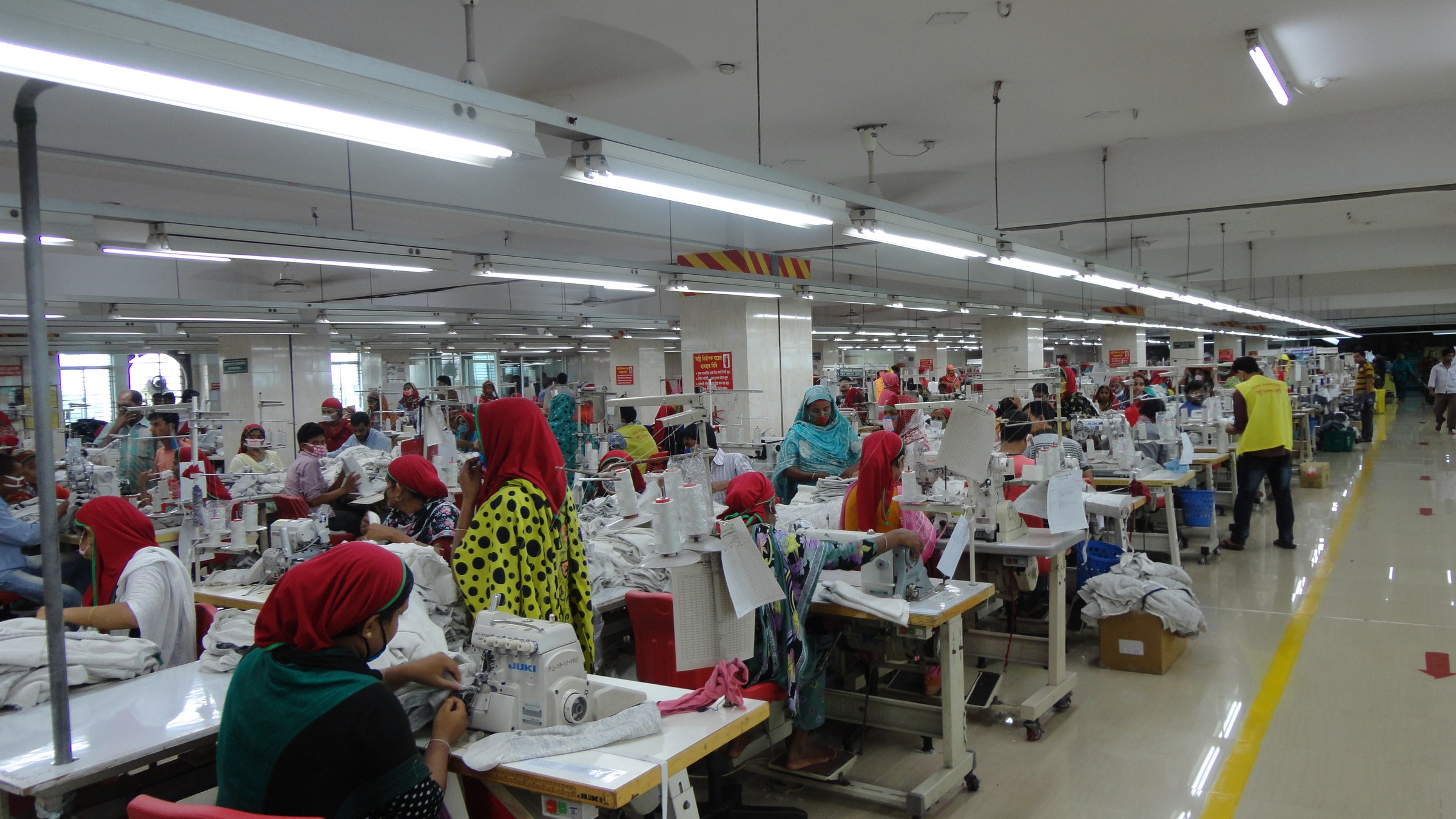
Bangladesh’s ready-made garment industry is not just an export business. It is one of the main foundations of the economy, of employment and of the livelihoods of millions of families. Yet the same industry keeps running into crisis over worker unrest, wage disputes, disrupted production and strained relations between owners and workers. The latest protests have brought those old problems back to the surface. If the industry contributes so much to the economy, why are its workers repeatedly forced onto the streets to secure a minimum standard of living? And how will factories survive the pressure of international competition and rising production costs?
Recent events show how deep the crisis runs. On 1 November, production was disrupted at 529 garment factories as workers protested for the minimum wage to be raised from Tk 12,500 to Tk 30,000. According to the Bangladesh Garment Manufacturers and Exporters Association (BGMEA), nearly 987,000 workers walked out of their workplaces that day. There were demonstrations, road blockades and clashes with law enforcement in parts of Dhaka, Gazipur, Savar-Ashulia and Mymensingh. The same day, the Ministry of Labour and Employment formed a new six-member wage board.
At a wage board meeting on 4 November, owners and workers agreed that the new wage would take effect in December and that workers would receive the higher pay in January. But the size of the increase had not been settled, and protests continued in several industrial areas. At the board’s second meeting on 9 November, the workers’ side proposed a minimum of Tk 32,000, and Tk 30,000 for new or apprentice workers. The owners could not submit a written proposal that day and were given four working days. In other words, the wage review is moving, but workers’ uncertainty has not gone away.
Wages and the cost of living
One of the main causes of discontent among garment workers is the widening gap between income and the cost of living. Low-income working families face hard choices every month to pay for food, rent, transport, medical care and their children’s schooling.
The demand to raise the current minimum wage, set in December 2023 at Tk 12,500, to Tk 30,000 amounts to an increase of about 140 percent. A gap that large raises a question in itself: how far does the existing wage structure match what workers actually need to live?
Babul Akhter, general secretary of the Bangladesh Garment and Industrial Workers Federation and a workers’ representative on the wage board, told Al Jazeera that Bangladesh’s garment wages are among the lowest in the world. After the board’s meeting on 9 November he told reporters that, counting nutrition, rent, medical care and education for a family of four, a worker needs Tk 45,000 to 60,000 a month to live normally; taking the industry’s capacity into account, the workers’ side proposed Tk 32,000.
That calculation points to a basic question for the industry. Bangladeshi garments sell at competitive prices on the world market; how much of that competitive pressure is being carried by the workers deserves scrutiny.
What the export figures say
Export figures help explain why the industry matters so much. According to the Export Promotion Bureau (EPB), garment exports stood at $39.35 billion in fiscal 2024-25. In fiscal 2025-26 they fell to $38.70 billion, a decline of about 1.64 percent in a year.
In the same fiscal year, garments accounted for about 80 percent of the country’s total merchandise export earnings. That one figure explains why prolonged unrest in the industry is a serious concern for the whole economy.
But falling exports are not a reason to dismiss workers’ demand for higher pay. Nor do export earnings alone show a factory’s real financial capacity. That requires looking at production costs, profits, output per worker, the prices buyers pay and the finances of individual factories.
The owners’ difficulties are real too
Workers’ demands deserve serious consideration, and so do the problems facing garment entrepreneurs.
Energy costs, raw material prices, the cost of bank loans, international competition and pressure from foreign buyers to cut prices are major challenges for manufacturers. For small and medium factories in particular, a sudden large wage increase may be hard to implement.
BGMEA president Mahmud Hasan Khan told Al Jazeera that the government had already taken a step by forming the wage board. He warned that if the protests continued, owners would have no option but to invoke the “no work, no pay” provision.
That position reflects the owners’ concerns, but a question remains: if workers lose their income during a stoppage, will their hardship not deepen further? Calls to keep production running are therefore not enough; restoring workers’ trust also requires effective and credible negotiation.
Possible ways forward
With inflation high, workers’ demand for higher wages is understandable. But a very large increase could squeeze production costs and exporters’ profits and weaken Bangladesh’s price competitiveness abroad. Between those two realities, three things stand out: adjusting wages in phases, raising productivity, and securing fairer prices from international buyers.
That is why treating the wage dispute only as a conflict between workers and owners misses the full picture. In the international supply chain, buyers, manufacturers and workers are all part of the same economic relationship.
Why does unrest keep returning?
Worker unrest is not new in Bangladesh’s garment industry. There have been protests at different times over wage increases, unpaid dues, job security and working conditions.
The important question is how strong the institutions for resolving these problems have become. If workers have no reliable way to raise grievances, if there is no regular dialogue with their representatives, or if workers are not given enough information about how wages are set, it is hardly surprising that discontent builds up.
The latest protests show the same pattern: even after the wage board was formed and the start date for the new wage was agreed, the demonstrations did not fully stop. Until the size of the increase is announced, workers remain uncertain. That is not only a communication problem; it points to the distance between workers and the institutions that make decisions about them.
How much responsibility do international buyers bear?
One of the industry’s great strengths is its relatively low production cost. But it is time to ask again how sustainable it is to compete on low prices alone for so long. Bangladeshi manufacturers have business relationships with major international brands, in which price, delivery time, quality and working conditions all matter.
The responsibility for improving workers’ lives therefore cannot be left to local factory owners alone. Buyers’ purchasing policies and pricing must also be part of the discussion. The practical question is this: if foreign buyers keep up the pressure for low prices and fast delivery, how much room will there be to raise workers’ wages?
What should be done now?
First, the outcome of the wage board’s talks must be published transparently. Workers need to know clearly how much wages will rise, from when, and how implementation will be monitored.
Second, a regular wage review mechanism is needed, so that changes in inflation and the cost of living are taken into account in time. That could reduce the risk of major unrest building up every few years.
Third, worker-owner dialogue at factory level must be strengthened. Effective arrangements are needed for worker representation, grievance resolution and job security.
Fourth, both workers’ right to protest peacefully and the safety of factories must be ensured. Unreasonable force against workers is unacceptable, and violence, arson and destruction of property are not a solution either.
Fifth, raising productivity requires investment in technology, skills, energy supply and infrastructure. Manufacturers also need a stronger position when negotiating fair prices with foreign buyers.
Workers must be at the centre of development
The garment industry’s success story is long established. It has raised export earnings, created jobs for millions and given Bangladesh an important place in the world market. But how far workers’ living standards have improved alongside that success deserves equal attention.
On the other hand, if the industry’s competitiveness and production weaken, workers will be the first to be hurt. A fair wage for workers and the survival of factories should not be seen as opposing goals.
The current crisis is an important test for the government, owners and workers’ representatives. If the new wage board’s decision only halts the protests for a while without addressing the basic problems of workers’ lives, the same unrest may return.
Bangladesh now has to decide whether the industry’s competitive strength will rest on low wages alone, or whether a sustainable industry will be built on fair wages, a skilled workforce, higher productivity and responsible business relationships.
The future of the garment industry cannot be judged by export volumes alone. How safe, dignified and economically secure the lives of the people working in it become should also be a key measure of development.
বাংলায় মূল প্রতিবেদন পড়ুন · Read the original Bengali report