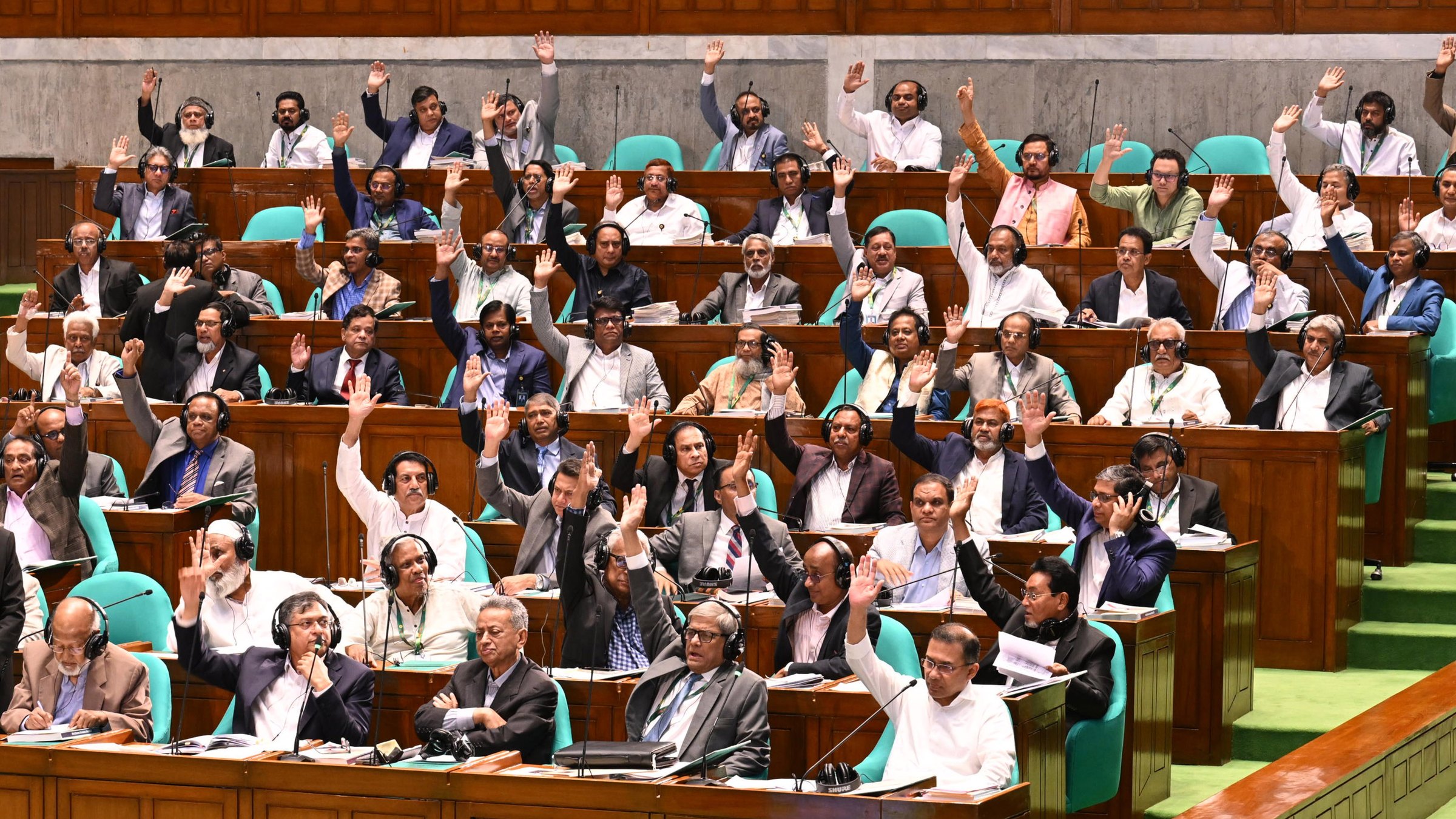
Jamaat-e-Islami’s members of parliament have taken the opposition benches in the 2026 Thirteenth National Parliament. The party’s arrival at the head of the parliamentary opposition, for the first time since independence, marks a significant change in Bangladesh’s political history.
But leading the opposition is not the same as being an effective one. How effective Jamaat will be in lawmaking, the scrutiny of public spending, constitutional reform and political dialogue is now an important question.
Al Masud Hasanuzzaman, a retired professor at Jahangirnagar University, has researched Bangladesh’s politics and the role of the parliamentary opposition. His book Role of Opposition in Bangladesh Politics (UPL, 1998) is a notable work on the subject. His analysis of the present political situation follows.
- Jamaat-e-Islami is the main opposition for the first time, in the Thirteenth Parliament.
- The opposition chairs one of the 50 standing committees.
- The opposition’s five seats on the constitution amendment committee have been empty since July.
- Jamaat MP Syed Abdullah Mohammad Taher chairs the Public Accounts Committee.
Historical background
You wrote Role of Opposition in Bangladesh Politics (UPL, 1998). In this parliament, where Jamaat-e-Islami leads the opposition for the first time, what is new, and which old patterns are returning?
Jamaat-e-Islami’s assumption of the opposition role in the Thirteenth National Parliament is a significant change in Bangladesh’s parliamentary politics. For the first time since independence, the party has come to lead the parliamentary opposition. This can be seen as a change in the established political alignment and also as the continuation of a long-term political trend. Facing various legal and political restrictions after 2013–14, Jamaat had no parliamentary representation after the 2014 and 2018 elections. Its rise to lead the opposition in 2026 is therefore an example of the party’s political re-establishment. Equally important is its transformation from a coalition partner into the main parliamentary opposition. Jamaat won 18 seats in the 1991 election and 17 in 2001. In 2001 the party joined the BNP-led coalition government, and two of its leaders served in the cabinet. In 2026 the BNP and Jamaat sit on separate sides of parliament, as government and opposition. There are signs of growing support for, or acceptance of, Jamaat among young and urban voters, but more elections and reliable opinion polls are needed to judge how lasting this change is.
As the main opposition, Jamaat must now take clear positions on constitutional reform, good governance, institutional accountability and parliamentary oversight. Implementation of the July National Charter is also among the party’s main demands. At the same time, old patterns of cooperation and competition persist in Bangladeshi politics. The BNP and Jamaat have at times cooperated in political movements against the Awami League, but over time their interests and strategies have drifted apart. The present parliamentary arrangement marks a new stage in that relationship.
Jamaat-e-Islami in parliament
- 1991 18 seats.
- 2001 17 seats; part of the BNP-led coalition government, with two leaders in the cabinet.
- 2014 and 2018 No representation in parliament.
- 2026 Jamaat-e-Islami leads the main opposition.
“For the first time since independence, the party is serving as the parliamentary opposition, which adds a new dimension to the country’s multiparty political structure.”
— Professor Al Masud Hasanuzzaman
Opposition politics in parliament and on the street
The opposition walked out over the President’s address on 12 March and over two bills on 6 September. Since July, the opposition’s five seats on the constitution amendment committee have also stood empty. When is a boycott legitimate political pressure, and when does it weaken parliament?
A parliamentary walkout can be effective political pressure when it is used for a limited time to protest procedural injustice. But when it becomes the main tactic of routine opposition, parliamentary debate and the representative role are weakened. The opposition members’ walkout during the President’s address on 12 March 2026 was one example of political protest. In June, opposition members walked out again after objecting to the opportunities to introduce bills and raise points of order. The opposition’s objections on 6 September to the amended versions of the National Human Rights Commission Bill and the Prevention and Remedy of Enforced Disappearance Bill were more significant. They argued that the amended versions weakened necessary safeguards. Both bills passed by voice vote after the opposition members left the chamber. The special constitution amendment committee formed on 13 July kept five seats for the opposition, but Jamaat and its allies nominated no members, objecting to the committee’s structure and procedures. These events show that a walkout can draw public attention, but a prolonged absence from constitutional decision-making limits the opposition’s effective role.
“Opposition politics in Bangladesh still depends significantly on street-level political movements alongside parliamentary activity.”
— Professor Al Masud Hasanuzzaman
The ruling party holds the posts of Speaker and Deputy Speaker and chairs 48 of the 50 standing committees. What should be done to give the opposition a real role under a government formed with a large majority?
Forming a government on the strength of a majority does not mean the opposition’s role in the parliamentary structure must stay limited. When the 50 standing committees were formed on 10 September, the opposition chaired only one of them.
The government could distribute committee chairs in a more balanced way and give the opposition the chance to exercise effective oversight. Opposition members could then review government policy, hold the executive to account and identify weaknesses in policy. Agreement with the opposition is not essential; what is essential is an institutional opportunity for it to raise questions and review the government’s actions. Such power-sharing can strengthen parliamentary accountability without obstructing the government’s policy programme.
The Awami League’s absence and the constitutional dispute
In February, the MPs of the Jamaat-led alliance took the oath as members of the reform council, but the BNP said the council is not in the constitution and refused to take the oath. Is this a dispute of principle or a struggle for power? How might it be resolved?
On 17 February 2026, BNP MPs took the parliamentary oath but refused to take a separate oath as members of the proposed constitutional reform council. Their argument was that the existing constitution does not recognise such a council. Jamaat and its allies, on the other hand, took both oaths.
At the centre of this dispute is the question of how the reform mandate expressed through the July National Charter and the referendum will be turned into lawful constitutional change. Resolving it requires an understanding among the main political parties, so that the need for reform and constitutional legitimacy support each other.
How do the ban on the Awami League’s activities and the party’s absence from the February election change the idea of an opposition? Whom does the opposition represent now?
The Awami League’s political activities were banned in May 2025, and the ban was later given a legal basis through the Anti-Terrorism (Amendment) Act 2026. As a result, the party could not take part in the February election. The Awami League’s absence has changed Bangladesh’s long-standing political alignment centred on the BNP and the Awami League. But absence from an election does not mean the party’s social and political base has disappeared. Jamaat is now the main organisational force of the parliamentary opposition, but it does not represent every citizen who opposes the government. Likewise, the BNP’s electoral victory is not proof that every Awami League supporter has changed political allegiance. Bangladesh’s wider political opposition is broader than the parliamentary opposition.
“The Awami League’s absence from the ballot does not mean its social and political base has disappeared.”
— Professor Al Masud Hasanuzzaman
From parliament to the street: ways to avoid confrontation
On 19 September the Leader of the Opposition warned that the eight-point demand could turn into a one-point demand. What lessons should both sides take from past experience?
The 19 September warning from Shafiqur Rahman, Jamaat’s amir and Leader of the Opposition, is a reminder that a parliamentary dispute could turn into a street movement. The eight demands include implementing the referendum verdict, trials for the July killings, resolving the fuel and fertiliser crisis, controlling prices, improving law and order, action against corruption and extortion, ending the politicisation of the administration, and implementing the Teesta master plan. Bangladesh’s political crises of 1996, 2006–08 and 2013–14 show that when parliamentary dialogue breaks down, the risk of conflict and instability can rise. The government and the opposition should therefore resolve their differences through dialogue and discussion. Street movements, hartals and blockades can affect the economy and the daily lives of ordinary people. The government should keep the path to a political settlement open; the opposition, too, needs to make use of the parliamentary process and the chance of a peaceful understanding.
Parliamentary oversight and accountability
Jamaat MPs now chair the Public Accounts Committee (PAC). How effective can this committee’s oversight be?
Jamaat MP Syed Abdullah Mohammad Taher has been made chairman of the Public Accounts Committee. But an opposition member in the chair does not by itself ensure effective oversight. The committee can identify wasteful spending, unauthorised expenditure, procurement irregularities and failures of financial management. Its effectiveness, however, depends on what action is taken on audit objections. Access to information, regular meetings, expert support, transparent reporting and the will to implement the committee’s recommendations must be ensured. Oversight becomes meaningful only when audit evidence takes priority over party identity.
What should a constructive relationship between government and opposition look like, and which reforms could strengthen parliament?
Cooperation between government and opposition needs to be institutionalised. The parliamentary committees must be strengthened, giving the opposition the chance of leadership, investigation and oversight of the government’s work. In Bangladesh, majoritarian politics, parliamentary boycotts, the excessive influence of the executive and weak parliamentary scrutiny have complicated relations between government and opposition. Giving the opposition an effective role within the parliamentary structure could widen the room for settling political differences through parliamentary debate and institutional accountability. Opposition chairs on important committees, proportional representation of the parties, and effective powers to summon ministers and officials, call for documents, hold public hearings and publish reports are needed. Alongside constitutional reform, reform of the parliamentary committees and inter-party dialogue also matter. Constitutional change without political understanding can create new disputes. Legally protected oversight by the opposition and regular dialogue among the political parties are therefore important ways to make parliament work.
Further reading
- Role of Opposition in Bangladesh Politics · Al Masud Hasanuzzaman · UPL, 1998
- Jahangirnagar University
- This interview in Bangla · BD Global Times
- Opposition shunned July memorial opening, says PM · BD Global Times
বাংলায় মূল প্রতিবেদন পড়ুন · Read the original Bengali report