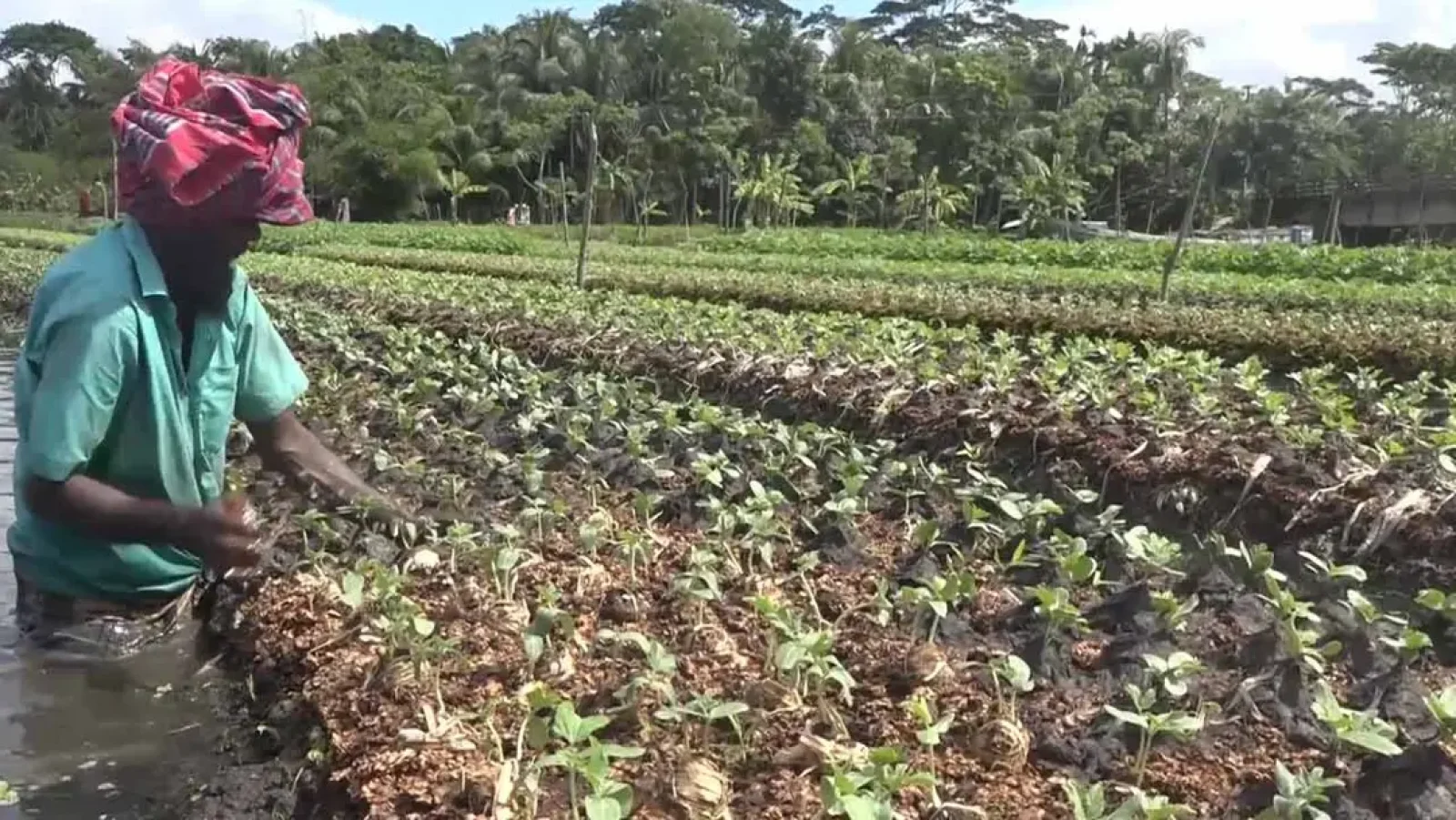
Large parts of southern Bangladesh remain under water for much of the year because of canals, wetlands and small rivers. In many areas of Deulbari Dobra union in Nazirpur upazila of Pirojpur and Baldia union in Nesarabad upazila, water remains for nearly six months during the monsoon, making conventional seedling production and cultivation difficult. Local farmers have turned the water into an opportunity. They build floating beds from water hyacinth, algae, dulalilata and other aquatic plants, then grow vegetable seedlings on them. The low cost and the chance to use waterlogged land have made the method increasingly popular. Plants once considered useless are now key materials for floating agriculture and part of local livelihoods.
The trade in materials for floating agriculture comes alive at Baithakata market in Nazirpur. The market meets on Saturdays and Tuesdays, and trading begins at dawn in rows of boats on the river. Sellers bring algae, water hyacinth, dulalilata and other aquatic plants from nearby villages. Farmers move from boat to boat to buy what they need. Some return to their villages with a small load, while others buy boatloads of plants to begin producing seedlings on floating beds.
Ibrahim, who sells algae at the market, said he brings it from Mollarhat and sells a bundle for Tk 150 to Tk 300. On a good day, he said, sales reach Tk eight thousand to Tk nine thousand; when the market is weak, they fall to about Tk five thousand. A buyer said he purchases algae to make floating beds for vegetable seedlings.
Farmers take water hyacinth, algae and vines from the market and use them to build beds in their own areas. Before seedlings can be grown, however, another important stage begins, involving many women in the villages.
Women make a structure called a mada from dulalilata as the first step in producing seedlings on a floating bed. The locally available vine is arranged in a set way to create a framework for sowing seeds. Seeds for eggplant, chilli, bottle gourd, bitter gourd, sweet pumpkin and cucumber are planted in it. Once they sprout, the seedlings are carefully tended and later moved to floating beds when they are large enough.
Some women collect vines, some make the mada, and others sow seeds and care for the young plants. They often work near their homes or wetlands. Their labour is important to floating agriculture, but many earn little.
Nurjahan Begum of Gagan village in Baldia is one of them. She began producing vegetable seedlings on floating beds in 2005 after moving to her husband Zakir Hossain’s family home. Alongside her own work, she has brought impoverished and unemployed women into the trade. About 10 women now work through her initiative.
“I am a woman entrepreneur and have been doing this since 2005,” Nurjahan said. “Many families are struggling. I want to help them move forward, but I cannot do enough. If the government provided interest-free loans, I could expand and employ more women. I want to work with women who stay at home and create jobs for them.”
Wages depend on the type and amount of work. A woman earns about Tk 150 for making 1,000 mada. Even after working all day, many earn around Tk 200, making it difficult to cover household expenses.
Rahima Begum, a worker from Baldia village, said she works from morning until afternoon but struggles to earn Tk 200 after a full day. “Women have no other work, so we do this,” she said. “Training would help. We receive Tk 150 for making 1,000 mada. How can a family live on that?”
Local women say training in modern seedling production, business management and marketing would improve their skills. Low-interest loans and other support could help women working on a small scale build their own enterprises. That would raise incomes and create more rural jobs.
Caring for seedlings and taking them to market
After the women finish the first stage, the seedlings are moved to floating beds. The beds, made from water hyacinth and other aquatic plants, hold rows of seedlings above the wetlands. Farmers apply necessary medicines, clear weeds and vines, and prepare the plants for sale. Thousands of seedlings of different vegetables can be grown on the beds at one time.
Lutfor Rahman, a floating-bed farmer, said he begins work at 6 a.m. He plants seedlings, applies medicine and clears vines. The seedlings go to Dhaka, Khulna, Gopalganj, Barishal and other areas, he said. The beds produce hundreds of thousands of seedlings each year, including papaya, bottle gourd, bitter gourd, eggplant, chilli and sweet pumpkin. Prices range from Tk 3 to Tk 7 per seedling.
Farmers take seedlings to Baithakata and nearby markets for sale. Wholesalers buy large quantities and distribute them across the country. Local retailers then sell the seedlings to farmers. The process connects floating-bed production with vegetable cultivation in many regions.
Rafique Sheikh sells seedlings at retail in Pirojpur town. He said he brings seedlings from Nazirpur’s floating beds and sells different varieties for Tk 10 to Tk 15 each, after buying them wholesale for Tk 5 to Tk 7.
Prices vary according to variety, size, demand and market conditions. The difference between wholesale and retail prices covers transport and other costs and provides income for traders. Farmers, wholesalers, transport workers and retailers have built a broad economic chain around the seedling trade.
Growing demand and potential
Vegetable seedlings grown on floating beds in Nazirpur and Nesarabad have moved beyond local markets and are now supplied to different parts of Bangladesh.
Saumitra Sarker, deputy director of the Pirojpur Department of Agricultural Extension, said seedlings are produced on floating beds in Nazirpur and Nesarabad and sent to Khulna, Jashore, Dhaka and other areas. About six thousand farmers are involved, he said, and the agriculture office provides advice.
Agriculture department data show that about 10 million vegetable seedlings of different varieties are produced in the area each season, with an estimated value of about Tk 10 crore. Traders and workers at several stages also depend on the trade. Experience, locally available aquatic plants and the use of water have combined to create a farming system that contributes to the rural economy of southern Bangladesh.
The sector could grow through modern cultivation methods, farmer training, easier loans and stronger marketing support. Training and financing for women working at the earliest stage could raise the value of their labour and help them become entrepreneurs.
বাংলায় মূল প্রতিবেদন পড়ুন · Read the original Bengali report