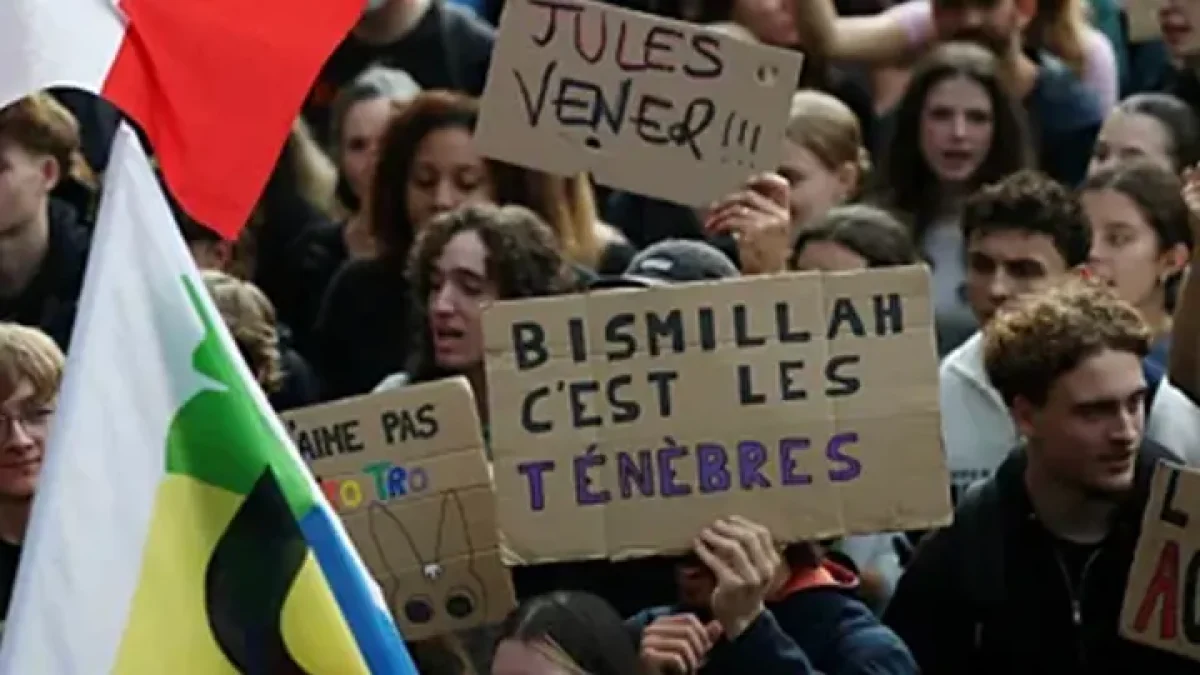
Last week hundreds of thousands of people took to the streets in France in support of student protests. Many carried cardboard placards bearing one slogan: “Bismillah, c’est les ténèbres”.
The Arabic word “Bismillah” means “in the name of God”, and the French phrase “c’est les ténèbres” means “it’s darkness”. The slogan combines the two, and on the face of it the phrase can seem to make little sense.
But its significance goes well beyond its literal meaning. Since young people began protesting last month over a lack of proper facilities in schools, it has become a symbol of the generation gap. Those protests later grew into widespread unrest.
Where the slogan came from
The slogan is thought to have started with a message posted on Snapchat. It was sent by someone trying to get into a private chat group of organisers of the French student movement.
The message began “Bismillah, c’est les ténèbres”, which appeared to imitate the mix of Arabic and French slang common among young people in France. The sender then wrote: “We’re going to smash everything.”
The same person is thought to have sent the message several times from different profiles. The profiles showed names such as Mamadou and Abdellah and an Algerian flag emoji.
Because the language of the messages seemed laughable, other Snapchat users took screenshots and spread them on social media. The true source of the messages could not be independently verified.
What happened next
Many young people suspect the messages were sent by members of the security forces trying to infiltrate the student movement. In their view, whoever sent them tried to imitate the way young people talk and failed comically.
Protesters then took up “Bismillah, c’est les ténèbres” as a mocking slogan, aimed at the authorities trying to suppress the student movement.
The slogan has now come to stand for long-running tension between the security forces and protesters, and in particular for strained relations between the police and students and ethnic minorities.
Black and Arab-origin French people, the children of immigrants from France’s former colonies, have long complained of discrimination. They say the messages also show how the authorities misunderstand them and the prejudices held about them.
Asked about the matter, France’s interior ministry did not say whether any of its agents had used the phrase. It did acknowledge that investigators sometimes use false identities online to contact people suspected of planning illegal acts.
“In this context, investigators may use pseudonyms in order to maintain contact with people likely to be involved in offences, and to gather and preserve evidence,” the ministry said in a statement.
Why the slogan struck a chord
For student protesters, the slogan’s odd language highlights the generation gap between their movement and the government. Protesters say the authorities fail to understand both the reality behind their movement and the way young people speak.
“No young person talks like that,” said Sabrine Kharbach, spokesperson for a prominent French student union. Young people have made the phrase their own, she said, to show that they notice attempts to watch and infiltrate their movement, and that they can still organise despite every obstacle.
Sadani Sabadi, a student at the University of Bordeaux who has joined the protests, said the Snapchat messages revealed a kind of prejudice: the assumption that those setting up blockades or wanting to smash things belong to one particular group of people.
For Phèdre Kemen, a high school student in Paris, “Bismillah, c’est les ténèbres” has become a national joke because “it is a really bad attempt to imitate how a young person talks”.
“It is seen as an example of racist behaviour, because it suggests that the people who will come to smash property are Arabs,” she said.
How the slogan spread beyond France
Beyond France, “Bismillah, c’est les ténèbres” has also been used at protests in Belgium and Germany. The Swedish environmental activist Greta Thunberg repeated the slogan in a video posted on an Instagram account set up in solidarity with the student movement.
Its popularity also recalls India’s “Cockroach movement”, in which students are likewise protesting for better education. After India’s chief justice called young and unemployed Indians “parasites” and “cockroaches”, the protesters adopted the insult as the name of their movement.
How the protests began
Student protests began last month at schools across France. In a movement that spread to several hundred schools, students demanded repairs to run-down buildings, more teachers, smaller classes and changes to overloaded timetables.
Many of the protests stayed peaceful, but some turned violent. According to official figures, at least 24 schools were set on fire or vandalised and looted. About 8,000 people have been arrested in connection with these incidents.
The student movement was gradually joined by national campaigns of trade unions and other rights groups, and protests spread across the country last weekend.
Tough police action has also fuelled protesters’ anger. France’s state police watchdog is investigating at least 34 complaints of police misconduct linked to the protests since last month.
বাংলায় মূল প্রতিবেদন পড়ুন · Read the original Bengali report