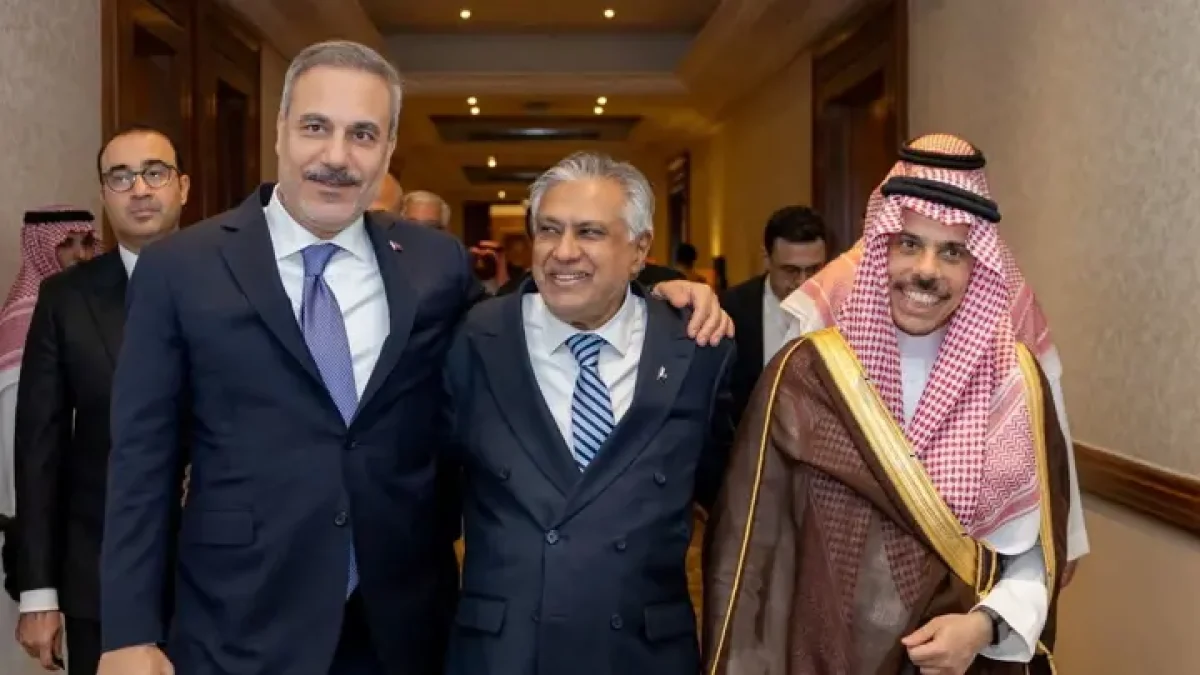
The Turkish government has submitted the full text of the “Mecca Joint Defence Agreement”, signed by Saudi Arabia, Turkey and Pakistan, to parliament for approval. On Tuesday the foreign ministry sent the agreement to the speaker with a motion for a vote, ahead of deploying troops for the security of allied states in the Middle East.
Under the agreement, signed in August, an armed attack on any one of the three countries will be treated as an attack on all of them. The others will then help the country attacked, using every means of mutual assistance, military capability included. The principle mirrors Article 5 of NATO, the military defence alliance.
The Middle East-based outlet Middle East Eye obtained the full agreement exclusively. It does not name any country or region as a threat. It does, however, commit members to take the necessary measures if any member’s independence, sovereignty or territorial integrity comes under armed attack.
The first article says that if a member’s territorial integrity, sovereignty or internationally recognised borders face a threat or danger, the members will use all necessary means to remove that threat.
The second article says an armed attack on a member from outside will be considered an attack on all members. If a member suffers military aggression by another country or countries, the other members will help it at once.
The kind of help given will be decided by an impartial assessment of what is needed. Members will help within the limits of their existing resources and capabilities, military means and capabilities included.
One aim of the arrangement is to ensure the right of self-defence recognised in Article 51 of the UN Charter can be exercised.
Defence industry and intelligence cooperation
The agreement, made up of 16 articles, covers not only mutual military help but also the development of defence industries, training of the armed forces and the supply of military equipment.
Under the agreement, the three countries will work more closely on defence and security. They will exchange defence technology, carry out joint research, develop technology and produce military equipment together. Defence industry workers will be trained and experience will be shared.
In war and in peace alike, the countries may exchange military officers and hold joint training and exercises. The aim is better coordination and more effective cooperation among the three armed forces.
The agreement also calls for stronger joint efforts against terrorism. The three countries will cooperate against every form of terrorism that harms regional and international stability and security. They will also share intelligence through mutually agreed secure channels, protecting the security and confidentiality of the information and personal data.
In peacetime, in war and in other emergencies, members may supply one another with weapons, ammunition, fuel, spare parts and other equipment needed. That help will depend on supply being available and compatible.
Strategic defence committee
Article 8 of the agreement sets up a “Strategic Political and Defence Committee” of the three countries’ foreign ministers, defence ministers and armed forces chiefs. Its job will be to give strategic direction to joint defence, expand defence and security cooperation and remove obstacles to carrying out the agreement.
The committee will meet twice a year, hosted by each of the three countries in turn. The countries’ leaders may meet once a year if they see the need. With the unanimous agreement of the three founding countries, the committee may also set the rules for admitting other countries to the pact.
A secretariat will be set up in Saudi Arabia to help carry out the agreement. Its secretary-general will be appointed in rotation from the three countries for three years. The first secretary-general will be a Pakistani national.
Withdrawal possible after 10 years
The agreement has no expiry date, so it will stay in force indefinitely. No member may leave it during its first 10 years in force. After 10 years a country may decide to withdraw, giving the other members at least three months’ written notice through diplomatic channels.
Protection of confidential information and documents received under the agreement must continue after a withdrawal or after the agreement ends. Likewise, a withdrawal will not affect activities and projects agreed before it.
Any dispute over the interpretation or implementation of the agreement will be settled amicably through talks and consultation among the members. Amending the agreement will need talks and unanimous agreement among the three founding countries.
The agreement will take effect once Turkey, Pakistan and Saudi Arabia have each completed their own approval process. It will be in force from the day the last instrument of ratification is lodged with the secretariat of the Strategic Political and Defence Committee. Three original copies were signed, in Turkish, Arabic and English. All three texts are equally authentic, but if they differ in interpretation the English text will prevail.
The full text of the agreement
Article 1
The parties will cooperate to ensure and protect one another’s independence, sovereignty, territorial integrity and the inviolability of their internationally recognised borders. If the territorial integrity, sovereignty or internationally recognised borders of any party face a threat or danger, the parties will use all necessary means to remove that threat or danger.
Article 2
An armed attack on any party from outside will be considered an attack on all parties. If a party suffers an armed attack or military aggression by another country or countries, the other parties will assist it at once, making full use of every means of mutual assistance they are able to give one another.
To ensure the right of self-defence recognised in Article 51 of the UN Charter can be exercised, the parties will decide the scope and type of assistance on an impartial assessment of the help needed. They will cooperate within the limits of their existing resources and capabilities, military means and capabilities included.
Article 3
In line with Article 2 of this agreement, the parties will cooperate closely in defence, the defence industry and security; develop relations between their armed forces; and carry out agreed activities to strengthen defence cooperation.
Article 4
The parties will consult regularly on international security matters. To protect their vital interests and national security, and to remove threats and dangers to national security, they will help one another consistently and effectively on the basis of shared assessments, and cooperate in developing individual and joint measures.
Article 5
The parties will further strengthen existing cooperation and joint efforts, including operational cooperation, against terrorism in all its forms and manifestations that harms regional and international stability and security.
Article 6
In war and in peace, the parties will encourage exchanges of personnel between defence institutions, joint training programmes and exercises, and deployments and activities aimed at improving the interoperability of their armed forces, so as to improve their defence capabilities.
Article 7
To strengthen defence capabilities, and by mutual understanding, the parties will support technology exchange, joint technology development, joint production and cooperation between defence industry institutions and companies. The areas of cooperation will be:
1. Encouraging joint production in the defence sector;
2. Bringing innovation to the defence sector through joint research and development projects in technologies that need specialised skills;
3. Training personnel on the parties’ territory through experts from any party, and supporting the military industry;
4. Sharing experience and lessons learned in the defence industry, defence research and development, and innovation;
5. Other areas of cooperation set by mutual agreement of the parties.
Article 8
1. The founding parties will form a “Strategic Political and Defence Committee” made up of their foreign ministers, defence ministers and armed forces chiefs. The committee’s duties will be to give strategic direction to joint defence, develop defence and security cooperation between the parties and deal with obstacles that may arise in carrying out this agreement.
The committee will meet twice a year, hosted by the parties in turn. The parties’ leaders may meet once a year if they see the need.
2. The Strategic Political and Defence Committee may form subcommittees if it sees the need.
3. Agreements or protocols to carry out the areas of cooperation set in this agreement will be negotiated between the parties as needed.
4. The Strategic Political and Defence Committee will have the power to set and approve the rules and policies for other parties to join this agreement, by unanimous agreement of the founding parties.
5. A secretariat with its headquarters in the Kingdom of Saudi Arabia will be set up to support the Strategic Political and Defence Committee. The secretariat will sign a headquarters agreement with the Kingdom of Saudi Arabia. The rules and policies on the secretariat’s operation, structure and establishment will be set later by unanimous agreement of the founding parties.
6. The secretariat will be headed by a secretary-general, appointed in rotation from among the founding parties for three years. The first secretary-general will be a citizen of the Islamic Republic of Pakistan.
7. The provisions of this article will not affect the work of the military cooperation committees already existing between the parties.
Article 9
To deepen intelligence cooperation and ensure the coordination it needs, the parties will exchange intelligence through mutually agreed secure channels, maintaining the security of information, data protection and confidentiality.
Article 10
Subject to the availability and compatibility of supplies and support services, the parties will give one another logistical support in peacetime, war and other emergencies, including weapons, ammunition, fuel, spare parts and other equipment.
Article 11
Without prejudice to international law and the relevant laws of each party, the parties will accept this agreement as the legal basis for carrying out its provisions. Where needed, they will also propose additional legal measures.
Article 12
This agreement will not affect the rights and obligations of the parties arising from international agreements they have made before.
Article 13
1. The parties will protect the confidentiality of classified information and documents received under this agreement and will abide by their own national laws.
2. Classified information and documents may not be shared with any state, company or person outside the parties.
3. Access to classified information and documents will be given only on a need-to-know basis and only to people holding the appropriate security clearance.
Article 14
Any dispute over the interpretation or implementation of this agreement will be settled amicably through consultation and negotiation between the parties.
Article 15
This agreement may be amended through negotiation and unanimous agreement among the founding parties.
Article 16
1. This agreement must be ratified according to the procedure that applies to each party. It will take effect on the date the last instrument of ratification is lodged with the secretariat of the Strategic Political and Defence Committee.
2. This agreement will remain in force indefinitely.
3. Any party may withdraw from this agreement after 10 years from its entry into force, giving the other parties at least three months’ written notice of its intention to withdraw through diplomatic channels.
4. The end of this agreement, or a party’s withdrawal from it, will not affect ongoing activities or projects agreed by the parties before the date of the end or withdrawal.
5. The parties’ responsibility to protect classified information and documents and prevent their disclosure will continue after the agreement ends or a party withdraws.
বাংলায় মূল প্রতিবেদন পড়ুন · Read the original Bengali report