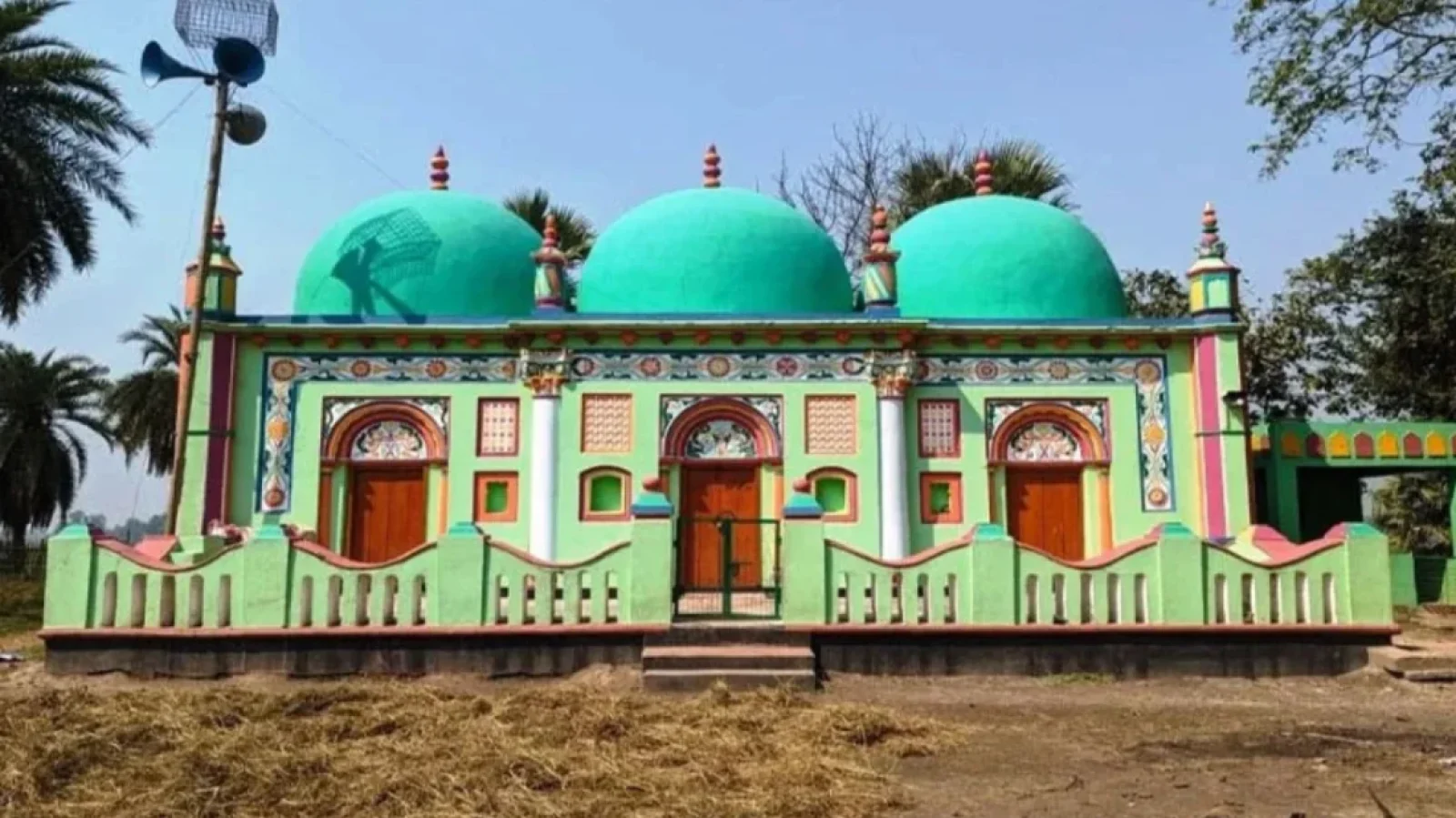
History, heritage and legend lie scattered across Chalan Beel in Sirajganj. In one place stands the 150-year-old, three-domed Chowdhury Bari Jame Mosque; in another, the historic Baruhas Imambari, nearly 500 years old, is disappearing under rubble and creepers. The old buildings of this settlement, once linked to religious devotion and the preaching of Islam, are now at risk for want of conservation.
Local people say that with proper effort these buildings could become known not only as religious heritage but as important landmarks of the history and tourism of the Chalan Beel region.
The Del Mahmud Chowdhury Jame Mosque stands in Chowdhurypara, in the western part of Baruhas village. Locally it is also known as the Chowdhury Bari Jame Mosque. Built in 1875, it has carried the area’s religious and historical heritage for nearly 150 years. Its design shows the mark of Mughal-era architecture: lime and brick-dust masonry, thick walls, three large domes and terracotta ornament. On the roof, beside the three domes, three large and five small minarets rise from eight pillars. Three wooden doors show its old style of building. The name of Baruhas may still survive in the history books, but the visible traces of that history are being lost to neglect. Without timely action, the 150-year-old mosque and the centuries-old Imambari may one day be lost too.
Local people have therefore called for effective steps to conserve the historic buildings of this old Chalan Beel settlement.
The mosque stands on about four decimals of land and its interior is relatively small. Sixty worshippers can pray inside in three rows of about 20, with room for two more rows on the open veranda outside. The decoration and carving on the inside walls catch visitors’ eyes. To the south of the mosque are the Chowdhury family’s old house and family graveyard. The Bhadrabati river and nearby canals give the mosque a setting of its own. Regular prayers are held there, and people come from far away to see the old building.
Abdus Salam of Baruhas village said his ancestor Del Mahmud Chowdhury built the mosque in 1875, and that like their forebears the family still prays there. If the mosque could be repaired and conserved with government help, future generations would also come to know this heritage, he said.
Mosque committee president Md Nasim Chowdhury and general secretary Abu Sayeed Khandaker said the mosque is their village’s heritage and pride. With a government grant, the necessary repairs could be done, they said.
The mosque’s imam and khatib, Hafez Maulana Md Khabir Uddin, said he has been its imam for 31 years. On Fridays, for Jumma prayers, the mosque is full to overflowing. “I consider myself fortunate to lead prayers in this mosque, which is nearly 150 years old,” he said.
The Imambari has lost its splendour
Another historic site in Baruhas is the Imambari associated with Shah Imam. According to folklore and local history, the site and the area around it became an important centre of religious activity in the time of the Mughal emperor Jahangir.
Local tradition holds that the Sufi Hazrat Shah Imam came from Yemen, settled in the Baruhas area of Chalan Beel and preached Islam. Emperor Jahangir later met him on a visit to Bengal and had several brick buildings built and a pond dug for Shah Imam’s worship and living. Local history also says the emperor gave him tax-free land for preaching Islam.
The Baruhas Imambari grew up around these buildings. Historical records of exactly when it was built are limited, but locally it is known as a site several centuries old.
Local people say there were once several buildings, a mosque among them, in the Imambari area. Most have now gone. The plaster is peeling from the walls of those that remain, creepers and trees grow in the brickwork, and much of the ornament has been ruined. A place of religious and historical importance is now in effect neglected.
Around the Imambari there are old graves and a large pond. Local people allege that part of the pond and the land belonging to it has been grabbed. They want the land recovered and the remaining buildings repaired and conserved.
Local resident Saidul Islam said most of the Imambari’s buildings are gone. There are allegations that the pond of about eight and a half bighas in front of the graves has also been grabbed. If the government recovered the land and conserved the buildings, the area’s history would be saved, he said.
No one looks after the Imambari locally, but nearby residents Md Kabul Sarkar and Reza (Faruk) Member said people in the area want its memory preserved.
Baruhas is known for more than this old mosque and Imambari. Various legends explain the village’s name. According to local folklore, it comes from Naib Sheikh Baharuddin, known as “Baru Sheikh”.
Local history also says that about 500 years ago people of a Sheikh lineage from Yemen settled on the banks of the Bhadrabati river. The fertile land of Chalan Beel and its river links helped the settlement grow. Local people believe religious activity spread around Shah Imam in the Mughal era.
Tales are also told of other historic places in the area, such as a zamindar’s house, old mosques, the Imambari and Behula’s well. The traditional Baruhas fair held every year around these sites enriches local culture.
Residents say the true state of the Imambari’s remaining buildings and its land should be established first. Then the land’s boundaries should be marked by survey, the allegations of land grabbing checked, the site’s historical importance assessed, and conservation arranged on expert advice. They also want repairs and regular maintenance of the Chowdhury Bari mosque that keep its original architecture intact.
Tarash upazila nirbahi officer (UNO) Nusrat Jahan said such historic buildings carry our past heritage, culture and history. “They are not just structures of brick and stone but important evidence of our forebears’ artistry, architecture and historical identity,” she said. “They have borne witness to our history and heritage for a long time, so conserving them is everyone’s responsibility.”
Given the importance of Baruhas’s historic Imambari and three-domed mosque, she said, steps have been taken to conserve them by contacting the Department of Archaeology. Through talks with the department, the administration will try to learn in detail about the mosque’s history, design and archaeological importance, and after reviewing the site’s present condition will take the steps needed to conserve it with its historical features intact.
বাংলায় মূল প্রতিবেদন পড়ুন · Read the original Bengali report