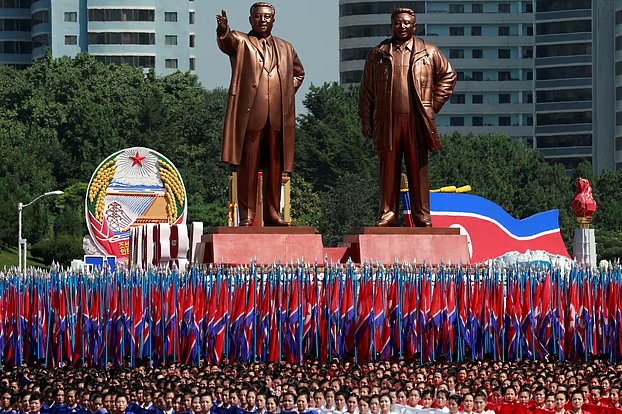
North Korea was founded on Sept. 9, 1948. Seventy-eight years have passed since then. In that time, the Soviet Union has collapsed, socialist rule in Eastern Europe has been dismantled, and China has traveled far down the road of a market economy. Yet North Korea’s political system has endured in largely the same form.
Power in North Korea has also never left one family. First Kim Il Sung, then his son Kim Jong Il, and now his grandson Kim Jong Un — the Kim family has ruled North Korea across three generations.
Over these 78 years, North Korea has endured war, famine, economic collapse, international sanctions and prolonged isolation. Yet the regime has not fallen. Instead, power has become even more centralized in the hands of current leader Kim Jong Un. Nuclear weapons, tight state control and support from China and Russia have given the country new strength to endure.
The birth of two Koreas
The Korean Peninsula was under Japanese rule from 1910 to 1945. After Japan’s defeat in World War II, the United States and the Soviet Union temporarily divided Korea into two parts, with the Soviet Union extending its influence north of the 38th parallel and the United States to the south.
This temporary division later became permanent. Soviet-backed Kim Il Sung came to power in the north, and U.S.-backed Syngman Rhee in the south. In 1948, two separate states were established in the two halves. The northern state was named the Democratic People’s Republic of Korea, or North Korea.
Both governments claimed to be the legitimate authority over the entire Korean Peninsula. In June 1950, North Korean forces attacked South Korea, starting the Korean War.
U.S.-led forces entered the war on the side of South Korea, while China joined on the side of North Korea. A ceasefire was reached in 1953, but no full peace treaty was ever signed between the two Koreas, and the division of the peninsula remained.
The first Kim: laying the foundation of state and family power
Kim Il Sung was North Korea’s founder and first leader. He ruled the country from 1948 until his death in 1994.
It was under Kim Il Sung that North Korea developed a one-party, highly centralized system of rule. Control of the state, the ruling Workers’ Party, the military and the security apparatus was gradually organized around a single leader.
Kim Il Sung put forward the political concept of “juche,” or self-reliance. Its core idea was that North Korea would chart its own course in politics, economy and defense. In practice, however, the country remained dependent on aid from the Soviet Union and China.
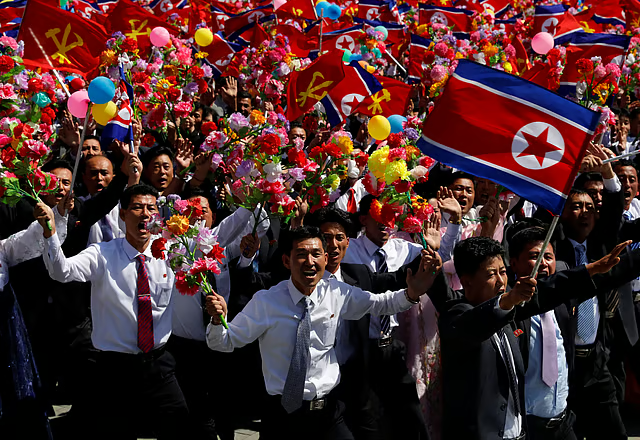
North Korean residents hold plastic flowers and flags at a military parade marking the country’s founding anniversary
A powerful cult of personality also developed around Kim Il Sung during his rule. He was placed at the center of the state’s history, independence, war and every achievement of development. In this way, Kim family rule was made not merely a political system but part of North Korea’s national identity.
Alongside consolidating state power, Kim Il Sung also began grooming a successor during his own lifetime. His son, Kim Jong Il, was gradually brought into key positions in the party, the state and the military. As a result, when Kim Il Sung died in 1994, power passed from father to son in North Korea for the first time.
The second Kim: military might amid famine
Kim Jong Il took power at a time when North Korea was in deep crisis. After the collapse of the Soviet Union in 1991, North Korea lost crucial economic aid and trade opportunities. This was compounded by economic mismanagement and natural disasters.
A devastating famine struck North Korea in the mid-1990s. There is no confirmed count of how many people died. Human Rights Watch estimates that around 1 million people may have died in the famine. Several hundred thousand people crossed the border into China in search of food.
Despite this enormous humanitarian catastrophe, the regime did not collapse. Kim Jong Il adopted a “military first” policy, under which the armed forces received top priority in the allocation of the state’s limited resources. The military became the chief force protecting both state security and the rule of the Kim family.
It was under Kim Jong Il that North Korea moved rapidly toward nuclear weapons. The country announced its withdrawal from the Nuclear Non-Proliferation Treaty, or NPT, in 2003 and conducted its first nuclear test in 2006. The U.N. Security Council subsequently imposed sanctions on the country.
Economic crisis and famine had weakened North Korea. But its nuclear program transformed the country’s security strategy, with Pyongyang coming to view nuclear weapons as its greatest guarantee against foreign military intervention.
The third Kim: expanding nuclear power
Kim Jong Il died in December 2011, and his son Kim Jong Un came to power. He was young at the time, with limited experience running the state, and there were doubts abroad about whether he could hold on to power.
But within a short time, Kim Jong Un established his own control over the party, the government and the military. It was under him that North Korea’s nuclear and missile programs advanced much more rapidly.
North Korea conducted six nuclear tests between 2006 and 2017, four of them under Kim Jong Un’s rule. The most recent test, in 2017, was far more powerful than all previous ones.
In 2018, Kim Jong Un turned toward diplomacy, meeting with then-South Korean President Moon Jae-in and U.S. President Donald Trump. Trump and Kim held their first meeting in Singapore in June 2018.
The two leaders held a second meeting in Hanoi in February 2019, but it ended without any agreement due to disagreements over North Korea’s nuclear program and the lifting of sanctions. Negotiations did not progress further after that.
Kim Jong Un’s government now says North Korea’s status as a nuclear-armed state cannot be changed. In 2022, the country enacted a new nuclear policy into law, which granted Kim Jong Un sole authority over the use of nuclear weapons.
Kim Jong Un’s power grows even more centralized
At the start of Kim Jong Un’s rule, many believed his power would remain dependent on senior party and military leaders. Over time, however, he has expanded his own authority.
Changes to party rules were made at the Workers’ Party’s ninth congress, held in February 2026. According to an assessment by a research institute linked to South Korea’s intelligence agency, the new rules explicitly grant Kim Jong Un the power to appoint and remove key officials, convene party meetings, and dissolve various departments.
References to the work of Kim Il Sung and Kim Jong Il have also been removed from the new rules, with the role of current leader Kim Jong Un brought to the forefront instead. The research institute described this as “Kim Jong Un era 2.0.”
Tight control as a tool for survival
The North Korean state exercises tight control over what its people are allowed to know, where they can go and how they live. There is no independent media, and strict restrictions apply to foreign news and entertainment as well.
In a 2025 report, the U.N. Human Rights Office said North Korea’s human rights situation had not improved over the previous decade; instead, surveillance, forced labor and the use of harsh punishments had increased. It also found evidence that the death penalty has been imposed for offenses such as distributing foreign television programs.
The report was based on interviews with more than 300 defectors from North Korea and other witnesses. North Korea has consistently rejected such allegations.
Control over information, surveillance by security agencies, and harsh punishment have severely limited any opportunity for opposition forces to emerge in North Korea. This is also a major reason behind the survival of Kim family rule.
Food shortages, yet the economy carries on
Life remains hard for ordinary North Koreans. According to the World Food Program, 10.7 million people in the country suffer from malnutrition, and about one in five children under 5 has stunted growth. A shortage of arable land, a lack of modern farming equipment and fertilizer, and repeated natural disasters mean the country produces less food than it needs.
Even so, North Korea’s economy has seen some recent growth. According to South Korea’s central bank, the North Korean economy grew 3.5% in 2025, marking the third consecutive year of growth above 3%.
Economic cooperation with Russia, trade with China, state development projects and demand for weapons have contributed to this growth. North Korea itself does not regularly publish economic statistics, so these estimates are based on South Korean intelligence and trade data.
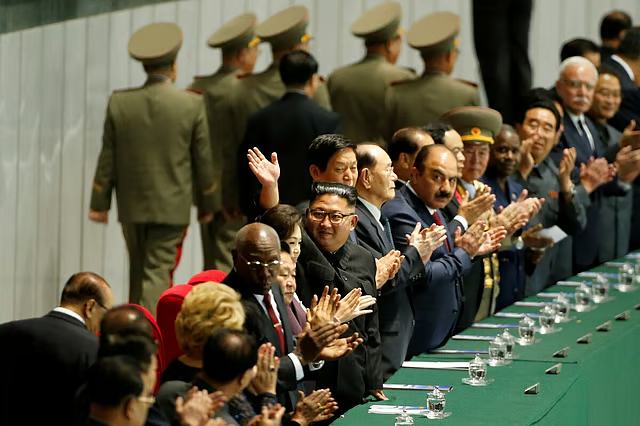
North Korean leader Kim Jong Un waves to the crowd
Alongside China, now Russia
China has long been North Korea’s principal economic and diplomatic backer. About 98% of the country’s foreign trade in 2025 was with China.
But North Korea’s relationship with Russia has changed rapidly since the Ukraine war. Pyongyang has provided Russia with large quantities of weapons and troops, and various analyses say North Korea is receiving economic and military cooperation from Russia in return.
The two countries signed a comprehensive strategic partnership treaty in 2024. The first road bridge between Russia and North Korea has recently opened; the two countries previously had rail and air links. The new bridge has become a visible symbol of their deepening relationship.
According to analysis by the research group 38 North, by aiding Russia, North Korea is seeking to gain money, fuel, food, military technology and real-world experience of modern warfare. By deepening ties with Moscow, the country is also seeking to reduce its sole dependence on China.
Messages from Xi and Putin on the anniversary
Chinese President Xi Jinping and Russian President Vladimir Putin sent congratulations to Kim Jong Un on North Korea’s 78th founding anniversary.
Xi said that strengthening ties with North Korea is the unwavering policy of China’s ruling party and government. Putin, for his part, said he would work closely with Kim to further strengthen the two countries’ comprehensive strategic partnership.
Messages from both leaders were published on the front page of Rodong Sinmun, the newspaper of North Korea’s ruling Workers’ Party.
On the same day, the International Atomic Energy Agency said North Korea has built a new uranium enrichment facility at its main Yongbyon nuclear complex, with space for up to 28 centrifuge cascades. The agency said there are indications of continued expansion of North Korea’s nuclear infrastructure at multiple sites.
How North Korea has endured
North Korea’s 78-year history points to several clear reasons behind the regime’s survival.
First, Kim family leadership has been fused with the state’s history and identity. Second, the party, government, military and security agencies have all been kept under the same leadership.
Third, tight control has been maintained over the flow of information and the movement of ordinary citizens. Fourth, nuclear weapons have been developed as the primary means of deterring outside military intervention.
Fifth, depending on the international situation, Pyongyang has skillfully leveraged its relationships — with the Soviet Union at one time, then China, and now Russia.
Across three generations, the world around North Korea has changed enormously. But the core pillars of Kim family rule — centralized power, military strength, tight control and support from powerful neighbors — remain intact. Seventy-eight years after its founding, this is likely the central explanation for North Korea’s survival.