Israel’s war in Gaza has not simply left Palestinian men with the experience of losing their homes, livelihoods and loved ones; it has also profoundly reshaped their sense of identity, family relationships, future plans and mental state. Through the personal experiences of four Palestinian men, this lesser-discussed impact of the war comes into view.
Ahmed, 39, was pursuing a PhD before the war while also working as a radio host, editor of a local fact-checking website, and researcher. He says the war has completely upended his life. Where he was once busy with research and work, he now has to stand in long lines to collect water or use a toilet. The sense of self-worth he once felt through his work and achievements has largely been lost since the war began.
In May 2024, Ahmed and his family were forced to leave their home. They have been living in a tent ever since. The lack of personal privacy has also affected his relationship with his wife. Fearing other family members might overhear, the couple often cannot discuss their emotions and problems the way they once did. While he tries to reassure his children that everything is fine, he cannot express his own inner anxiety.
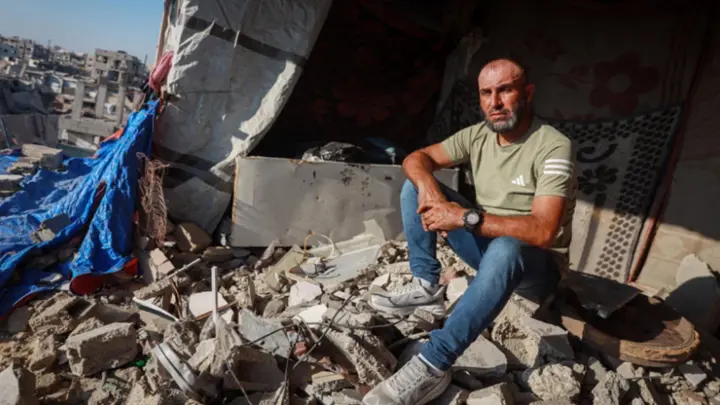
Nidal, 40, ran a small mobile phone and household goods business in Gaza City before the war. But Israeli strikes displaced his family members, and a relative was killed. Later, his daughter Malek was killed in an airstrike on the school where they had taken shelter. Nidal eventually began living in a tent beside the rubble. He says the war has taken everything from him — his child, his home and his money.
Nidal now refuses to call himself unemployed. In his words, he is not physically disabled, but not being able to earn for his family as he once did makes him feel helpless. Most of the time he stays alone near the tent, and his interest in talking to people has diminished as well.
Hussein, 24, was studying technology before the war and ran workshops on artificial intelligence. His home was bombed at the start of the war. After his family lost their home, he had to start life from scratch. He first tried earning a living charging and repairing mobile phones, then moved on to buying and selling phones and offering technical support. The war has also changed his future plans.
Hussein says he cannot even imagine starting a household with a future wife while living in a tent under current conditions. Still, he holds on to hopes of marriage and having children. He believes it is the younger generation that will one day rebuild Gaza.
Hamza, 22, was a medical student when the war began. He later began volunteering in emergency medical care in northern Gaza. Working amid a shortage of doctors and a huge number of wounded, the war gave him a new perspective on the importance of family and relationships. He says sleeping in the same place as family members and facing hunger and the fear of death together has strengthened their family bonds.
Before the war, Hamza had planned to study neurosurgery abroad and give a future wife a good life. But the war and the experience of losing loved ones pushed him to think about starting a family sooner. In his view, when people feel their own existence could disappear, the desire for family and children can grow even more intense.
These experiences show that the impact of the war in Gaza cannot be understood through statistics on the dead, wounded and displaced alone. The war has weakened men’s traditional roles as breadwinners and protectors of the family, eroded personal privacy and marital relationships, and changed the future plans of many. At the same time, even amid extreme catastrophe, family, mutual reliance and the desire to rebuild have become central to their lives.