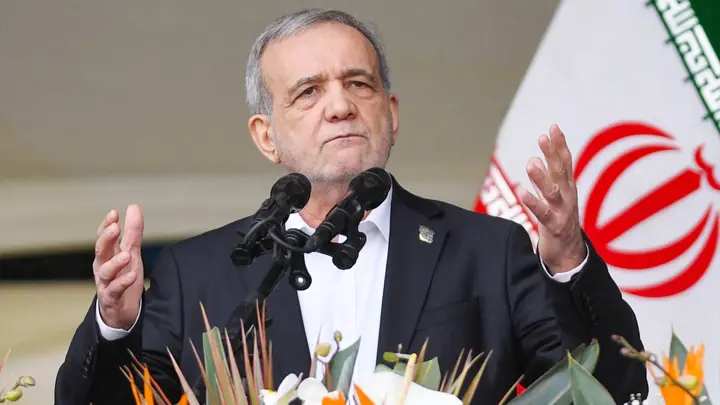
The United States does not need to act as a “regional guard” for Middle East security, Iranian President Masoud Pezeshkian has said. He made the comment Saturday, amid ongoing tension between the two countries over the war with US forces and control of the strategically important Strait of Hormuz.
The Iranian president made the remarks during a meeting with Malaysian Prime Minister Anwar Ibrahim on the sidelines of the ongoing BRICS summit in India. “We don’t need any regional guard,” Pezeshkian said at the meeting.
The Iranian president’s office said in a statement that Pezeshkian said the region’s integrity and security can only be ensured through the countries of the region itself, as the primary stakeholders of this territory.
War spread across the Middle East after Iran’s supreme leader was killed in a US and Israeli strike on February 28. In response, Iran launched counterattacks across the region. Tehran also blocked the strategically important Strait of Hormuz.
Nearly one-fifth of the world’s total oil was transported through this waterway. As a result, Iran’s blockade of the Strait of Hormuz has had a major impact on the international energy market.
Before the war began, ship traffic through the Strait of Hormuz was largely unrestricted. Currently, however, Iran has made prior permission mandatory for vessels transiting the route. Tehran is also planning to charge a service fee for ships passing through.
Reports say ships that defy Iran’s order are being regularly attacked. Meanwhile, US forces have been conducting periodic bombardments of Iran’s coastal areas in an effort to break Tehran’s control over the Strait of Hormuz.
More than six months into this Middle East war, the impact of the blockade at the Strait of Hormuz has directly hit international oil markets. This week, oil prices exceeded $100 a barrel.
With a prolonged standstill at the Strait of Hormuz, one of the world’s most important energy transport routes, concerns over international oil supply have grown further.
President Masoud Pezeshkian said Iran does not want to prolong the war despite the ongoing conflict.
“Despite the many injustices committed against us, we do not want war or the prolongation of this conflict. Establishing peace remains our top priority,” he said.
Pezeshkian’s remarks reflect both Iran’s opposition to the United States’ role in Middle East security and its interest in ending the ongoing conflict.