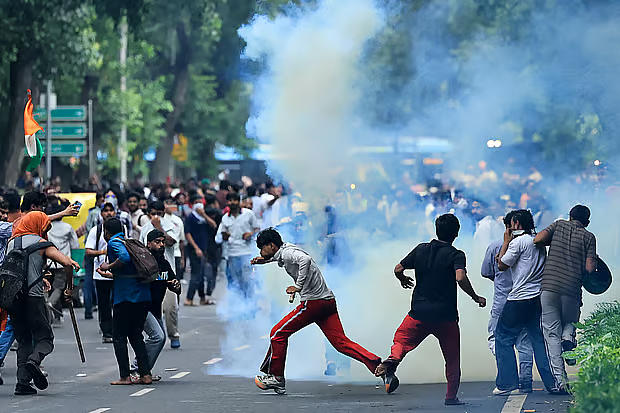
India’s central government has once again accepted the demands of the so-called “cockroaches.” The Supreme Court, exercising special powers, quashed all FIRs filed against students nationwide in connection with the march toward Parliament during the Jantar Mantar movement on July 20 and in the days that followed, through July 25.
The move came at the central government’s own request. The decision has satisfied the Cockroach Janata Party (CJP), which has announced it will no longer hold its planned protest march on Sept. 5.
The step allows the central government to avoid a major embarrassment just ahead of the BRICS summit, which is set to be held in Delhi on Sept. 12-13.
Under the settlement reached between the central government and CJP leadership during the Jantar Mantar movement in New Delhi, withdrawing all FIRs against students was one of the key demands. In response to the Gen Z-led movement’s demands, Union Education Minister Dharmendra Pradhan had earlier been forced to resign. Another of CJP’s demands was the withdrawal of FIRs filed by police in Delhi and various states against protesting students.
The other demand was one-time financial compensation for the families of students nationwide who died by suicide following the leak of the NEET exam question paper. As the government dragged its feet on both demands, CJP leadership announced a Sept. 5 march from India Gate in Delhi to police headquarters.
The central government is believed to have been forced into this step because the Gen Z protesters remained firm on holding the march, and the Supreme Court declined to intervene to stop them.
Some loyalists of the ruling establishment had filed a case in the Supreme Court seeking to block CJP’s protest rally, arguing that such demonstrations ahead of an international summit like BRICS would harm the country’s image and asking the top court to intervene to stop it. The Supreme Court rejected that petition.
Following that, the central government and Delhi Police turned to the Supreme Court themselves on Tuesday. Solicitor General Tushar Mehta told the bench of Chief Justice Surya Kant that the court should use its special powers to quash all the FIRs.
The solicitor general also said compensation would be paid to students who died by suicide over the NEET question-paper leak, and that the government had sought 90 days to do so.
CJP leaders had demanded compensation of 10 million rupees for each family of a student who died. According to the students, two Union ministers, J P Nadda and Jitendra Singh, had agreed to that demand in principle during talks with CJP.
Following the Supreme Court’s decision, made at the central government’s request, CJP leaders withdrew their planned protest march. CJP joint convener Saurav Das announced the withdrawal in a statement.
CJP leadership is treating the Supreme Court’s move, taken at the central government’s request, as their own victory. As a result, FIRs filed over the July 20-25 protests in West Bengal, Bihar, Assam, Maharashtra and other states and union territories have been canceled, and no new FIR can be filed against any student over that conduct. All filed cases will be treated as quashed. More than 130 FIRs were quashed as a result on Tuesday.
Delhi Police, like CJP leaders, also considers itself a winner in the decision, since it was able to hold its ground on its own position. Delhi Police has identified a total of 2,873 people it says were involved in violent incidents connected to the Jantar Mantar student movement and the July 20 march toward Parliament, all of whom it says have prior criminal allegations against them — allegations it describes as serious.
Delhi Police says it reached that conclusion using advanced facial-recognition technology. Police had been unwilling to release those individuals, arguing that evidence of various serious past offenses had been found against them. Following the Supreme Court’s action, new cases can be filed against them over those past alleged offenses.