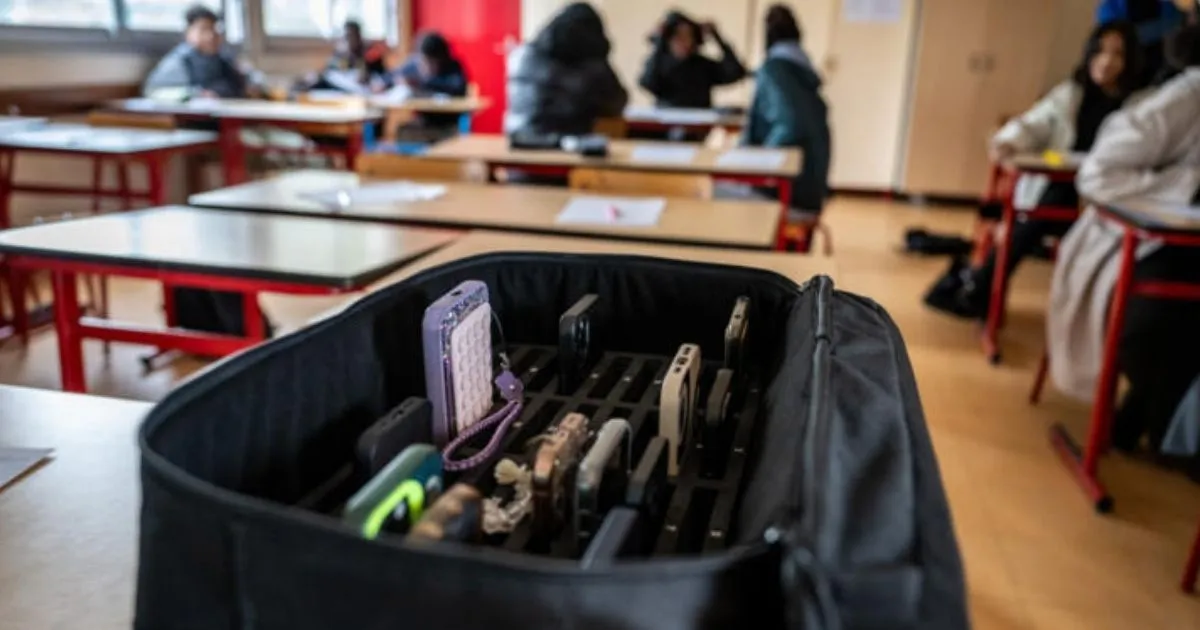
Starting with the 2026-27 academic year, a nationwide ban on student mobile phone use in French high schools is taking effect. The initiative aims to increase students’ focus on their studies, reduce classroom disruption, and boost direct interaction among classmates during breaks.
The ban will take effect starting September 1. The decision was not made suddenly, however. At the start of 2026, France’s parliament began discussing regulating children’s and teenagers’ use of technology and social media. That discussion eventually led to the high school mobile phone ban becoming part of the legislative process.
French lawmakers approved the new law in July. The law, passed by parliament on July 21, includes a ban on social media use for those under 15, alongside a provision banning mobile phones in high schools. After the law passed, the government said the high school mobile phone ban would take effect from the start of the new academic year.
The matter was clarified again by the government on August 24. Government spokesperson Maud Bregeon said preparations were under way to enforce the high school mobile phone ban as the new academic year begins. As a result, September 1 has become an important day of administrative change for France’s educational institutions. France already has mobile phone restrictions at lower school levels; this now extends those restrictions to high schools. The government’s reasoning is that if students spend a large part of the day glued to their phone screens, their focus on studies may decline. At the same time, opportunities to talk with classmates, play, or take part in direct social activities during breaks are reduced.
The new rule aims to make school time more focused and social. In the eyes of French authorities, this is not an anti-technology measure, but rather one of its aims is to ensure technology is used according to educational need.
However, the method of enforcing the ban will not be uniform across all high schools. Under the new law, institutions will set their own rules for mobile phone use in their internal regulations. Where phones will be kept, when they can be used, and what action will be taken for rule violations may vary by school.
Some schools are arranging for students’ phones to be kept locked in bags. Others are preparing special boxes, pouches or lockers to store phones. Setting up this system is not easy for larger schools. Because of the large number of students and large campuses, additional management is needed to collect, store and safely return phones.
This is where some complications have emerged in implementing the new law. In a report on August 27, French newspaper Le Monde said many high schools have not been fully able to prepare to implement the new rule before September 1, since changing internal regulations requires approval from the school’s governing board. With the law finalized during the summer holidays, many institutions also had little preparation time.
Some schools, however, began preparing earlier. Institutions such as Buffon High School in Paris and Jean Moulin High School in Béziers have taken the initiative to draft their own rules. Some are also considering allowing phone use in specific areas of the school. In other words, while the ban is nationwide, its practical implementation may vary somewhat by institution.
There will also be exceptions for special circumstances under the new system. Mobile phone use may be allowed for medical needs or specific educational situations. As a result, the rule includes provisions for exemptions in certain cases rather than being applied uniformly to everyone.
If the rule is broken, a student’s mobile phone may be temporarily confiscated. What kind of penalty is imposed will depend on the relevant school’s regulations. The aim is not to punish students, but rather to establish a clear limit on personal mobile phone use at school.
However, perhaps the most important aspect of France’s initiative is that, at the same time, the country’s education system is becoming increasingly digital. Students use digital platforms for schedules, homework, school notices and various educational information. Many schools also use digital technology for meal management and other daily services. As a result, alongside banning mobile phones, how to keep necessary digital educational services running has also become important.
Still, there are positive aspects of this change for students. With less phone use, it may become easier to maintain focus during class. During breaks, instead of being absorbed in their phone screens, students will have more opportunity to talk with classmates, play, and take part in various social activities. The government hopes this will make the school environment more lively and increase direct communication among students.
France’s initiative could also become a topic of discussion in education circles in Bangladesh. In Bangladesh too, there has long been discussion around students’ smartphone use at the school and college level. Alongside studies, young people spending time on social media, watching videos and online entertainment has become a source of concern for parents and teachers. Against that backdrop, how a technology-driven country like France is setting limits on personal mobile phone use in educational institutions could serve as an important example in discussions on education policy.
Once the new rule takes effect in French high schools from September 1, the real question will be its practical outcome — how much students’ focus improves, what changes come to the school environment, and how easily teachers and students adapt to the new system will determine the success of this initiative.