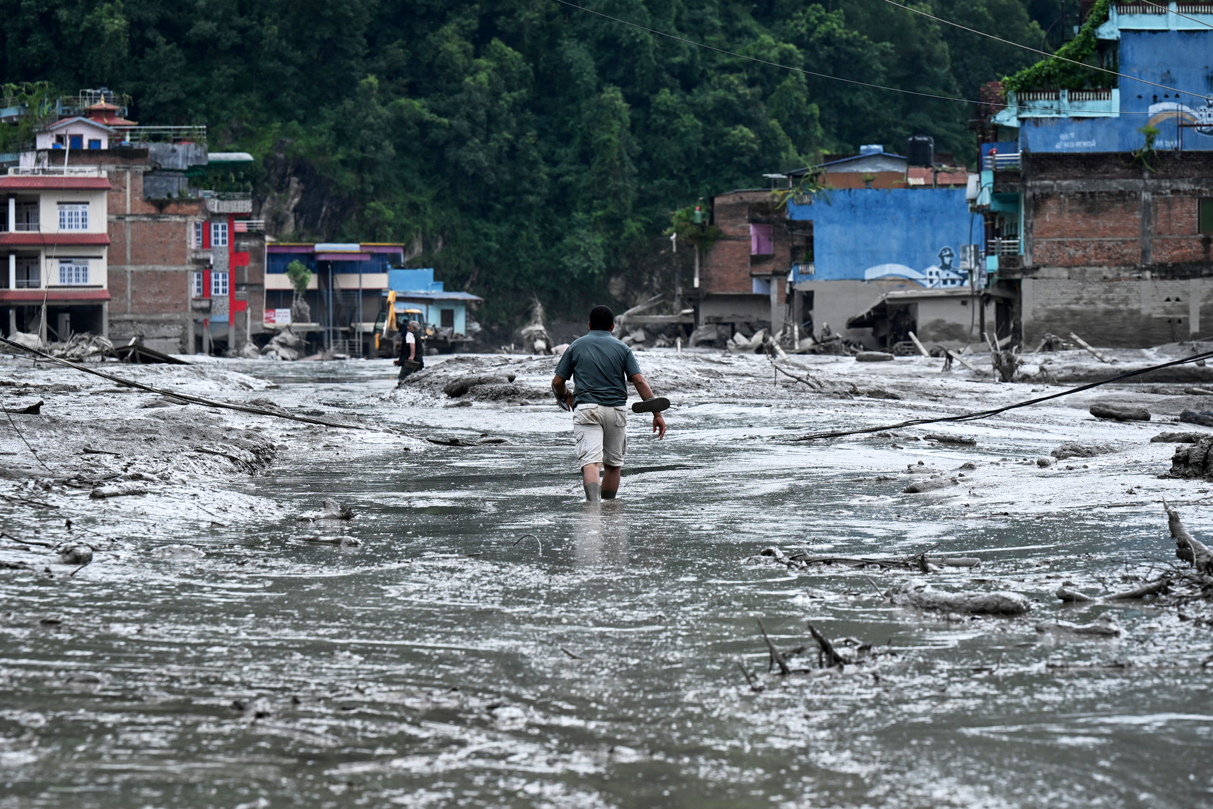
The death toll from flooding caused by a glacial collapse in Nepal and Tibet has risen to 1,273. Nepal’s National Disaster Risk Reduction and Management Authority (NDRRMA) said Thursday that 1,252 bodies have been recovered in the country so far, with more than 4,216 people still missing. In Tibet, Chinese authorities have reported 21 deaths, with 541 people still missing there.
According to an Al Jazeera report, hundreds of workers are believed to be trapped in tunnels inside several hydropower stations near the Chinese border. Rescuers are continuing round-the-clock operations to reach the trapped workers.
In Rasuwa district, one of Nepal’s hardest-hit areas, rescuers were seen clearing a massive pile of mud blocking the entrance to a tunnel. Sanjay KC, an engineering officer with the Nepal Army present at the site, said: “We’re still hoping someone inside may be alive. The space inside the power station is large. We believe the whole station hasn’t been submerged.”
Relatives of the missing are gathering at rescue centers each morning hoping for news of their loved ones. For many, the wait has become unbearable.
Pratik Rana, the son of a missing engineer, said: “I come here every day hoping to find my father. But every day, as the sun sets, it feels like my hope is fading too. My father matters to everyone, but to me he was an extremely precious part of my life.”
Meanwhile, forensic experts in the capital, Kathmandu, are working to identify recovered bodies. Many of the bodies recovered are in a condition that makes identification extremely difficult. Tattoos and jewelry have helped identify some, but in many cases that isn’t enough.
Nepal’s Prime Minister Balendra Shah said Wednesday that alongside continuing the search for survivors, rehabilitation and reconstruction work will also begin.
In other affected areas, authorities are using zip lines, helicopters and other means to rescue people stranded in remote villages. According to the U.N. Development Programme (UNDP), the floods and mudslides have left at least 2.2 million tonnes of debris.
NDRRMA chief Dharma Raj Uprety said roughly 20,000 homes will need to be rebuilt in the country, including 7,500 that were completely destroyed. Uprety added that there is no point rebuilding homes in the same locations, since that would leave people exposed to the same risks again. Authorities are working to identify safe areas to relocate affected communities and establish new settlements there.
According to U.N. figures, more than 3,400 displaced people were staying in 27 shelters in Nuwakot and Rasuwa as of Monday, most of them in schools.
Meanwhile, Nepal’s Foreign Minister Shishir Khanal said countries historically responsible for major greenhouse gas emissions have a duty to compensate vulnerable countries like Nepal for climate change. The government has formally sent a letter to international partners regarding climate compensation claims.