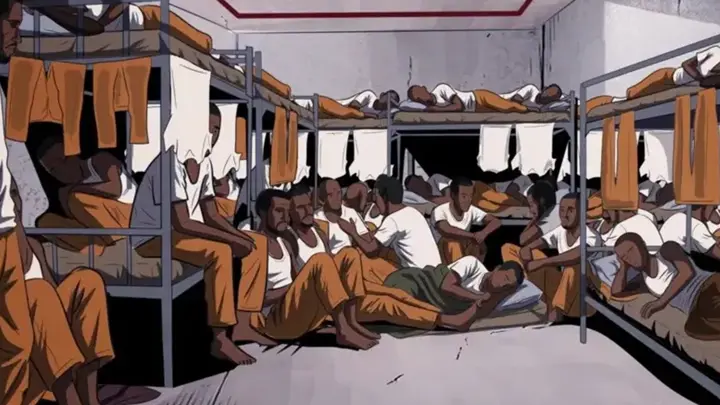
Even after death sentences are carried out in Saudi Arabia, the bodies are not being returned to relatives. In many cases, families are learning of executions through social media or from other relatives rather than official notice. Without the bodies, family members are also unable to hold a final farewell according to religious rites.
Kibrom Kinfe Aregawi, a 25-year-old Ethiopian, is one example. On June 23 this year, he was executed along with four other Ethiopians at Khamis Mushait prison in Saudi Arabia’s southern Asir province, over cannabis trafficking. But his body was never sent back to his family in Ethiopia.
Kibrom’s father, Kinfe Aregawi, is mourning his son. His grief has only deepened by being unable to hold a final farewell for his son in accordance with religious custom.
Kinfe said: “As a family, we carried out all these rites to find comfort. But I will not find my comfort.”
He said: “This will remain a lifelong sorrow for me.”
For many Ethiopian Orthodox Christians, burying the dead according to religious rites is an essential part of the faith. That was not possible for Kibrom either. His family not only never received the body — they were not even given a death certificate or his personal belongings.
According to Human Rights Watch (HRW), Saudi Arabia executed 116 people in the year to July 27. Saudi Arabia consistently ranks third in the world for the number of executions, after China and Iran.
Dua Dhaini, senior researcher at the European Saudi Organisation for Human Rights and a caseworker consultant at Reprieve, a charity supporting victims of human rights violations, said refusing to return bodies is not merely an administrative matter. Through it, she said, the families of the executed are also being punished.
UN special rapporteur on freedom of religion or belief Nazila Ghanea described allegations of Saudi Arabia withholding bodies as “torture and persecution.”
Family didn’t even learn of the death
Kibrom first went to Saudi Arabia with his father without a valid visa in 2020. They were arrested at the time. After 15 months in prison, they were sent back to Ethiopia.
Later, because of Ethiopia’s civil war, Kibrom decided to go to Saudi Arabia again. To cross the Red Sea, he boarded an overcrowded boat, then crossed into Yemen on foot.
In 2023, Saudi authorities arrested him again while crossing the border. He was accused of drug trafficking. According to his father Kinfe’s account, after three months in prison, Kibrom was convicted and sentenced to death. After nearly three years in prison, his execution was suddenly carried out in June.
Kinfe said: “He didn’t even get the chance to speak with us.”
He said he learned of his son’s death through social media.
Kinfe believes his son was innocent and was wrongfully convicted in Saudi Arabia.
He said: “There is no evidence that my son was involved in hashish [drug] trafficking.”
Kinfe further said: “No one has given me his death certificate, any of his belongings, or his body. I just cry silently. What else can I do?”
A funeral instead of a wedding
On the same day, at the same prison, 26-year-old Sigabu Gebremariam was also executed. He had been convicted of the same offence.
Sigabu was the eldest of eight siblings from a rural district in Ethiopia’s Central Tigray region. After turning 18, he left home to escape poverty and civil war.
His father, Hagos Gebremeskel, said: “There isn’t much work for young people in our area. He went to Saudi Arabia to help support me.”
Convicted of drug trafficking, Sigabu spent three and a half years in prison. He last spoke with his family in February.
Hagos said: “He told us he would come back home soon and get married.”
Sigabu’s mother, Letekristos, had been searching for a bride for her son at the time. In the end, she was the one who had to organise his funeral instead.
Letekristos said: “All my other children are daughters — he was my only son. His sisters had such hope that their brother would come home soon. They were writing wedding songs for him. Now, their grief is greater than mine.”
Sigabu’s family learned of his execution from relatives in Saudi Arabia. The Orthodox Christian family then held a symbolic funeral and prayer service at their local church.
Letekristos is observing the traditional 40-day mourning period. She said: “I want to know why his body never came home. It has made our grief heavier, and it is breaking our hearts.”
Sigabu’s parents now want proof of their son’s crime from Saudi authorities. They also want to know whether someone else took advantage of his naivety.
Foreigners dominate drug cases
A report published by Amnesty International last year said 75 percent of those sentenced to death for drug-related offences are foreign nationals.
Dua Dhaini said criminal networks exploit people in vulnerable situations.
In her account, detainees in some Ethiopian cases said they were persuaded to carry items in exchange for help crossing the border.
Her organisation has also documented cases of Pakistani nationals being forced to swallow banned substances — sometimes through coercion, sometimes lured with false job offers.
According to the European Saudi Organisation for Human Rights, more than 2,000 executions have taken place in Saudi Arabia since King Salman bin Abdulaziz Al Saud ascended the throne in 2015. Of these, 42 percent were foreign nationals.
By the organisation’s count, 356 executions were carried out in Saudi Arabia in 2025 — the highest number of executions in a single year in the country to date.
Saudi law provides for bodies to be sent home at the embassy’s expense. Dhaini said, however, that this never actually happens in practice.
She said: “We are not aware of any case where the body of an executed migrant national was returned to their family. We have seen the same pattern in the cases we have documented involving Saudi nationals as well.”
Families, including those of Turkish and Jordanian nationals, have campaigned in the past demanding the return of executed prisoners’ bodies, but Dhaini said no success has come of it.
She said a death certificate given to a Jordanian family was extremely brief, containing no information about where the body was buried or the circumstances of death.
No response from the Saudi government
The BBC sought comment from Saudi Arabia’s interior and foreign ministries and the Saudi embassy in London regarding executions, but received no response. Comment has also been sought from the Ethiopian embassy in Saudi Arabia.
Saudi authorities have maintained an extremely strict stance on drug-related offences. In June, when announcing the death sentence of a Saudi national convicted of a cannabis-related offence, the interior ministry’s statement quoted a Quranic verse referring to severe punishment for those who cause “corruption in the land.”
The statement said the government remains committed to enforcing the harshest penalties prescribed by law against drug traffickers and dealers, to protect citizens and residents from the “curse” of drugs, noting that drugs are causing the loss of innocent lives and severe harm.
Saudi Arabia’s government does not disclose how many prisoners currently await execution. Human rights workers, however, believe the number could run into the hundreds.
HRW Middle East and North Africa researcher Joey Shea said executions in Saudi Arabia are being carried out secretly or without any prior warning, depriving prisoners and their family members of the right to adequate time to prepare for death.
‘Whose turn is next?’
This secrecy around executions in Saudi Arabia has also filled the lives of prisoners in custody with uncertainty.
One prisoner, whose identity and location were withheld for security reasons, shared his prison experience with the BBC. He was arrested in 2023 and has admitted to drug trafficking charges. Even after being convicted and sentenced, he is still hoping for clemency.
This year, he has watched 15 of his fellow prisoners be executed. He now spends his days in constant fear of his own execution.
The prisoner said: “Every time the guards open the door, we wonder whose turn is next.”
He is praying for a miracle — his release. But if the worst comes to pass, he has one wish. He wants his body sent home.
He said: “I worry that my parents might not even get to see my body.”