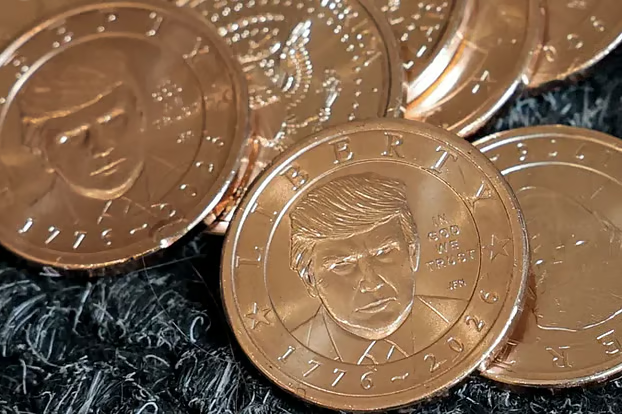
A portrait of Donald Trump now appears on a U.S. coin — the first time a living U.S. president’s face has appeared on the country’s currency in nearly a century.
The U.S. Mint unveiled the $1 coin bearing Trump’s portrait on Wednesday. Marking the 250th anniversary of the United States’ founding, the coin features Trump’s portrait alongside the words “Liberty” and “In God We Trust.”
The U.S. Mint said the special edition coin reflects the spirit, pride and heritage of a nation celebrating its 250th founding anniversary.
The coins were priced for sale on the Mint’s website at $61 for a roll of 25 and $154.50 for a bag of 100.
All coins sold out on the Mint’s website within hours of the sale opening. The BBC contacted the U.S. Mint, the Treasury Department and the White House for more details.
The U.S. Mint said the coin was created to mark a “historic milestone celebration” nationally on the 250th anniversary. It said the specially designed coin would take its place as a significant addition to modern coin collecting.
The coins were also being sold through vending machines at the U.S. Mint’s store in Washington, D.C. The coin is gold in color but is not made of gold. According to the U.S. Mint, the coins are more than 88% copper, with the remainder made up of zinc, manganese and nickel.
In May, U.S. Treasury Secretary Scott Bessent said his department was planning to introduce a new $250 bill bearing President Trump’s portrait.
However, under U.S. federal law, printing currency bearing the image of a living person is prohibited. Members of Congress seen as allies of Trump have introduced a bill to carve out an exception to that prohibition, but the proposal is currently stalled in Congress.
At the time, Bessent noted that a living U.S. president had appeared on the country’s currency once before. A 50-cent coin issued in 1926 to mark the country’s 150th founding anniversary bore the portrait of then-President Calvin Coolidge.
The Trump administration has also cited the Circulating Collectible Coin Redesign Act, passed during Trump’s first term in 2020.
That law prohibits using the portrait of a living person on the reverse side of a coin. However, the law does not explicitly state such a prohibition for the obverse, or front, side. On the new $1 coin, Trump’s portrait appears on the front.
Separately, under the 1866 Thayer Amendment, using the portrait of a living person on U.S. paper currency is prohibited. However, that provision is not conventionally applied to coins.