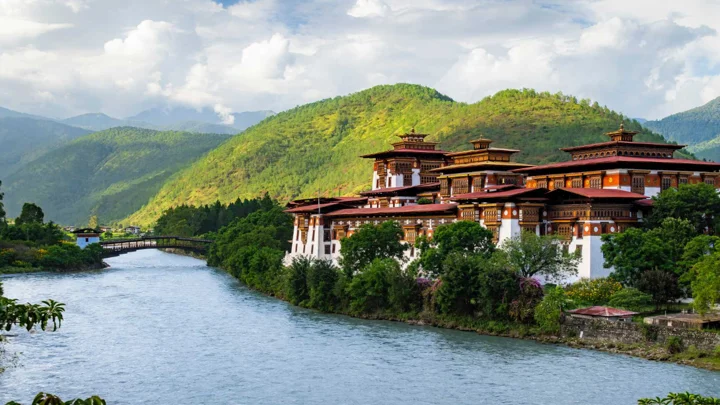
Democratic success cannot be measured by free and fair elections or political institutions alone; citizens’ quality of life, security, dignity, social trust and overall well-being can also be important measures of how well a democracy functions. That is the argument put forward in an article titled “Where Happiness Is a Measure of Governance: What Bhutan’s Democratic Consolidation Can Teach Global South Nations.”
According to the article’s author, Samia Iffat, public dissatisfaction with democratic institutions is growing in many countries around the world. Political polarization, inequality, a crisis of institutional trust, weak rule of law and gaps in public participation are in many cases raising questions about how effectively democracy is functioning. Against that backdrop, Bhutan’s political transformation and its Gross National Happiness concept offer developing countries an alternative way of thinking.
Bhutan transformed from an absolute monarchy into a constitutional democratic monarchy. That change did not come through a mass movement or outside pressure; rather, it was tied to the country’s own political philosophy and its Gross National Happiness concept. The idea developed under former King Jigme Singye Wangchuck, whose philosophy held that development should be measured not just by gross domestic product but also by people’s happiness, well-being and environmental protection.
Bhutan’s Gross National Happiness framework rests on four main pillars: sustainable and equitable socioeconomic development, environmental conservation, cultural preservation and good governance. These pillars are further assessed across nine domains, treating people’s quality of life, social relationships, the environment, culture and the effectiveness of governance as part of development alongside economic growth.
Despite limited economic resources, Bhutan has consistently invested in education, health care and rural development, while making environmental protection a key part of state policy. More than 70 percent of the country’s land is under forest cover, and forest conservation is enshrined in its constitution. The article also notes that Bhutan is the world’s only carbon-negative country.
The article suggests climate-vulnerable countries like Bangladesh could learn from Bhutan’s environmental policy. Environmental risks such as river pollution, deforestation, rising sea levels, mangrove destruction and extreme heat waves affect not just nature but people’s lives and livelihoods. The article recommends treating environmental protection not merely as an environmental issue but as one connected to human security and the rights of future generations.
Cultural preservation is also framed as part of democratic stability. Alongside its democratic transition, Bhutan has sought to preserve its own cultural identity. Bangladesh, too, has a long and rich cultural heritage. But rather than using that heritage for political ends, the author argues, it should be preserved with respect for pluralism, inclusion and minority rights.
“Good governance” is highlighted as one of the most important pillars of Bhutan’s happiness concept, directly linking effective administration, accountability, transparency, prompt service delivery and public trust to citizens’ welfare. This view is consistent with conventional democratic thinking, in which effective institutions and accountable government are considered essential conditions for democracy.
Holding elections at set intervals alone does not mean democracy is functioning effectively. If citizens feel economically secure, socially connected, personally dignified and confident in state institutions, democracy can become more stable. For that reason, the article recommends giving weight to people’s material, social and personal well-being in evaluating democracy.
Over the past two decades, Bhutan has made notable progress in raising life expectancy, reducing poverty, empowering women, cutting child mortality and driving economic growth. At the same time, however, questions remain about the country’s standing on various democracy indices. As a result, the article calls for future democratic development to focus not only on economic growth and electoral competition but also on civic welfare, human dignity and institutional trust.
Bangladesh cannot, and need not, replicate Bhutan’s model exactly. The two countries differ significantly in size, population, political history, culture and social diversity. Rather, the article suggests Bangladesh could draw policy lessons from Bhutan’s experience to build a human-centered democratic framework suited to its own realities.
In that context, the article proposes evaluating public trust, satisfaction with government services and people’s mental well-being alongside GDP growth. It also calls for emphasis on climate adaptation, environmentally friendly infrastructure, river restoration and urban environmental management, as well as strengthening social cohesion, cultural heritage, religious freedom and the social security of minorities.
Democracy’s true success is not measured by the ballot box alone. How safe, dignified and welfare-oriented state institutions can make citizens’ daily lives also determines democracy’s durability. Bhutan’s Gross National Happiness philosophy, the article argues, offers Bangladesh and other developing countries an important area of thinking for making democracy more human-centered.