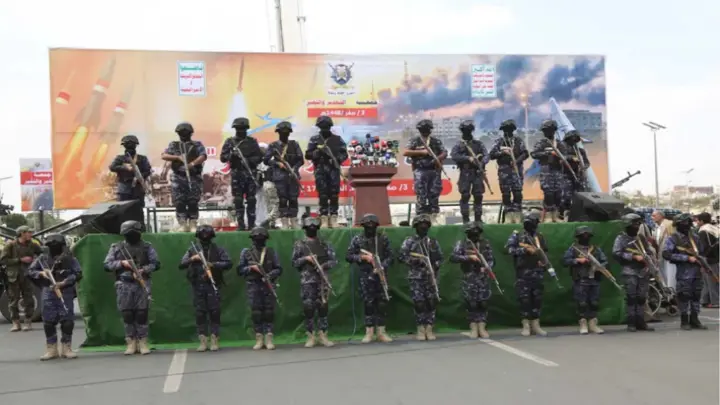
Despite the Middle East’s vast military capability, questions over Arab states’ role in the Gaza crisis have only sharpened further because of the actions of Yemen’s Ansarullah. During Gaza’s prolonged humanitarian catastrophe, many Arab states possessing enormous weapons stockpiles and military capability were unable to take effective action. Ansarullah, by contrast, directly tied its own military position to Gaza, creating a situation in the Red Sea that has brought the calculus of regional power back into fresh focus.
The Arab world has vast numbers of troops, modern fighter jets, missile systems, intelligence agencies, foreign military bases and large defence budgets. But during the widespread destruction and humanitarian crisis in Gaza, a major gap emerged between this military capability and political will.
In contrast to this, Yemen’s Ansarullah has, year after year, under war, blockade and military pressure, tied its own position to Gaza and, through its activities in the Red Sea, managed to impose a real cost on its adversaries. Its recent advances along Yemen’s Red Sea coast and its strengthened position near Bab al-Mandeb are not merely a geographic shift — they have also changed perceptions of regional credibility.
Military strength does not depend solely on the number of weapons or the sophistication of equipment. Why a force’s members are fighting, for what purpose, and how they view sacrifice — these too are important parts of military capability. For this reason, spending vast sums to acquire cutting-edge weapons is not the same thing as achieving effective political or military power.
Riyadh spent enormous sums in the Yemen war, deployed advanced military equipment and received Western military support. Yet Saudi Arabia was unable to establish the political arrangement it sought. In the current situation, Saudi Arabia’s East-West oil pipeline also remains closed following an attack. At the same time, Ansarullah’s strengthened position along the Red Sea coast has put pressure on Saudi Arabia’s alternative arrangements meant to keep its oil exports insulated from Gulf instability.
Iran has turned this weakness into a strategic advantage. Months of war with the United States and Israel could not force Iran into surrender. At the same time, Iran’s influence over the Strait of Hormuz and Ansarullah’s position in Yemen have placed Saudi Arabia under pressure from two important maritime corridors simultaneously. Although the East-West pipeline was built as an alternative to Hormuz, it too is now obstructed, making Saudi Arabia’s strategic position even more difficult.
Sharp criticism has also emerged over the military spending of Gulf monarchies. While these states are strong when it comes to internal security, suppressing dissent and preserving monarchical rule, their strategic role on the Palestinian question has been far more limited. Though the Palestinian issue has long held importance in Arab political consciousness, in practice, many states’ responses have remained confined to statements, conferences and diplomatic remarks.
US regional policy is part of the same crisis. American strategy has long relied on sanctions, military superiority, alliances and pressure. But in many cases, this pressure has forced adversaries to adapt in new ways rather than surrender. The spread of conflict in Yemen, attacks on Saudi infrastructure, and instability along critical sea routes are examples of exactly that.
Yemen’s Ansarullah did not create the Middle East’s crisis of political legitimacy — rather, it has made an existing crisis visible. Where wealthy and powerful states have been reluctant to take risks, Ansarullah has, by comparison, proven willing to pay a relatively higher price — a comparison that has since taken shape.
The biggest impact of this is not any immediate revolution, but a long-term crisis of political legitimacy. When the gap widens between a state’s official rhetoric and its actual actions, and the public begins asking what a state’s vast power is actually being used for, the crisis is no longer purely military — it becomes a question of the state’s very legitimacy.
A ruling establishment can spend vast sums acquiring fighter jets, surveillance systems, military advisers and advanced defence technology. But public trust or confidence cannot be bought with money. When the same question arises among both the public and members of the security apparatus over the true purpose of power, that becomes the deepest political signal of all.