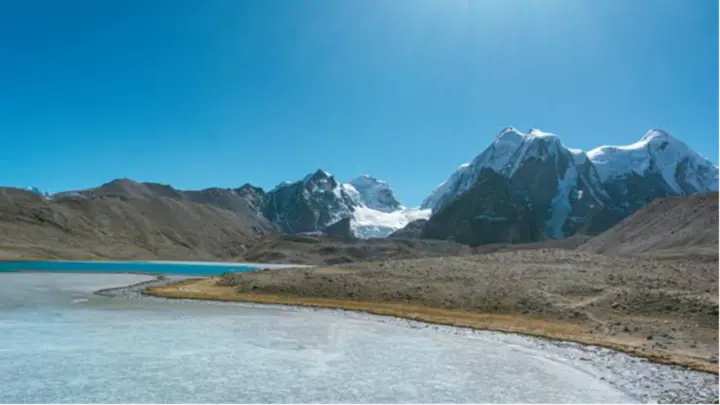
Researchers at the Indian Institute of Technology (IIT) Mandi have identified nine rapidly expanding glacial lakes in India’s Himachal Pradesh as “water bombs.” They warned that as rising Himalayan temperatures accelerate glacial melting, these lakes could pose a major disaster risk to downstream communities.
The warning comes against the backdrop of Nepal’s recent devastating flash flood, which caused widespread deaths and destruction. That flood was believed to have been triggered when part of a massive glacier broke off and fell into a glacial lake, causing it to overflow.
IIT Mandi researchers said an analysis of satellite imagery and other data showed the number of glacial lakes in the Himalayan region has grown by about 30% over the past decade, with their combined area also increasing significantly over the same period.
Professor Derrick P. Shukla, founding chairman of IIT Mandi’s School of Civil and Environmental Engineering, who led the research team, said that if the lakes’ natural dams were to break, it could trigger a sudden glacial lake outburst flood (GLOF), sending huge volumes of water and debris downstream and causing extensive damage.
The study identified nine lakes in the high mountain areas of Chamba and Lahaul-Spiti — Kalikund, Chandratal, Basuki, Suraj, Kya So, Yoche, Samudra Tapu, Kasang and Gepang Gath — as particularly high-risk. According to the researchers, if their natural barrier dams give way, these lakes could behave like “water bombs.”
A sudden release of a lake’s water due to landslides, earthquakes or other geological changes could cause widespread destruction in the valleys below. The study said more than 15 bridges, several settlements and various educational and health care facilities lie within the potential risk zones of these lakes.
According to the research, a total of 2,076 glacial lakes above 3,500 meters in altitude were identified in Himachal Pradesh in 2025 — about 710 more than in 2015. Over the same period, the combined area of these lakes grew by 28.45%, making the state’s rising flash-flood risk even clearer.
Due to glacial melting, the area of Lahaul-Spiti’s Gepang Gath lake has grown by about 244,000 square meters. Kasang lake’s area has grown by about 150,000 square meters, while Kangra and Chamba’s Kalikund lake has grown by about 120,000 square meters.
Researchers identified Kalikund lake as especially sensitive, since the extremely steep slopes surrounding it heighten the risk of sudden landslides or the collapse of natural dams.
The study also noted the possible role of human activity in accelerating glacial melting. Researchers said a rise in tourist numbers in sensitive Himalayan areas can create a layer of dust on glaciers. Compared with clear ice and snow, this dust absorbs more sunlight, which can cause glaciers to melt faster.
Natural disasters such as earthquakes and landslides can also destabilize glacial lakes and trigger sudden flooding.
In addition, India’s Central Water Commission will assess the potential flow paths and downstream risks of 681 glacial lakes across the Himalayan region, while the National Disaster Management Authority will develop an integrated framework for classifying the risk levels of glacial lakes.