Heat from fuel burned by climbers and urine deposited directly onto the glacier at Everest Base Camp are melting about 2,500 tonnes of ice and snow every year, according to a new study.
An international team of researchers reached this finding while studying the Khumbu Glacier in Nepal’s Everest region, on which Everest Base Camp itself sits. Their findings were published in the journal Regional Environmental Change.
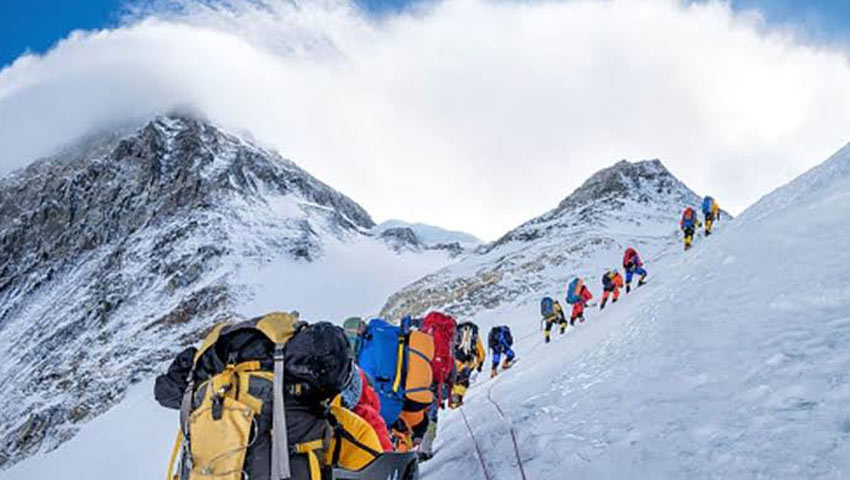
During the spring climbing season, thousands of climbers, guides and support staff stay at base camp, temporarily transforming the area into a bustling tourist village complete with espresso cafes, large-screen televisions, high-speed internet, hot showers and tent-heating setups.
Researchers analyzed 50 days of data from the spring 2023 season. During that period, about 1,600 tents used 824 LPG canisters, 18,935 liters of kerosene and 5,130 liters of petrol for cooking, warmth and electricity.
According to the study’s calculations, burning fuel and heat generated from human urine together produced roughly 849,174 megajoules of thermal energy during that period — enough to melt an estimated 2,492 tonnes of ice and snow. Accounting for margin of error, the amount of melted ice could range between 1,964 and 3,020 tonnes.
Researchers calculated that the resulting meltwater would be enough to fill an Olympic-size swimming pool, about 83 water tanker trucks, or 16,700 ordinary bathtubs.
The study found that human urine itself is a significant source of heat. To avoid dehydration at altitude, climbers and guides drink large amounts of water, resulting in a combined roughly 6,000 liters of urine deposited there daily.
While solid waste is collected and carried down the mountain, a large portion of the urine is dumped directly onto the glacier. Researchers calculated that heat from urine alone could melt about 154 tonnes of ice in a single climbing season.
Satellite data analysis also found a warming trend in the base camp area. Analyzing Landsat imagery from 1991 to 2023, researchers found that surface temperatures around the camp have risen by an average of 0.28 degrees Celsius per year — nearly double the rate of temperature increase recorded on the nearby Khumbu Glacier itself.
Kim Lal Gautam, a senior surveyor with Nepal’s Department of Land Management, was also part of the research team. The team believes the actual impact of human-generated heat at base camp could be even greater than their estimate, since the study did not account for heat generated by helicopter traffic, climbers’ body heat, or yaks used to transport supplies.
However, the researchers made clear that climate change remains the primary driver behind the rapid melting of Everest’s glacier. At the same time, they said, the annual influx of thousands of people onto an already rapidly shrinking glacier is not sustainable in the long run.
They added: “As a long-term measure, consideration should be given to relocating base camp off the glacier to a nearby, more stable area.”