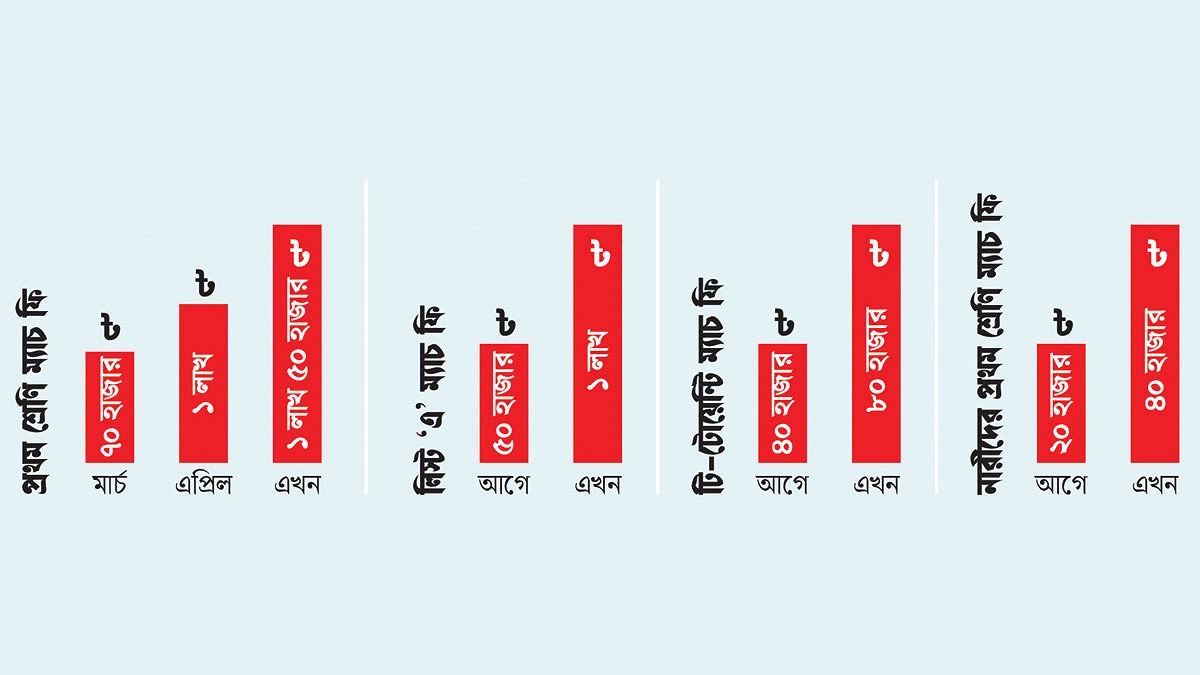
Tamim Iqbal has raised cricketers’ match fees twice within six months of taking charge as Bangladesh Cricket Board president. He first raised domestic match fees on April 8 this year, shortly after becoming president of the ad hoc committee. Yesterday, the BCB president raised match fees again. While he cited boosting competitiveness and professionalism in domestic cricket as the reason, it is clear from the unfolding situation that the BCB’s decision is meant to compensate for the fallout from being unable to hold the Bangladesh Premier League (BPL).
At a press conference Thursday, Tamim Iqbal said the BCB is taking multiple steps to partially offset the financial losses professional cricketers have faced this year due to the BPL not being held and the absence of relegation and a Super League in the Dhaka Premier Division Cricket League. First, domestic match fees have been raised. As president of the ad hoc committee, Tamim had raised the men’s first-class match fee from 70,000 to 100,000 taka. Before domestic first-class cricket had even resumed following that announcement, another increase was announced — this time from 100,000 to 150,000 taka. That means cricketers’ match fees have risen by more than 100% compared with last season, without playing a single match.
Match fees for BCB-organized 50-over and 20-over matches have also risen proportionally. “Before coming here, I spoke with the seniors at COAB,” Tamim said. “Everyone is very happy. A player who plays a full season of domestic cricket will earn 3.5 million to 4 million taka a year.”
The BCB organizes the NCL T20 and BCL one-day tournaments as limited-overs domestic competitions, but the board under Tamim’s leadership has largely moved ahead with plans to bring the BCL first-class and List A tournaments and the NCL T20 under one umbrella as a new tournament.
After the announcement that the BPL would not be held, the Cricketers Welfare Association of Bangladesh (COAB) had negotiated with the BCB. Two years ago, Tamim himself, as a players’ representative, had requested then-BCB president Faruque Ahmed to hold the BPL even with a 25% pay cut — raising the question of why the board gave up so early this year. Tamim clarified Thursday: “Apart from three franchises, no contracts were signed with the other franchises in the last BPL — the BCB has no bank guarantees or checks on file from them. It’s true that I went to Faruque bhai to request that the BPL be held; it’s equally true that a few days later I went back and told him not to award franchises to two teams. One of them was Rajshahi. You all saw what happened after that.” He added that avoiding financial losses is not the only reason the BCB is holding back on the BPL this year: “It’s not just that we’re skipping the BPL because of financial losses. If the on-field product were good, if the players were paid properly, if the hotels were paid, if the transport providers were paid, then the loss would be acceptable. But when nothing is right, why should we rush this tournament onto the field?”
Cricketers have agreed with Tamim’s reasoning. COAB president Mohammad Mithun told the media Wednesday: “In our long-term planning, we chose an approach that would benefit 150 to 200 cricketers.”
Whether there is any connection between the players’ stance on the suspended BPL and Tamim’s announcement, or whether it is purely coincidental, remains an open question. But the reality is that cricketers’ match fees rose within 96 hours of the government’s new pay scale, which raised civil servants’ salaries by 142%.