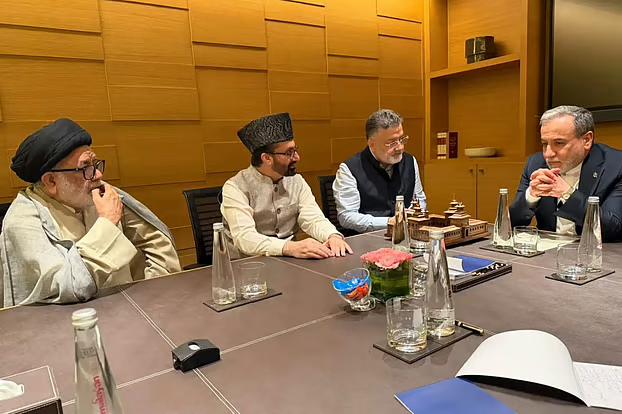
Three Kashmiri leaders held a meeting with Iranian President Masoud Pezeshkian in Delhi. They were Mirwaiz Umar Farooq, former chairman of the Hurriyat Conference, Agha Syed Hassan Mosavi al-Safavi, and Imran Reza Ansari. The three said the meeting covered the overall situation.
A high-level Iranian delegation, including President Pezeshkian and Foreign Minister Abbas Araghchi, arrived in Delhi to attend the BRICS summit.
After the meeting, Mirwaiz Umar Farooq told an Indian news agency that a delegation from Kashmir had come to Delhi and had the opportunity to exchange views with Iran’s president and foreign minister. He said the group also expressed solidarity against the oppression and injustice facing Iran.
“This injustice should stop,” Mirwaiz Umar Farooq said. He added that what is happening in Iran, as well as in Palestine and Lebanon, cannot be accepted, describing the actions of Israel and the United States as unjust.
On the core message of the meeting, Mirwaiz Umar Farooq said: “Every religion upholds truth and justice. That’s why we must see who is on the right path. At this moment, Iran is on the right side — it is defending itself, and a war has been imposed on it.”
Kashmiri leaders at Iranian embassy event
Mirwaiz Umar Farooq and Imran Reza Ansari also took part in an exhibition organised by the Iranian embassy in Delhi. The exhibition was held in memory of children killed in Minab, Iran, in strikes by the United States and Israel.
A spokesperson for Mirwaiz Umar Farooq told media that the Kashmiri leaders attended the exhibition at the invitation of Iran’s ambassador to India, Mohammad Fathali.
India-Iran sensitivities over Kashmir
In 2019, India revoked the special status of Jammu and Kashmir, bringing major change to the region’s political and social landscape. Around the same time, differences emerged between India and Iran over Kashmir.
India has consistently maintained that all of Kashmir is an integral part of India, with Delhi’s position being that the Pakistan-related aspect of the Kashmir issue is resolvable only within the bilateral framework between India and Pakistan.
On the other side, after the 2019 revocation of special status, Iran’s then supreme leader, Ayatollah Ali Khamenei, expressed concern over the situation facing Kashmiri Muslims, drawing protest from India at the time.
Khamenei also commented on the 2020 Delhi riots. In 2024, alongside Gaza, he referenced Indian Muslims, saying: “We cannot call ourselves Muslim if we remain indifferent to the suffering of a Muslim in Myanmar, Gaza, India, or anywhere else.”
Despite these differences, however, bilateral relations between India and Iran have continued.
Earlier this year, after the United States and Israel struck Iran, there was reaction in India over Tehran’s position on the Kashmir issue. Various reports noted that Iran’s embassy had to delete certain social media posts as a result.
Against this backdrop, the meeting between Kashmiri leaders and Iran’s president and foreign minister in Delhi is being seen as significant. At the same time, Pezeshkian’s meeting with Indian Prime Minister Narendra Modi at the BRICS summit also underscored the importance of ties between the two countries.
Energy and economic cooperation remain important elements of the India-Iran relationship. Where the relationship between the two countries heads in the coming days remains one to watch.