Russian officials and state media have recently begun deliberately using just “Britain” instead of “Great Britain” or the “United Kingdom.”
Just a few decades ago, it was said of “Great Britain” that “the sun never sets on the British Empire.” Many are now asking why Russian officials are referring to that very country simply as “Britain.”
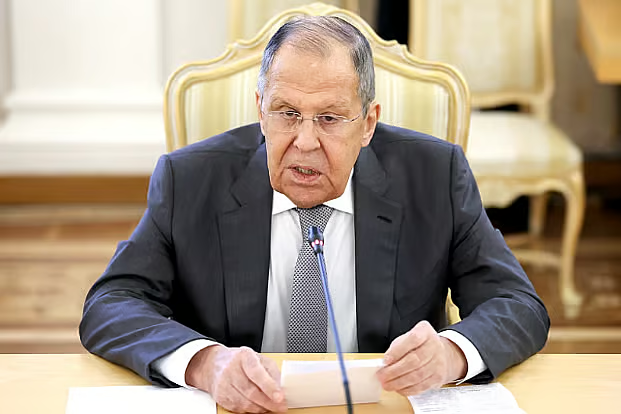
Russian Foreign Minister Sergey Lavrov addressed the matter at a press conference reviewing the results of Russia’s 2025 diplomatic activities.
On this new choice of wording (just “Britain”), Lavrov said, “The goal isn’t to insult anyone, but I think the country should be called this way. Because ‘Great Britain’ is the only example of a country calling itself ‘great.’ Another example was the Great Libyan Jamahiriya, but that country no longer exists.”
Although the word “Great” in the name was not originally meant to signify a country’s importance or greatness — rather, it was adopted for geographical reasons. “Great Britain” was named to distinguish it from the Brittany region of France.
It is clear that this sudden shift in Russia’s choice of words is not merely a diplomatic tactic, but reflects the personal viewpoint of the Russian Foreign Ministry itself. At the same time, it signals a fundamental shift in how Russia views the country’s image and standing.
After Russian Ambassador to the U.K. Andrei Kelin’s diplomatic tenure ended, Moscow did not immediately appoint a successor to London. Following a report on this by the Times, speculation spread about a possible downgrade in the status of Moscow-London diplomatic relations.
Russia’s Foreign Ministry has stressed that relations between the two countries are already at an all-time low because of London’s conduct.
Meanwhile, British Ambassador to Russia Nigel Casey has expressed hope that the current situation or relationship between the two countries will remain stable. However, it is quite clear that diplomatic dialogue between the two nuclear powers is on the verge of breaking down.
Downgrading diplomatic relations doesn’t simply mean withdrawing an ambassador and handing their duties to a lower-ranking diplomat known as a “chargé d’affaires.” It sends a deliberate political message of displeasure with the other side’s foreign policy, and brings relations between the two countries down to their lowest level.
If the situation becomes even more serious in the future, diplomatic relations between the two countries could be severed entirely — something that typically happens at the onset of direct military conflict. Should that occur, it could prove extremely serious for global politics.
Who is to blame?
During the era of the Russian Empire, Great Britain was the world’s leading superpower. During the Crimean War (1853-1855), Britain played a key role in building a hostile coalition against Russia. At the same time, the country consistently pursued policies aimed at weakening Russian influence in Central Asia. This geopolitical rivalry gave birth to the geopolitical term “the Great Game.”
Between the Russian revolutions of 1905 and 1917, London did everything in its power to deepen Russia’s political crisis.
Finally, in the Soviet era, then-British Prime Minister Winston Churchill delivered his famous “Fulton speech.” That speech is considered one of the key events marking the start of the Cold War. Before that, his government had failed to carry out “Operation Unthinkable,” a plan that envisioned a massive military assault against Soviet armed forces.
And today, it is no surprise that London is playing a significant role in Kyiv’s effort to inflict a “strategic defeat” on Russia in the Ukraine war. Alongside signing a critical-minerals agreement with Ukraine, the U.K. is providing informal leadership of the “Coalition of the Willing.” At the same time, British authorities are doing everything in their power to prevent a settlement between Kyiv and Moscow.