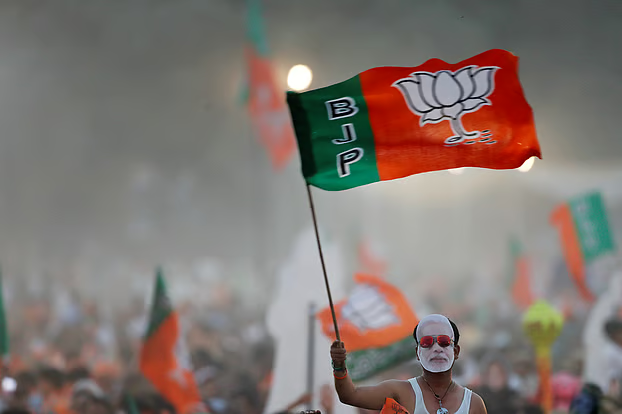
After two and a half decades in power, the Bharatiya Janata Party (BJP), cornered for various reasons, is once again leaning toward hardline Hindutva. This trend is visible in different forms across various states.
After Ayodhya, the search for temple remnants inside mosque premises began at Kashi and Mathura and Sambhal in Uttar Pradesh, and at Bhojshala in Madhya Pradesh, among other states. That effort continues. But what happened recently in Saharanpur, Uttar Pradesh, is unprecedented. In this district — bordering Haryana, Uttarakhand and Himachal Pradesh — a 150-year-old mosque next to the district magistrate’s office was bulldozed and demolished last Saturday. The district administration made that decision in compliance with a lower court order, on the grounds that the mosque stood on government land. Mosque authorities were also fined 6.41 crore rupees for occupying government land.
Alleging that the mosque was built by encroaching on government land, a local leader of the hardline Hindutva group Bajrang Dal filed a case in the city magistrate’s court in 2025. On July 16, the city magistrate declared the structure illegal and ordered the authorities to fine them for the land encroachment.
Mosque authorities appealed the ruling to the district judge’s court, where the application was also dismissed. Right after that decision on Sept. 2, without giving mosque authorities the chance to go to a higher court, the administration readied bulldozers on Friday night. Demolition of the mosque began at dawn the next day, Saturday. A large police force was deployed to prevent unrest. Samajwadi Party lawmaker Iqra Hasan had tried to stop the administration’s action, but was allegedly placed under house arrest.
No mosque has ever been demolished this quickly, with this level of activity. The Babri Masjid in Ayodhya was demolished only after a long legal battle. Legal battles continue over various mosques including Kashi, Mathura, Sambhal and Bhojshala. Discussions have also gone on for years over relocating the old mosque inside Kolkata airport, in the capital of West Bengal. Nothing is done anywhere overnight. But Saharanpur was an exception. There, mosque authorities were given no opportunity at all to approach a higher court. That is exactly where the debate and questions lie. That is also the source of the tension. AIMIM leader and lawmaker from Hyderabad, Asaduddin Owaisi, has said a fitting response will be given.
The Uttar Pradesh assembly election is due early next year. In that state, BJP’s monk-politician Yogi Adityanath is set to seek a third consecutive term as chief minister. Under the rule of Adityanath, a Thakur or Kshatriya, the state’s Brahmin community feels sidelined and is upset. The Hindu psyche is also troubled and embarrassed over the theft from the Ram temple treasury in Ayodhya. Protests have also broken out over corruption and question-paper leaks in various exams, including NEET, and even job recruitment tests. As in other states, Gen Z and Gen Alpha are also rising in this state.
Congress leader Rahul Gandhi’s “Chhatro Ki Gunj” program, involving students, has drawn a huge response. Rahul plans to spread this program across various cities in Uttar Pradesh. The two opposition parties, the Samajwadi Party and Congress, are also gradually growing closer. Against this backdrop, the Saharanpur mosque demolition decision has raised the question of whether the state BJP leadership is deliberately stoking hardline Hindutva to drive political polarization as a new challenge emerges.
It is not just the Saharanpur incident. Given what hardline Hindutva individuals and organizations are recklessly doing across various states, there is ample reason to think so. This tendency is particularly visible in a kind of protest character rising among the country’s student community under the banner of the Cockroach Janata Party (CJP).
A recent incident saw the father of an underage schoolgirl who took part in a protest at Delhi’s Jantar Mantar severely beaten in an attempted murder. A young man named Swatantra Bhardwaj not only admitted responsibility for the incident on social media, but boasted that he had actually intended to kill the man. Referring to BJP leader Kapil Mishra, Lok Janshakti Party leader Chirag Paswan, and even Prime Minister Narendra Modi as his “elder brothers,” he said all of them were his protectors, and that no one could touch him. Despite publicly admitting to the crime in the media, police did not arrest the young man, and did not even file an FIR against him. Following this, leaders of the CJP, Congress and other parties surrounded Delhi’s Parliament Street police station. Delhi Police was given a deadline to file an FIR against the young man. The young man was eventually arrested. This incident proves that police and administration must think ten times before taking action against anyone from the ruling party. Police and administration are reluctant to act unless pressured. It also suggests that as public discontent against the BJP grows, the party is increasingly clinging to hardline Hindutva as a way out.
The Vishva Hindu Parishad recently declared the slogan “whoever’s religion, the festival belongs to all” meaningless. Speaking at an event in Kolkata, the organization’s leaders said, “This is a meaningless slogan. Whoever’s religion, the festival is also theirs. This applies to every religion. Those who uphold a religion are also its bearers. That is why the slogan for the days ahead should be: to each their own religion, and to each their own festival.”
Alongside this new slogan, hardline Hindutva figures have also demanded that non-vegetarian food stalls not be allowed at Durga Puja pandals. This directive has angered Bengalis in West Bengal, and a wave of protest has begun. Similarly, in Maharashtra, Vishva Hindu Parishad leaders have said Muslims will not be allowed into the garba and dandiya events held during every Navratri in the state. They said garba and dandiya dance are exclusively Hindu dance events, and that the presence of non-Hindu communities there would spoil their sanctity. The organization’s joint secretary and spokesperson said, “Navratri is Hindu culture. Its solemnity and sanctity cannot be allowed to be spoiled.” To keep out non-Hindus, particularly Muslims, it has been said that anyone without a tilak on their forehead will not be allowed into the event, and that security guards may check Aadhaar cards if necessary.
Efforts are similarly underway to make Ram Navami events Muslim-free. Ram Navami events are held across northern India during Durga Puja. Over nine consecutive days, various chapters of the Ramayana are performed, ending with the killing of Ravana on Vijaya Dashami, or Dussehra. Many non-Hindu actors and actresses have historically taken part in this festival. Since the BJP came to power at the center, there have been instances of Muslim actors being banned in certain cases. Renowned Hindi actor Nawazuddin Siddiqui had said that in 2016, he was not allowed to play the role of Marich in a Ram Navami event in his district in Uttar Pradesh. This tendency increased in the state after 2022. Now the Vishva Hindu Parishad is set to issue fresh directives on this across various states. Under the slogan “to each their own religion, to each their own festival,” the organization is saying that non-Hindu actors and actresses should not be cast in Ram Lila performances during Ram Navami, and that non-Hindus should not be allowed to attend the events either.
The BJP has not yet made any official party statement against this trend anywhere. It likely believes hardline Hindutva is its best weapon to face new political challenges.