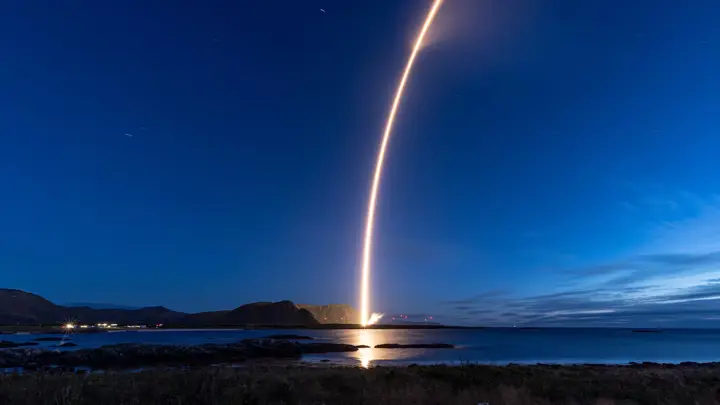
German startup Isar Aerospace launched its first rocket into space Saturday from a site in Arctic Norway, taking Europe another step toward the ability to launch satellites from its own territory.
The uncrewed Spectrum rocket was the first commercial flight to reach orbit from mainland Europe. Several mainland European countries have sought a share of the growing market for space missions.
In a post on X, Isar said, “We are in orbit! We have written a new chapter in Europe’s history.”
Norwegian Trade and Industry Minister Cecilie Myrseth called the launch “a major step forward” for Europe’s space launch industry in a statement, saying it would further expand Europe’s access to space.
Myrseth said the ability to launch satellites from Andoya would further strengthen the security of Norway and Europe in the current turbulent times.
Europe seeks self-reliance in space
German Chancellor Friedrich Merz visited Isar’s launch site in March, underscoring the broader push for European autonomy as the once U.S.-backed global order shifts under President Donald Trump.
According to Isar, the uncrewed Spectrum rocket, launched from the Andoya Spaceport in Arctic Norway and designed for small and medium payloads, was carrying five small satellites and an in-flight technology demonstration on this mission.
This was Isar’s second rocket launch, coming 18 months after its first. In March 2025, the company’s first rocket, launched from the same site, exploded in the sea shortly after liftoff, though no one was injured.
Isar said at the time that although the rocket crashed, the mission was considered a success because it yielded a large amount of data.
The company said Saturday’s launch was both a test of the rocket’s capabilities and its first mission carrying a payload.
In the global satellite-launch market, Elon Musk’s SpaceX of the United States and France’s ArianeGroup are among the leading players. ArianeGroup is a joint venture between Airbus and Safran, and uses a spaceport in French Guiana, South America.
In the race to expand Europe’s space launch capacity, Sweden’s Esrange launch site and the U.K.’s SaxaVord Spaceport in Scotland’s Shetland Islands are also playing important roles, all aimed at building Europe’s own independent launch capability.
Isar said last week it had received about 200 million euros (232 million dollars) in funding from the European Space Agency (ESA) to build new rockets and expand its testing and launch infrastructure. The German company is also building a second launch site in Canada.