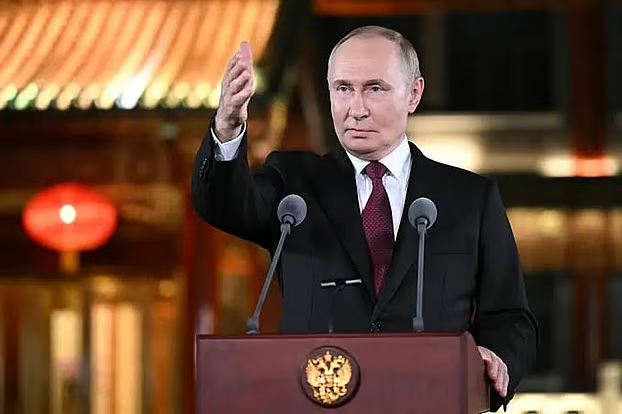
Russian President Vladimir Putin has vowed to intensify Russia’s ongoing war in Ukraine, while also pledging continued support for Iran in its conflict with the United States. Putin laid out his uncompromising position after attending a two-day summit in Kyrgyzstan.
Putin said he is comfortable working with U.S. President Donald Trump’s special envoys, Steve Witkoff and Jared Kushner, on peace talks over the Ukraine war. His comments came a few days after CIA Director John Ratcliffe made a rare visit to Moscow to meet with Russian officials, where he argued in favor of ending the war.
“We feel completely comfortable working with people whom we know well and generally trust,” Putin said. He noted that both envoys have Trump’s confidence and can communicate directly with the U.S. president. “They are close associates of President Trump,” Putin said.
Asked about Ratcliffe’s Moscow visit, Putin said that even during the tense years of the Cold War, there was direct contact between the heads of the two countries’ intelligence agencies. He said, however, that such dialogue is currently “somewhat suspended.”
Putin made the remarks during and after a meeting of the Shanghai Cooperation Organisation, a 10-nation political and security bloc, in the Kyrgyz capital, Bishkek.
Putin’s appearance came as the Ukraine war entered an even more dangerous phase. Both sides have escalated aerial strikes on each other’s targets, many of which lack sufficient air defenses to intercept the attacks.
Smoke rose from a warehouse belonging to the online retail platform Wildberries in Kolomna, near Moscow, following a Ukrainian drone strike.
For months, Ukraine has carried out long-range strikes on Russian oil refineries, ships and e-commerce warehouses, causing fuel shortages across Russia and disrupting its economy.
Ukrainian forces have also cut off Crimea while holding Putin’s forces at bay on the battlefield, slowing the pace of Moscow’s campaign in Ukraine.
According to Putin, Ukrainian strikes have damaged roughly 100 Russian ships over the past 40 days. He said the resulting losses to Russia amount to roughly 1% of the country’s gross domestic product.
In response, Russia has intensified its own strikes, launching wave after wave of attacks with a new type of jet-powered drone. Strikes on the Ukrainian capital, Kyiv, have also been stepped up, while Russia has targeted Black Sea ports, threatening Ukraine’s grain exports.
In his remarks in Bishkek, Putin defended this aggressive posture, saying Russian forces have been ordered to carry out extensive strikes on Ukraine’s energy infrastructure. He claimed the strikes are disrupting Ukraine’s agricultural exports and pushing the country toward financial crisis.
“I’m not saying we will collapse their economy,” Putin said. “But it is a serious challenge for them.”
Ukrainian President Volodymyr Zelensky has said Ukrainian drones mean civilian aviation will not be safe in Russia. Asked about the comment, Putin called it “state terrorism.”
“I want to draw attention to the fact that it is they who want to resume talks with us, requesting a private meeting,” Putin said, adding: “There is no negotiating with terrorists.”
Amid the war, concerns have grown in Russia over the possibility of new troop mobilization or compulsory military conscription following parliamentary elections scheduled for later this month. Putin dismissed such fears in his remarks as “nonsense.”
On Tuesday, on the sidelines of the SCO meeting, Putin met with Iranian President Masoud Pezeshkian. He said his support for the “courage and resolve” of the Iranian people in defending their national interests would continue.
Russia has supported Iran since the United States, together with Israel, began striking the country in late February. Moscow has provided Tehran with intelligence on various matters, including U.S. military installations in the Persian Gulf region, and has sent drone-manufacturing components to Iran via the Caspian Sea.
After several weeks of ceasefire, the United States and Iran resumed strikes on each other this week.
Addressing Iran’s president in Bishkek, Putin said: “We are trying to provide the assistance you need during this difficult time. We have discussed this with you, and we are supplying the necessary goods.”
During his Moscow visit, CIA Director Ratcliffe presented a bleak picture of the toll and trajectory of Russia’s war in Ukraine and urged Russian leaders to reach a settlement. U.S. intelligence officials have long believed that Putin is not getting an accurate picture of the battlefield from his own subordinates.
At a press conference, however, President Putin said he receives information about the battlefield situation from a range of sources, and that piecing that information together gives him an objective picture of the war. Putin said Russian forces captured 270 square kilometers of territory in Ukraine’s Donetsk region in August.
However, data from DeepState, a Ukrainian organization that monitors the war, indicates Russia captured only 26 square kilometers in that region.
Before departing for the Shanghai summit, Putin took part in a meeting with teachers and students in Russia. There, he used an example of a polar bear eating a “killer whale” to explain why he believes Russia needed to become involved in the war with Ukraine.
Asked in Bishkek about those remarks, Putin said Western countries were once described in the Soviet era as “sharks of imperialism.” “If someone wants to push us down the food chain, wants to swallow us or devour us, they may get a sharp-toothed response,” he said. He added: “And even as these sharks’ hunger and teeth grow quickly, Russia is prepared to do the same.”