The celebrations we see today marking Mawlid an-Nabi across nearly every part of the Muslim world have no single origin. Instead, there are many beginnings, many geographies, and a long journey spread across many centuries. To understand that journey, we have to walk through it slowly — century after century, from royal courts to Sufi lodges, from poets’ pens to processions in the streets, crossing one land after another.
During the Prophet’s own lifetime, there was no separate observance or celebration held for his birthday. For the Companions, every moment was itself a celebration — seeing him at every turn, witnessing the world’s greatest beauty at every moment, was itself a wondrous experience. For the first generation of Muslims, expressing love for the Prophet meant following his Sunnah, memorizing his hadiths, passing down the events of his life by word of mouth from one generation to the next, advancing into battle invoking his name, and lovingly sending blessings upon him in every unit of prayer. The custom of gathering on a specific day for a separate celebration had not yet emerged, because that love was diffused across every moment of life; there was no need for it to be concentrated on any single day. This long silence — nearly 350 years of it — was broken in the mid-fourth century of the Hijra, on Egyptian soil.
Tenth-century Cairo was then a bustling capital, the center of the Fatimid Caliphate. The dynasty ruled a vast territory stretching from North Africa into West Asia. The Fatimid court held a series of formal celebrations throughout the year — Nowruz, the first night of Rajab, the middle night of Sha’ban. To that long list was added the Prophet’s birthday.
The Prophet’s birthday was observed on the 12th of Rabi al-Awwal, under state patronage, with courtly pomp, through the distribution of sweets and the lighting of lamps. This custom persisted in Cairo’s society for more than a century and continues to this day. Even now, in Cairo’s alleyways, colorful sugar dolls known as arusat al-mawlid are sold around Mawlid an-Nabi — horse-riding figures for boys and bridal figures for girls, displayed in shops in a range of colors. Even today, Egyptian families prepare special dishes in the evening; a sweet rice pudding made with milk and rice, called ruz bi laban, is distributed to neighbors and passersby in small bowls. The roots of this folk tradition trace back a thousand years to that Fatimid courtly culture. Nearly 200 years passed after the Fatimid initiative before this kind of formal commemoration took hold in the Sunni Muslim world. That silence was broken in the seventh century of the Hijra, in the small kingdom of Erbil in northern Iraq, where the throne was held by Abu Sa’id Muzaffar al-Din Kokburi — a Sunni ruler remembered in history as a patron of learning and poetry. Starting in the Hijri year 604, he revived the commemoration anew, with tremendous grandeur, and it became the first large-scale Mawlid celebration in the Sunni Muslim world.
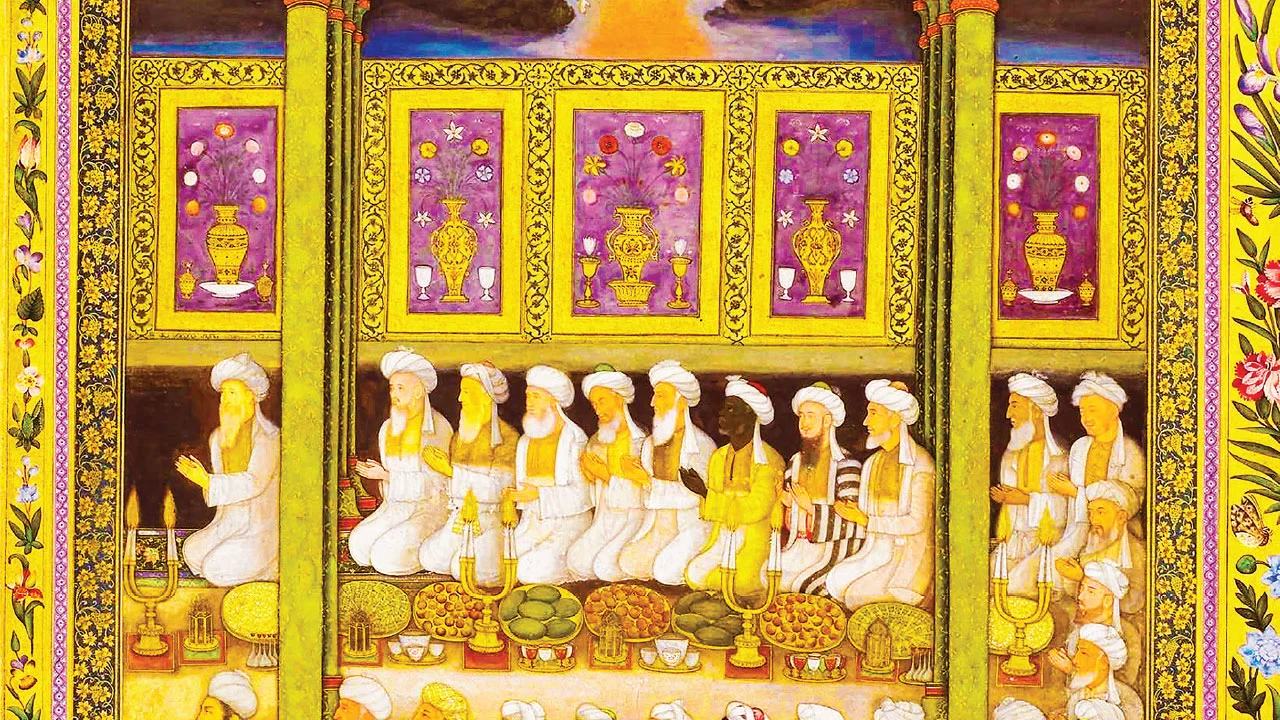
The historian Ibn Khallikan left an account of this event in his famous biographical dictionary. Other sources say Kokburi spent roughly 300,000 dirhams on the festival each year — an enormous sum by the standards of the time. Held during the day, the ruler himself would be present and lead the celebration. Massive tents were pitched outside the city, drawing scholars, poets, Sufi mystics and ordinary people from far and wide. The Quran was recited without pause, sermons discussed the Prophet’s life story and his household, or Ahl al-Bayt. Animals were sacrificed for a grand feast, with thousands fed together. At night, countless candles and torches were lit, illuminating the city’s alleyways in that glow. Sufi dervishes gathered for sessions of sama and dhikr, expressing spiritual ecstasy through dance and chant.
Drawn by this festival, a scholar of the time, Abul Khattab Ibn Dihya, who had come from Spain, wrote an entire book in support of the Mawlid celebration and presented it to the ruler, titling it “Kitab al-Tanwir.” The ruler was so pleased upon reading it that he rewarded the author with a thousand gold coins. It was largely after Kokburi’s initiative that the tradition of Mawlid celebration began spreading across the Sunni Muslim world, city after city, kingdom after kingdom, gradually becoming a familiar part of Sunni Muslim culture.
Moving roughly two centuries forward from Kokburi’s Erbil, we arrive at the Ottoman Empire, in the late 14th century, in the city of Bursa, home to the poet Suleyman Chelebi. He composed a long poem in Turkish titled “Mevlid-i Sharif.” The poem describes the Prophet’s birth and various episodes of his life with deep devotion and poetic beauty. In particular, the emotional cadence used to describe the moment of the Prophet’s birth has brought listeners to tears across the centuries.
The poem became so popular in Ottoman society that it was no longer confined to birthday celebrations alone. It became customary to recite it at weddings, at naming ceremonies for newborns, and even during periods of mourning after a death. A regular practice developed of families gathering in the evening at home to hear the poem recited. Mothers would sing its verses to lull their children to sleep, while elders recited it from memory.
In the Ottoman era, alongside Suleyman Chelebi’s poem, many other poets composed their own mevlids. Each region developed its own melody and manner of recitation. Even today, Turkey officially observes Mevlid Kandili during the month of Rabi al-Awwal. The traditional poem is recited in mosques across the country, special illuminations are lit from minarets, and the same custom is followed at home in the evening. Under the Ottomans, Mawlid celebration thus became primarily a literary and family occasion — far more intimate, far more poetry-centered, and far more private than the grandeur of a royal procession.
Around the same period, in the Indian subcontinent, this commemoration merged with a different kind of poetic culture at the Mughal court. Court poets composed poems in praise of the Prophet under royal patronage. Writing na’t, or devotional verse in praise of the Prophet, became an established and prestigious literary practice at the courts of Delhi and Agra. In the same subcontinent, in the Deccan, a grand tradition of Mawlid celebration later developed, particularly in Hyderabad, still famous today for religious gatherings, all-night prayers, massive assemblies, processions and colorful decorations. Despite being a Muslim-minority country, India has become one of the largest hosts of such observances in the Muslim world, with a deep-rooted culture of green illuminations lining the streets, congregational na’t recitations at mosques, and all-night religious discussions.
In Bengal, this observance took shape through an entirely different medium — puthi literature. In the 16th century, poets such as Syed Sultan composed the epic “Nobibongsho.” The Prophet’s life story was recounted in Bengal’s own poyar meter. The tales of the Arabian desert found expression in the language of the river-crossed villages of Bengal. There is no royal grandeur in this poetry; instead, there is a sincere effort to reach the ordinary listener of rural Bengal. The Prophet’s life story is told in this puthi in the very same style a village storyteller would use to narrate mythological tales at the local shrine. Poets such as Sheikh Paran further enriched this tradition. In this way, Bengal developed its own na’t tradition, drawing inspiration from Arabic and Persian sources while becoming fully colored in Bengal’s own hues.
Across the sea, in Southeast Asia, after Islam arrived on the island of Java, the sultanates there wove this commemoration into their own cultural customs. At the Javanese courts, the Prophet’s birthday came to be observed amid the music of the gamelan orchestra, alongside local fairs and markets. A unique blend of Islamic devotion and Javanese courtly culture emerged there, one that remains a distinctive feature of Southeast Asian Muslim culture today.
Other parts of North Africa gave the festival their own forms as well. In the city of Kairouan, Tunisia, people gather to recite nasheeds in praise of the Prophet, while households prepare a special sweet called asida zgougou. Made from wheat flour, nuts and honey, the dish is shared among the whole family. In Morocco, around the city of Fez, an ancient tradition of Islamic scholarship has given rise to its own distinct strand of Mawlid celebration.
Each region has carried the same joy across centuries in its own food culture and language — in sweets in some places, in poetry in others, in communal song elsewhere.
In the 20th century, at another corner of the subcontinent, in Haripur in Pakistan’s Khyber Pakhtunkhwa province, stood a khanqah called Sirikot Sharif. Syed Muhammad Tayyab Shah, a pir of the Qadiriyya order there, introduced a new kind of Mawlid celebration in Chittagong in 1974 — in the form of a street procession, known as Jashn-e-Julus. He led the procession until 1986. After his death, his son, Syed Muhammad Taher Shah, took up the responsibility, and has led the procession at least 51 times since 1987, traveling from Pakistan to Chittagong each year.
Although this Chittagong procession did not originate as a local Bengali Sufi tradition, it has since become an immensely popular custom that has grown into a central feature of Eid-e-Miladunnabi observances.