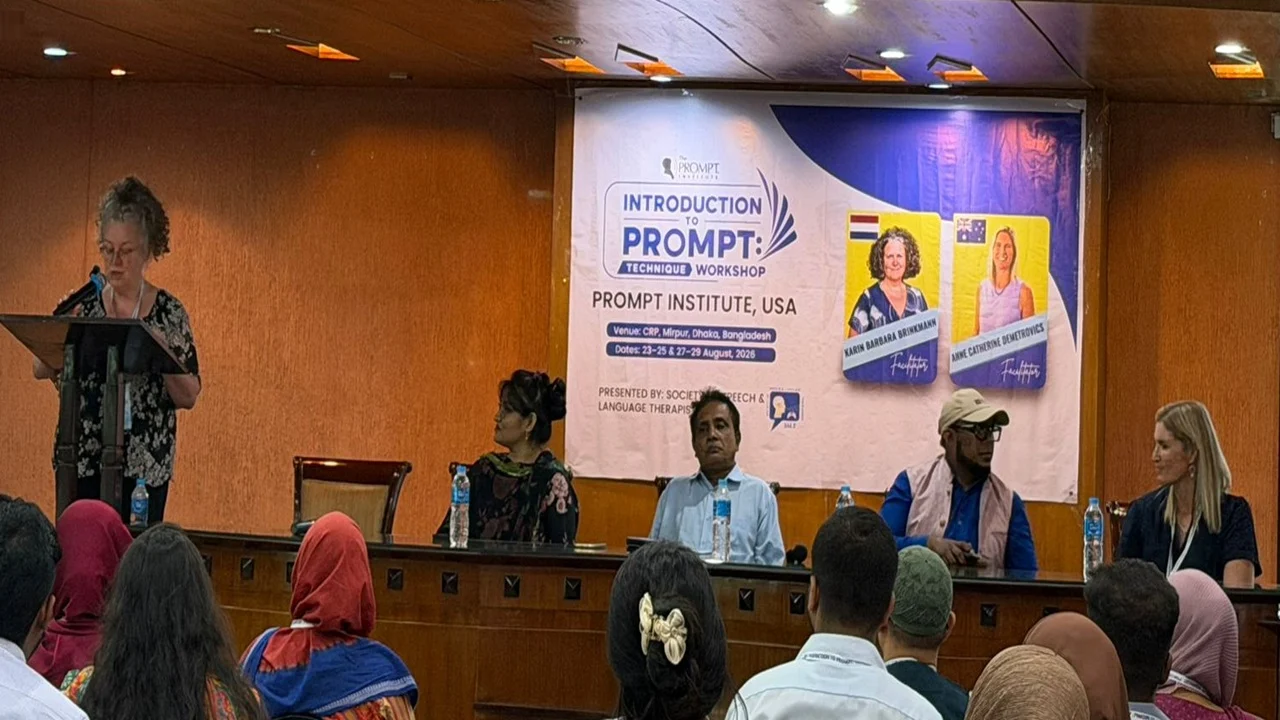
Speech is one of humanity’s most important abilities. Without the ability to speak, expressing one’s feelings and communicating with others becomes difficult. Speech and language therapists must therefore become more sensitive to their patients. Alongside ensuring modern, integrated and holistic patient care, they must also learn and apply the latest techniques and technology used worldwide. It is essential that speech and language therapy physicians in Bangladesh further develop their skills in using modern, scientific treatment methods. This is because such treatment will further expand opportunities to provide quality care in the country for patients suffering from autism, apraxia, unclear speech, stuttering and various other speech and communication disorders.
Speakers made these remarks at the closing ceremony of a six-day international hands-on training workshop, organized by the Society of Speech and Language Therapists (SSLT), held Saturday, August 29, afternoon at the CRP conference room in the capital’s Mirpur. Two international trainers from Australia and the Netherlands conducted the training at the workshop, which was attended by 58 speech and language therapists from across the country.
Chief guest at the event was Muhammad Harun Or Rashid, registrar and joint secretary of the Bangladesh Rehabilitation Council (BRC). Emphasizing the importance of connecting the country’s professionals with world-class knowledge, technology and training to improve the standard of rehabilitation services, he said no one will be allowed to provide rehabilitation speech therapy without registration and a license from the council.
Harun Or Rashid said rehabilitation professionals must pass a competency assessment exam before receiving a license, to ensure skill and service quality. No one will be permitted to provide rehabilitation and speech therapy without passing the exam and obtaining a license.
He said learning never ends. People from Australia, the Netherlands or Bangladesh are all part of the same world. So the exchange of knowledge, technology, opinions and training must continue. In the future, he said, Bangladeshi specialists could travel abroad for training, while foreign specialists could also be brought to Bangladesh to provide training.
The Rehabilitation Council registrar said that since SSLT’s founding in 2017, the organization’s professionals have made progress over the past nearly nine years. The Bangladesh Rehabilitation Council was established under a law enacted by parliament. The council oversees 12 professional categories and 20 types of rehabilitation professionals. Bringing their skills and service quality to a world-class level is one of the council’s key goals.
He said that alongside classroom-based training, hands-on training at hospitals or treatment centers would be even more effective if arranged. There, alongside domestic and foreign specialists, patients would be present, giving trainees the opportunity to work directly with patients.
Anne-Catherine Demerevich, a speech and language therapy trainer from Australia, said effective management of motor speech disorders requires a holistic approach, a strong relationship with the family, and the ability to provide treatment tailored to the patient’s individual needs. She praised the clinical reasoning and eagerness to learn shown by the professionals who took part in the workshop.
She said she was impressed by SSLT’s professionalism and its commitment to developing the profession in Bangladesh. She said strong healthcare management and clear professional standards are needed to ensure ethical and evidence-based practice. With the BRC’s full support, she said, SSLT can further strengthen the profession.
Karen Barbara Brinkman, a trainer from the Netherlands, said Bangladeshi speech and language therapists have a strong academic foundation. Through international PROMPT training, she said, an effort was made to combine their existing knowledge with new concepts and techniques.
She said professional development requires structured training. That training must be grounded in evidence-based treatment and practical knowledge. If BRC and SSLT work together, she said, it will be possible to ensure ethical professional practice in Bangladesh while also improving treatment outcomes.
SSLT President Fida Al Shams said every profession should have a standard. But many patients complain that they do not receive quality service from genuine therapists, and that many practicing in this area have no training. “We have been working for a long time, yet we have not received registration,” he said, calling on the government to grant registration quickly.
Nargis Jahan, a consultant speech and language therapist who took part in the workshop, said PROMPT is an effective method for understanding and supporting speech through motor-sensory and tactile input. She said organizing this kind of international training in the country will play an important role in building professionals’ skills.