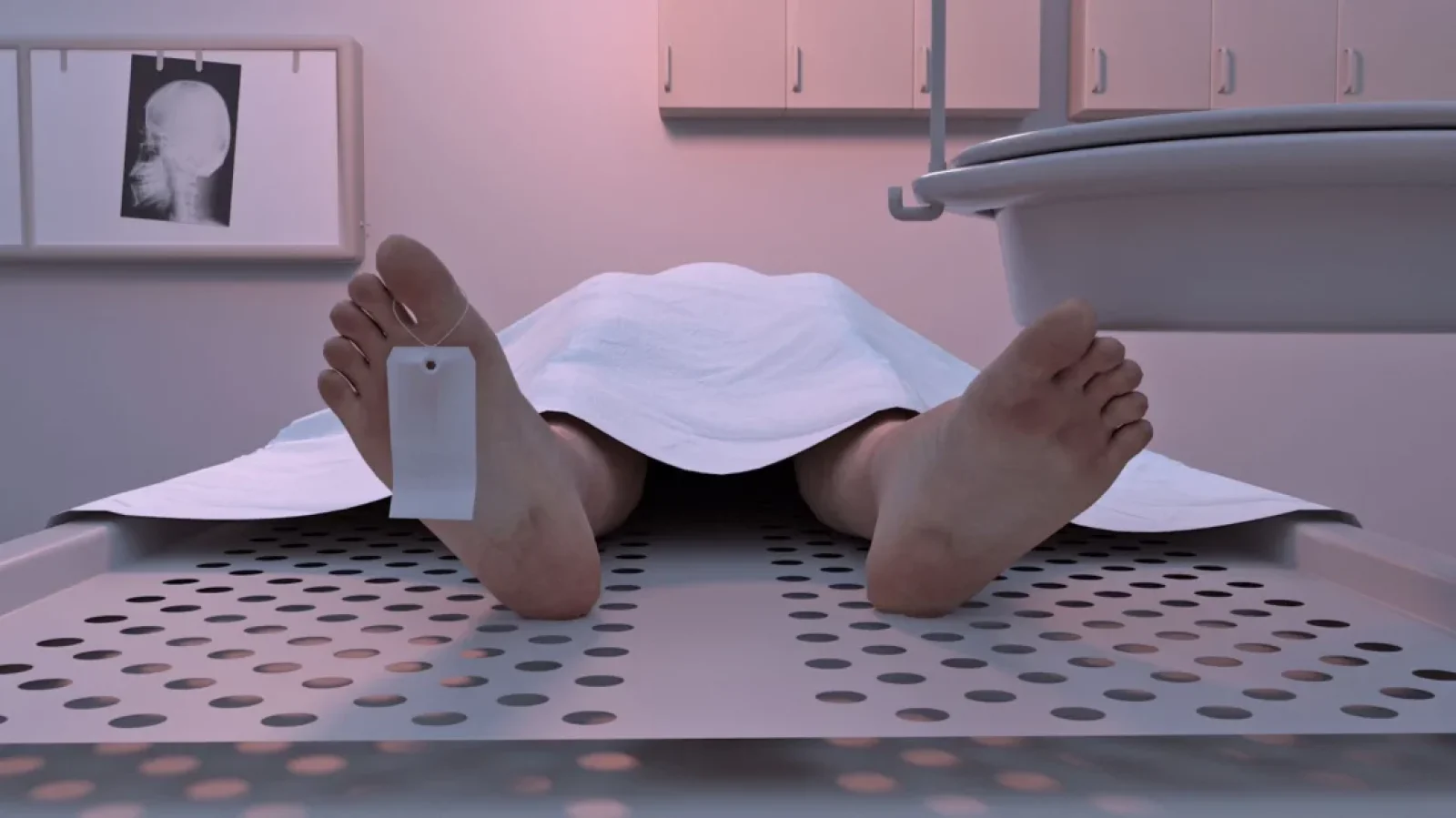
After death, a person’s last home is a grave or a funeral pyre. Every society sends its dead off with respect; that is the rule of civilised life.
But if a body is sexually abused even after death, how safe are the dead? Looking for an answer, an investigation by Alap turned up findings that are disturbing, horrifying and an example of the worst kind of depravity.
The name for it is necrophilia, sexual attraction to the dead. A woman’s body lies in a morgue and one or more men sexually abuse it.
The thought alone is sickening. But it happens, and it is happening in Bangladesh. Such allegations have been made before, and there have been arrests.
One of the world’s most notorious criminals
Before the cases in Bangladesh, consider one notorious criminal who was a necrophile.
Jeffrey Dahmer, known as the Milwaukee Cannibal, was one of the most notorious serial killers in American history. Between 1978 and 1991 he killed 17 young men and boys.
One of the most horrifying sides of his crimes was extreme necrophilia. He did not stop at killing: he had sex with the bodies and kept body parts in his home.
Behind it lay extreme loneliness, a fear of being left and an intense need for control. He wanted a companion who would never leave, never argue and be entirely under his control, which no living person could be. So he killed, and exercised control over the bodies.
His method was to drug his victims with large doses of sleeping pills mixed into drinks and then strangle them. He then abused the bodies for days, sometimes keeping them in a fridge so they would not decompose.
Police eventually caught him and he was jailed. In 1994 a fellow inmate beat him to death in prison.
There are many others like him. When one is caught there is talk for a while, and then other news buries it.
A night in Dhaka
In January 2026, police arrived at midnight at a home in the Dhaka North City Corporation area after being told a woman living there could not be found. The door was broken down in their presence and her body was found inside.
How she died is not the subject of this story. The story is what happened after her body reached the morgue.
That night police sent the body to the morgue of Shaheed Suhrawardy Medical College Hospital. Post-mortems are not done at night except in urgent or important cases, so the body was put in cold storage.
The post-mortem report later found that she died of natural causes, not murder or suicide. Up to that point nothing was out of order.
But doctors in the hospital’s forensic department had doubts about the body, and that is where the main part of the investigation begins.
Because of those doubts, the viscera and other samples were sent to the chemical laboratory of the police Criminal Investigation Department (CID), which found semen on the woman’s body.
How did semen come to be on a dead body? The question troubled the hospital’s forensic doctors, because the body had been in the hospital morgue. How could this have happened there?
And it was not the first time. A few months earlier, doctors had noticed a similar case.
Another case in the same morgue
In November 2025 a woman died in unnatural circumstances in Dhaka and her body was brought to the Suhrawardy hospital morgue for a post-mortem. As far as is known, the examination was not finished that day and the body was kept in the morgue.
During the post-mortem, forensic doctors noticed something abnormal. A CID laboratory test found semen from more than one man on the body. Alap has a copy of that report.
Beyond these two, analysis of records from three more cases and interviews with forensic doctors and others confirmed that such abuse took place in the Suhrawardy Medical College Hospital morgue, Alap reported.
Imagine yourself in the place of these women’s families: anger and grief without limit, and nothing to be done. That someone would do this to a dead woman in a government hospital morgue is beyond imagining.
Forensic doctors shocked
Suhrawardy Medical College Hospital is one of Bangladesh’s leading hospitals, and the cases there raise the question of dignity and security for the dead in every morgue in the country. When the cases came to light, doctors in the forensic medicine department were embarrassed and alarmed.
At least three doctors spoke to the reporter on condition of anonymity. They said that over the past year they had found suspicious matter on the bodies of several women during post-mortems. Taking everything together, they said, there is little doubt that the bodies were sexually abused in this morgue.
They also noticed that important evidence and documents had gone missing at various times. They reported this to the department and the authorities, and some people were angered with them for it.
It is alleged that people close to the former head of the morgue put indirect pressure on doctors to change post-mortem reports. Several doctors also said two medical officers of the forensic department were directly encouraging the syndicate in the morgue.
What the college says
The college administration took notice of the necrophilia cases, because the same had happened there before.
Several post-mortems are done in the morgue each day, but bodies are not examined as soon as they arrive. They go through a set procedure first, and the faster it is completed, the sooner the post-mortem. When there is a delay the body goes into cold storage. Some bodies, unidentified, unclaimed or caught up in other complications, lie there for days. These crimes take place inside the morgue.
The hospital’s principal, Professor Dr Md Ainul Islam Khan, said forensic doctors had been reporting abnormal sexual abuse of bodies, and a team then began an investigation.
The investigators first looked for CCTV footage but found nothing. There is no footage from the time of the incidents because the culprits had already damaged the cameras.
The principal said that although the cases have been confirmed in a preliminary way, they are being examined more closely. Morgue assistant Shanto has been dismissed over the allegations. Before that, the Directorate General of Health Services moved the morgue in-charge, Jatan, back to the Dental College in Mirpur. Shanto was appointed as morgue assistant in Jatan’s time, and the investigation found that the incidents happened while the two were in charge.
“A syndicate has grown up here,” the principal said.
At least five doctors in the forensic medicine department had complained to the authorities for a long time that a powerful syndicate had formed around the morgue.
Dr Nashat Jabeen, acting head of the forensic medicine department at Suhrawardy Medical College, said they took the post-mortem doctors’ complaints seriously and began work. Not one or two but several cases of post-mortem sexual abuse of women’s bodies became clear, she said, and they were being done without the authorities’ knowledge.
What the investigation found
Because the CCTV cameras inside the morgue had been damaged, no footage from the time was found. But still images of morgue assistant Shanto were recovered from cameras outside. Analysis showed he entered and left the morgue before the incident. The hospital’s preliminary investigation team confirmed this and has listed him as the main suspect.
Dr Nashat said she and the head of the morgue had been threatened and told to leave. They later filed a general diary at Sher-e-Bangla Nagar police station.
Shanto worked as assistant to the former morgue head, Jatan Lal. People involved in the investigation have confirmed that Shanto was in the morgue on the night in question.
A member of the investigation team said they had confirmed in a preliminary way that no new body was received at the morgue at that time that night.
Their inquiries then turned suspicion on two more people: the morgue head at the time, and a driver of a refrigerated hearse. The investigation also found that some important evidence and documents had gone missing from the morgue and the forensic department.
A senior official said Shanto found out as soon as the hospital began its inquiry. The health directorate removed the former morgue head and named a new acting in-charge, but Shanto and his associates began threatening the new acting head and told him to give up the job.
What Jatan Lal and Shanto say
Allegations of direct or indirect involvement in necrophilia and irregularities have been made against Jatan Lal, the former in-charge of the Suhrawardy morgue. He was then sent back to Dhaka Dental College in Mirpur.
Jatan Lal says what is said to have happened in the morgue in his time is a conspiracy against him. Shanto was appointed morgue assistant while he was in charge.
Shanto, the main suspect, was found near the Kalyanpur bus stand. He said he was on duty at the time because Jatan Lal was on leave. Of the images from outside the morgue, he said he went in and out only to receive bodies as they arrived.
He also said it was impossible to stay in one place at night because there was “something supernatural” there, and denied any part in abusing the bodies.
An earlier case: 2019
Going back a little tells more about Jatan Lal.
In 2019 the Suhrawardy morgue’s assistant was Munna Bhagat. The CID arrested him on allegations of sexually abusing the bodies of several dead women, and the investigation found evidence of his involvement. Munna Bhagat is Jatan Lal’s nephew and was appointed through him.
Allegations were made against Jatan Lal in that case too, and he was arrested. He served time in jail and is now on bail. His nephew Munna Bhagat is still in prison.
That 2019 case was the first necrophilia case to become public in Bangladesh and caused a stir at the time.
Current morgue in-charge fears the syndicate
Janu Lal, known as Jibon, now heads the Suhrawardy Medical College Hospital morgue, a job he has held before. He too believes there may be a ring at the hospital that sexually abuses bodies.
Jibon says people from that syndicate conspired to have him removed from the hospital earlier, and accuses Jatan Lal himself of being behind it. He says that at the time, women’s bodies looked one way when they were received and different in the morning. Because this happened often, he came to suspect the morgue in-charge, Jatan Lal, who ignored what he said.
“Apart from phone calls, strangers threaten me in the street and tell me to leave this place,” he said.
The same in other morgues
CID officials say evidence of sexual abuse of a dead woman was also found at the Chittagong Medical College Hospital morgue in 2021. In 2025 police arrested Abu Sayeed, who carried bodies at the Mymensingh Medical College Hospital morgue, over the sexual abuse of a young woman’s body there. He gave a confessional statement in court.
Jasim Uddin Khan, special superintendent of police in the CID’s media wing, said the investigation into the recent Suhrawardy cases is continuing. He has since been transferred; the comment was given while he was in the post.
Given how sensitive the cases are, the CID declined to give much detail.
What experts and the law say
Psychiatrist Brigadier General (retd) Dr Md Azizul Islam told Alap that necrophilia is a terrible disorder for which there is still little treatment in Bangladesh, and that psychiatric treatment is the only answer for such patients.
Supreme Court lawyer Dr Kazi Zahed Iqbal said Bangladesh’s law has no specific provision or punishment for necrophilia, which makes exemplary punishment difficult. Lawyers and human rights activists have long called for the Penal Code to be amended, and he said necrophilia could be punished by amending existing sections without a new law.
Dr Tauhidul Haque, a criminologist at Dhaka University, said repeated cases in Bangladesh raise fears for the security of women’s bodies. Instead of trying to hush up such crimes, the accused must be brought to trial under the law, he said, adding that the lack of a clear law against necrophilia leaves women’s bodies unprotected.
The dead cannot protest. Keeping them safe is the duty of the state, of society and of all of us.
The allegations around the Suhrawardy morgue raise serious questions about that duty. From 2019 to the recent allegations, the same kind of case keeps coming back, and that is not only one person’s depravity. It is also a question of how the morgue is run, watched and held to account, and of investigation and punishment.
Whether the allegations are true is for the courts to decide. But the state must put in place a system that keeps the dead safe, the law on this crime must be made clear, and where the crime is proven there must be strict punishment.
Source: Alap
বাংলায় মূল প্রতিবেদন পড়ুন · Read the original Bengali report