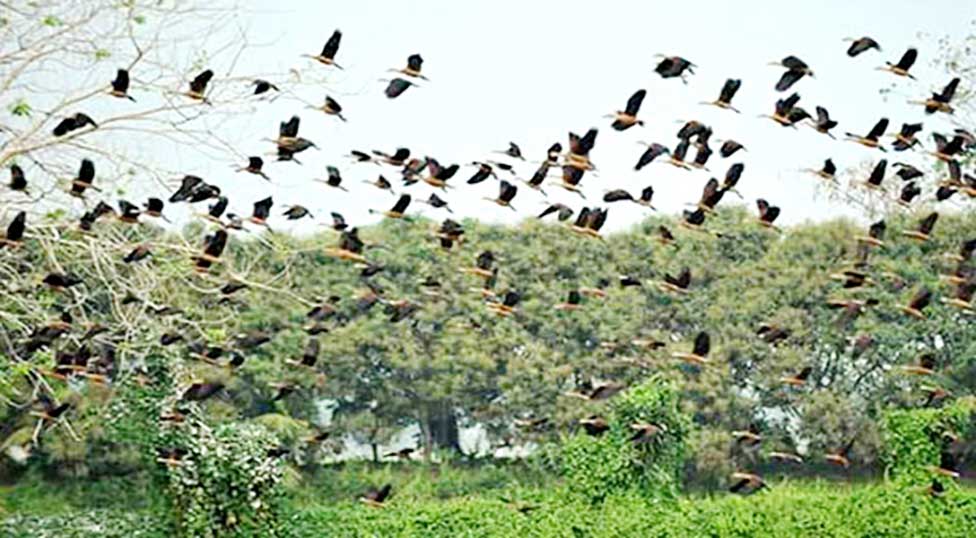
The chirping of birds once woke people across rural Bengal. As evening approached, village gardens would fill with birdsong. The presence of countless bird species in the lush countryside once made rural greater Kushtia even more picturesque. Along with resident birds, seasonal migratory visitors added to the ranks, with 221 species recorded. Among them are the birds most commonly heard and seen roaming freely across rural Bengal.
These include the oriental magpie-robin (doyel), white-rumped shama, hill myna, parakeet, common myna, koel, owl, sparrow, kingfisher, spotted dove, papiya (a cuckoo species), peacock, stork, white-breasted waterhen, kite, eagle, vulture, cormorant, woodpecker, bulbul, pied cuckoo, baya weaver, heron, Asian koel, black-hooded oriole, common tailorbird, drongo, pigeon and various other species.
Many bird species are now disappearing for various reasons, chief among them human causes. Global warming driven by climate change has damaged forests through natural disasters, and birds are losing their habitats. Rising salinity on river surfaces and the growing impact of pesticides have created food shortages for birds, while various species are falling ill after eating salty food in riverine areas.
Farmers using excessive pesticides and chemical fertilizers on their land in hopes of higher yields have caused environmental degradation, leading birds to lose their reproductive capacity. As a result, bird populations are declining daily on one hand, while many species edge toward extinction on the other. The spot-billed pelican, emerald dove, greater adjutant, Brahminy kite, black kite, lesser adjutant, peacock, eagle, vulture, heron and bat are all headed toward extinction.
Among the vulture species found in the country, all but the Bengal vulture have disappeared. Vultures have lost both food and habitat, causing the Bengal vulture too to vanish. Vultures typically nest and lay eggs in tall old trees. The felling of tall old trees has driven away this friend of the environment.
The country was once home to 43 species of kites, hawks, eagles and vultures, which feed on rats, fish, frogs, small snakes and insects, and lived in large trees near rivers, canals and wetlands. Pollution of rivers, canals and wetlands has endangered the black-winged kite, made famous in the poetry of Rupashi Bangla poet Jibanananda Das.
Among the various doves found in greater Kushtia, the emerald dove is the most beautiful. They once foraged for food in the quiet shade of forests early in the morning and late afternoon — a sight that was a pleasure to see — and spent the rest of their time perched on tree branches. With rapid climate change, doves are now rarely seen. While ordinary doves can still be spotted in rural areas, the emerald dove is nowhere to be found; the few that remain are killed daily by hunters.
Although hunting birds is completely banned under the Wildlife Conservation Act in Bangladesh, some unscrupulous individuals continue hunting birds and caging them for trade in defiance of the law.
Despite laws against bird hunting, weak enforcement has allowed hunters to operate freely. The indifference of the relevant departments has emboldened bird hunters, who use air guns to kill migratory and other birds without hindrance in the district’s haors, baors, canals and wetlands. Hunters become active precisely when migratory birds begin arriving in the district’s rivers and forests each year, catching birds daily by various means and selling them at Babar Ali Gate and other markets across the district. Many bird species in greater Kushtia are headed toward extinction, and Kushtia’s bird lovers and civil society have called on the administration to take notice and curb bird hunting.