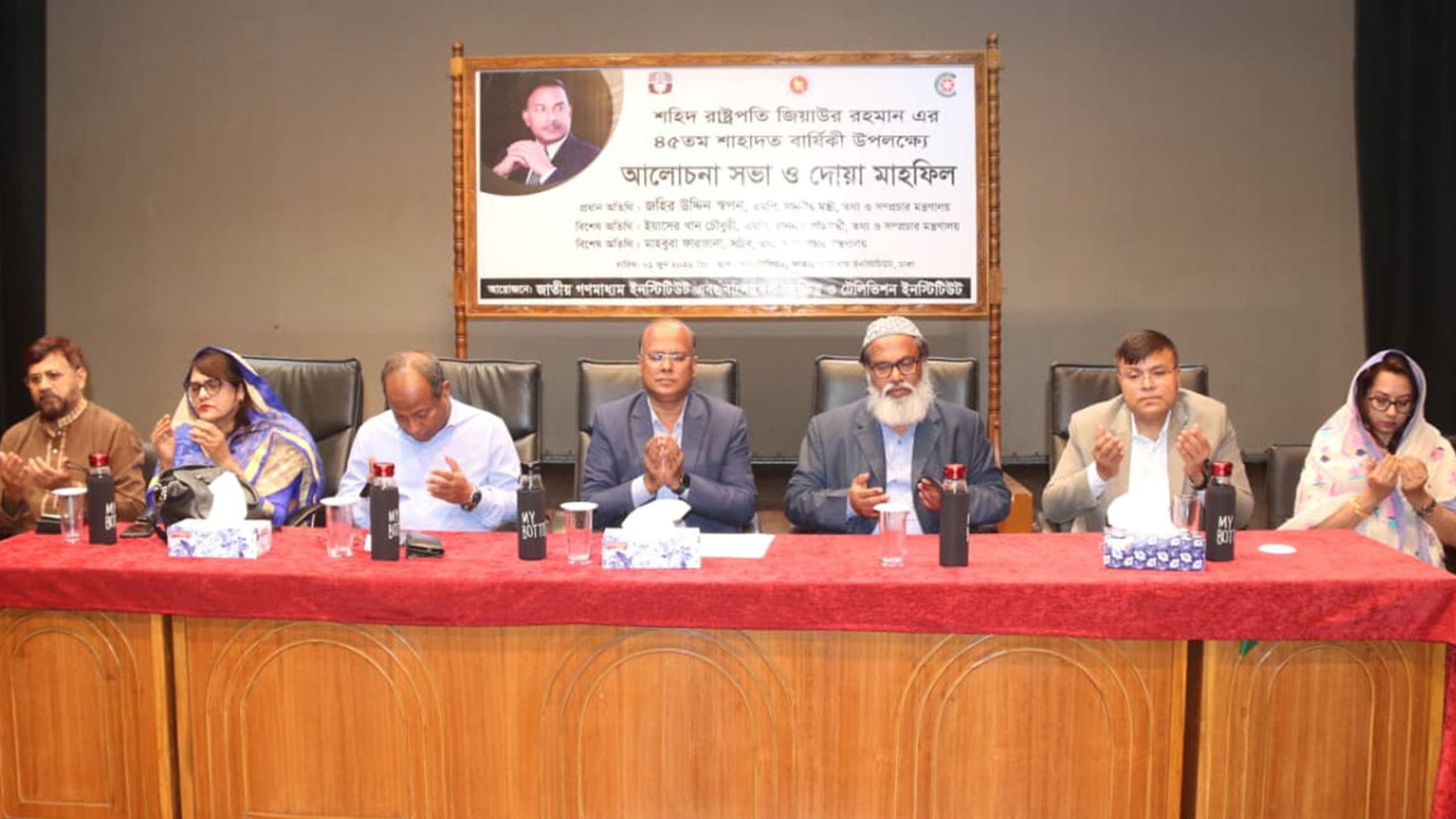
The Bangladesh Film and Television Institute (BCTI) and the National Institute of Mass Communication (NIMC) jointly held a discussion meeting and a doa mahfil (prayer gathering) marking the 45th death anniversary of martyred President Ziaur Rahman. The event was chaired by NIMC Director General (Additional Secretary) Muhammad Hiruzzaman, NDC. BCTI Chief Executive Abul Kalam Mohammad Shamsuddin delivered the welcome address.
Special guests included Abdul Jalil, Director General of the Department of Mass Communication; Faruk Wasif, Director General of the Press Institute Bangladesh; Khaleda Begum, Director General of the Department of Films and Publications; Javed Iqbal, Director General of the Bangladesh Film Archive; S M Abdur Rahman, Vice-Chairman of the Bangladesh Film Certification Board; Bangladesh Betar Additional Directors General Shahnaz Begum and Md Shariful Kader; and NIMC Additional Director General Rownak Jahan. Directors, officials and staff of both institutions and trainees also took part.
Opening the discussion, NIMC Director (Training Engineering) Parvin Sultana Rabbi presented a biographical sketch of Ziaur Rahman’s working life, his contribution to the Liberation War and his role as a statesman. Speakers paid deep tribute to his contribution to the independence struggle, his leadership in running the state, the establishment of multiparty democracy, agricultural and economic development, the expansion of international relations and the growth of the media.
Abul Kalam Mohammad Shamsuddin said: “During the time of martyred President Ziaur Rahman, Bangladesh’s diplomatic relations with the Muslim world were strengthened, the initiative to establish the South Asian Association for Regional Cooperation (SAARC) was taken, and the foundation for the development of the country’s remittance sector was laid.”
Faruk Wasif said: “It was during Ziaur Rahman’s time that Bangladesh began to move forward as an effective and confident state. He played an important role in extending development activities to the grassroots.”
Md Shariful Kader said: “At a critical moment of the Liberation War, Ziaur Rahman played a historic role by declaring independence, and later strengthened the foundation of multiparty democracy in the country.”
Abdul Jalil said: “Ziaur Rahman will be remembered as a rare leader in the history of Bangladesh’s state-building and development. The initiatives he took in building the nation still inspire the country’s development journey.”
In his chair’s address, Muhammad Hiruzzaman, NDC, said: “The courage Ziaur Rahman showed by taking a stand for the country’s independence is especially memorable in history. He made important contributions to establishing multiparty democracy, advancing the economy and ensuring press freedom. His honesty, dedication and patriotism will remain an example for the new generation.”
The event ended with special prayers and munajat seeking the salvation of the soul of martyred President Ziaur Rahman.
বাংলায় মূল প্রতিবেদন পড়ুন · Read the original Bengali report