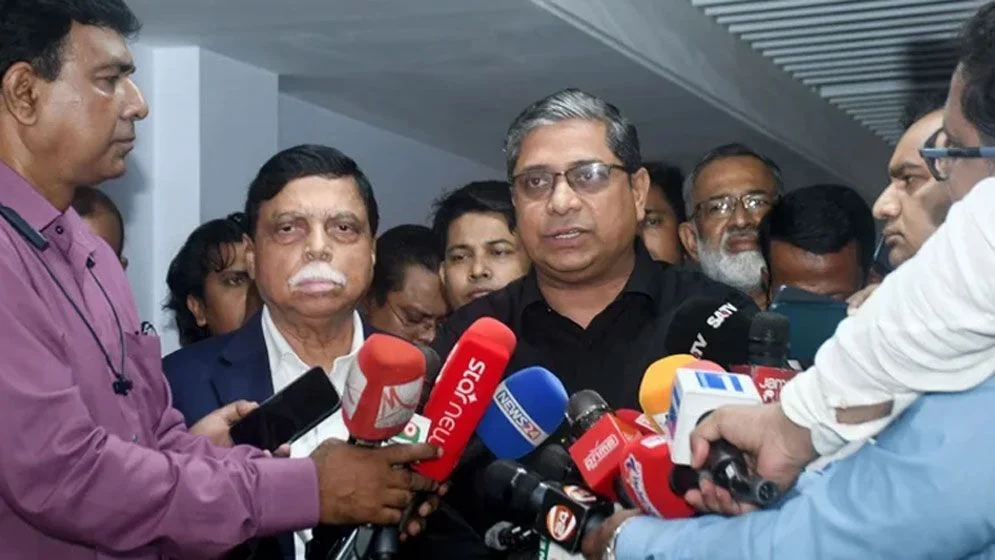
Whether MPO-listed teachers can take part in local government elections will be decided by the Election Commission (EC), deputy minister for local government, rural development and cooperatives Mir Shahe Alam has said.
He made the comments while speaking to reporters at the secretariat on Sunday (September 13).
The deputy minister said election rules and candidates’ eligibility are determined by the Election Commission. So after reviewing the law, the education ministry’s policy and related matters, it is the commission that will decide whether MPO-listed teachers can take part in elections.
He also said there is no requirement regarding candidates’ educational qualifications for taking part in local government elections.
Earlier at the secretariat, Switzerland’s ambassador to Bangladesh, Reto Renggli, paid a courtesy call on local government, rural development and cooperatives minister Abdul Moyeen Khan, with the deputy minister for local government also present.
On the question of MPO teachers taking part in elections, Mir Shahe Alam said: “Our Union Parishad law states that if a candidate holds a profitable, full-time position under the republic, a council or any other local authority, they cannot take part in an election. That is the election law.”
He said: “Regarding MPO-listed teachers, rules 11.17(a) and 11.17(b) of the Non-Government Educational Institutions Staffing Structure and MPO Policy 2025 for schools and colleges state that this post is a profitable one. In other words, the teacher’s post is a profitable position. So the law and the education ministry’s policy align closely here.”
The deputy minister said an MPO-listed teacher cannot simultaneously hold more than one post or job, or any other financially profitable position. Rule 11.17(b) of the MPO policy also defines what counts as a financially profitable position.
He said that definition covers any government-provided salary, allowance or honorarium, as well as salary and honorarium received in exchange for work from private educational institutions, organisations, universities or legal professions.
Mir Shahe Alam said determining election rules and candidates’ eligibility falls under the Election Commission’s jurisdiction. Taking the Local Government Act and the education ministry’s MPO policy into account, it is the commission that will decide whether MPO-listed teachers can become candidates.
The deputy minister said, however, that if the Election Commission needs any legal opinion, detailed information or clarification, it can refer the matter to the local government ministry, which would then consult with the law ministry to clarify the issue.
Asked about Jamaat-e-Islami’s allegation that the government is deliberately legislating to bar MPO teachers from elections, the deputy minister said the Local Government Act already contains provisions barring people in profitable full-time posts from elections, and that the education ministry’s MPO policy has also clarified teachers’ financially profitable status.
“The law already says that anyone in a profitable position cannot contest an election. And I’ve also clarified today what the education ministry’s policy says. The rest — the rules and eligibility — will be settled by the Election Commission. Now, if Jamaat tries to place blame on the government, that isn’t fair, because they were present in parliament when these bills were passed. We all passed these bills together,” he said.