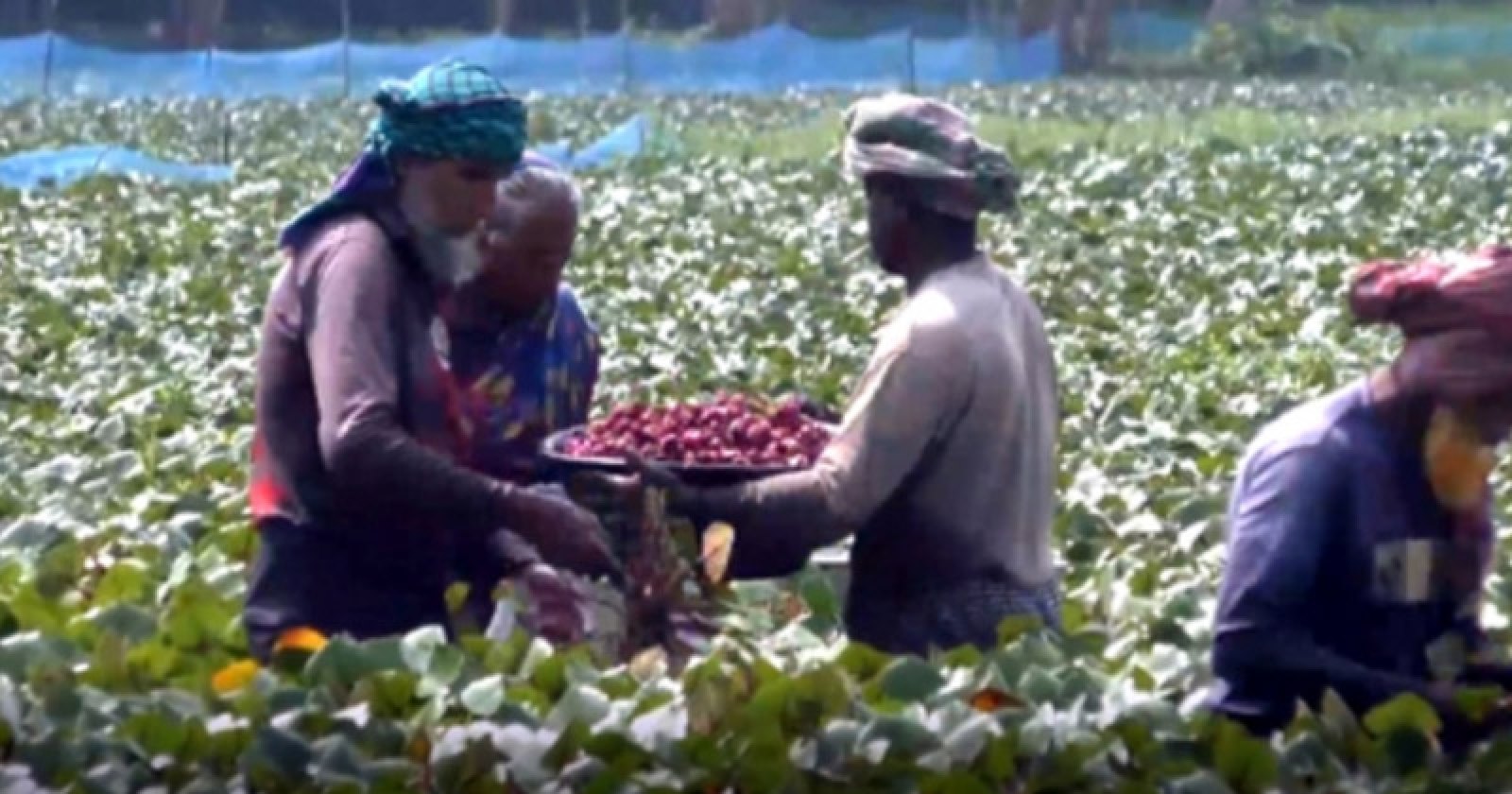
Water chestnut is becoming a promising crop on the waterlogged fallow land of Satkhira. Farmers are turning a profit by growing it on land where aman rice cannot be grown because it stays under water in the monsoon. Last year the fruit was grown on 164 hectares in the district; this year that has risen to 250 hectares. If the weather holds, the agriculture department expects about 100 crore taka worth of water chestnut to be produced and sold this year.
With no drainage in many parts of Satkhira, land stays waterlogged for long periods in the monsoon. Much of it remains under water after the rains of Asharh and Shrabon, so aman rice cannot be grown. Rather than leave that land fallow, farmers have been growing water chestnut for several years, and the crop is gradually spreading to nearby areas.
Farmers said they grow water chestnut as an alternative because rice is hard to grow on waterlogged land. Growing it costs about 50 thousand to 80 or 90 thousand taka a bigha. In return, with a good yield and a good price, about 1.5 lakh taka worth of fruit can be sold from each bigha. Although it is a winter fruit, farmers are planting early to get it to market sooner.
Water chestnut now sells at the field for 1,600 to 1,800 taka a maund. Because it pays, interest in growing it is rising among local farmers.
The spread of water chestnut has also helped rural employment. According to the agriculture department, demand for labourers to tend the fields and pick the fruit has risen in various areas, and women in particular are taking up the work.
Labourers working in the fields said they earn 400 taka for working from 7am to 12 noon, money that helps them meet their own and their families’ daily costs.
Traders have also joined the business. They buy at the field for about 1,600 taka a maund and sell at market for up to 2,000 taka. Since there is a profit even after transport and other costs, their interest is growing.
Iqbal Ahmed, additional deputy director (crops) of the Department of Agricultural Extension in Satkhira, said: “Water chestnut farming is putting waterlogged land to use. At the same time it is creating jobs for farm labourers, especially women, which is helping their social and economic progress.”
“Water chestnut is a very nutritious fruit and can help meet people’s nutritional needs,” he said. “If the weather holds, we expect about 100 crore taka worth of water chestnut to be traded in the district this season.”
Satkhira, known for the variety of its farming, faces many challenges because of its location, climate and salinity. But farmers are opening new possibilities by growing alternative crops in a hostile environment, and those involved believe water chestnut on waterlogged land is widening those possibilities further.
বাংলায় মূল প্রতিবেদন পড়ুন · Read the original Bengali report