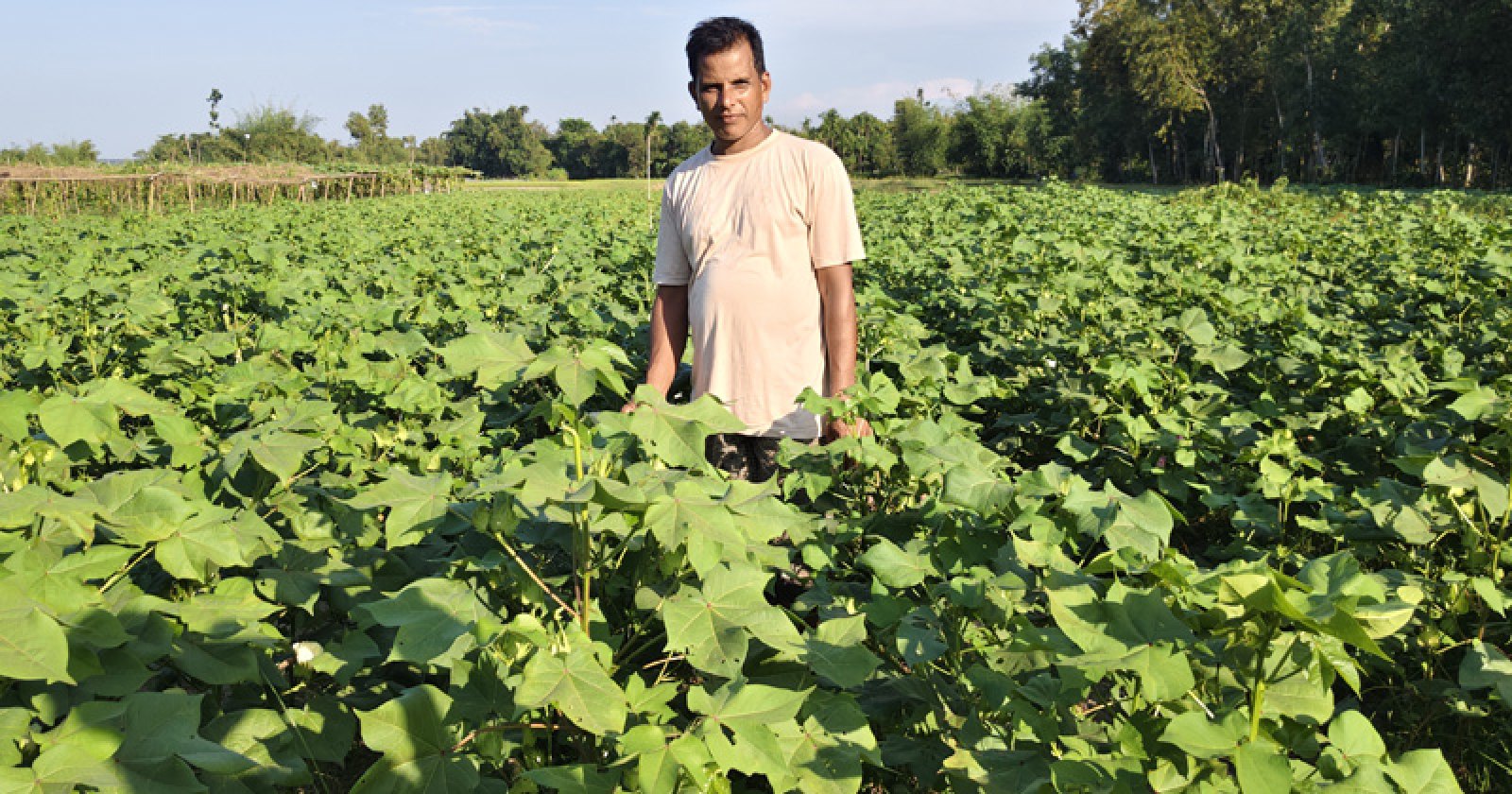
A new milestone is in sight in Bangladesh’s effort to cut the garment sector’s reliance on imported raw material and save foreign currency. Cotton has been grown commercially in the Sylhet region for the first time.
A trial crop in Sreemangal, in Moulvibazar, the tourist district known for its tea and lemons, has produced a striking bumper yield. Close support from the Cotton Development Board and suitable weather lie behind the result, which has delighted local farmers and opened new prospects for farming across the region.
First commercial success in Sreemangal
Tapas Kumar Kurmi, 40, a farmer from Saitula village in the upazila’s Ashidron union, sowed the high-yielding hybrid variety CB Hybrid-1 on about four and a half kiyar of land (a kiyar is about 15 decimals) in July this year. Within six months, clusters of pink and white cotton flowers hang among the green leaves across the field, drawing visitors from far away.
Kurmi told the Daily Khola Kagoj that his total cost, from preparing the land to sowing and tending the crop, was only 35 to 40 thousand taka. Going by the Cotton Development Board’s estimate, he expects to harvest about 60 maunds of cotton from the plot. At 4,000 taka a maund, he hopes to sell about 2.5 lakh taka worth of cotton.
Md Masukur Rahman, a sub-assistant officer at the Sreemangal upazila agriculture extension office, said: “By an early estimate we expect a yield of about 60 maunds. New land has been identified to expand cotton farming. This will continue with the department’s support.”
Target of 500,000 bales by 2030 to cut imports
According to the Cotton Development Board, the country needs about 8.5 million bales of cotton a year but produces only 200,000. Importing the rest costs about 45,000 crore taka a year. To save that foreign currency and meet growing demand, the board has set an ambitious target of producing 500,000 bales of cotton by 2030.
Md Kutub Uddin, a deputy director of the board, told the Daily Khola Kagoj: “Every kilogram of cotton we grow in the country saves about 3 dollars. We are working hard to meet our basic need of 1.6 million bales and to reach the 2030 target.”
“Because there is a lot of fallow land in the Sylhet region, a special project has been taken up targeting the high ground in Moulvibazar and Habiganj districts,” he said. “If it is carried out, six or seven new offices can be set up in the region and a unit office of our own can open in Sylhet this year.”
A long effort pays off
Several earlier attempts to grow cotton in Sylhet division stalled for various reasons. This time the idea has taken root in Sreemangal. Shuk Dev Roy, the board’s Dhaka store-cum-fieldman and the officer in charge of the Sreemangal area, told Khola Kagoj: “After getting past heavy rain at the start, healthy cotton now stands on about 5 bighas. Seeing how keen the farmers are, we plan to grow cotton on about 300 bighas next time.”
Sreemangal upazila agriculture officer Md Alauddin said: “The joint work of the agriculture department and the Cotton Development Board has brought the yield we hoped for this season. Cotton is now a very profitable and promising crop for Sreemangal and the region.”
CB Hybrid-1 at a glance
The high-yielding variety has a purity rate of 98 percent and a germination rate above 70 percent. It has a life cycle of 170 to 180 days, and each cotton boll weighs 5 to 6 grams.
When to sow: 16 July to 15 August (the Bengali month of Shrabon) is the best time to sow seeds or plant seedlings.
Soil and care: High loam or sandy loam soil where water does not collect is suitable, and the field must be kept free of weeds for the first 60 to 70 days.
Experts say that if government incentives and the board’s steady support continue, cotton could spread widely over the high fallow land of Moulvibazar. That would not only change local farmers’ fortunes but add a solid new base to the national economy.
Those involved believe that if the message of growing cotton on high ground can be spread with the help of the media and local people, cotton farming could take off in the Sylhet region and play an important part in the country’s economy.
বাংলায় মূল প্রতিবেদন পড়ুন · Read the original Bengali report