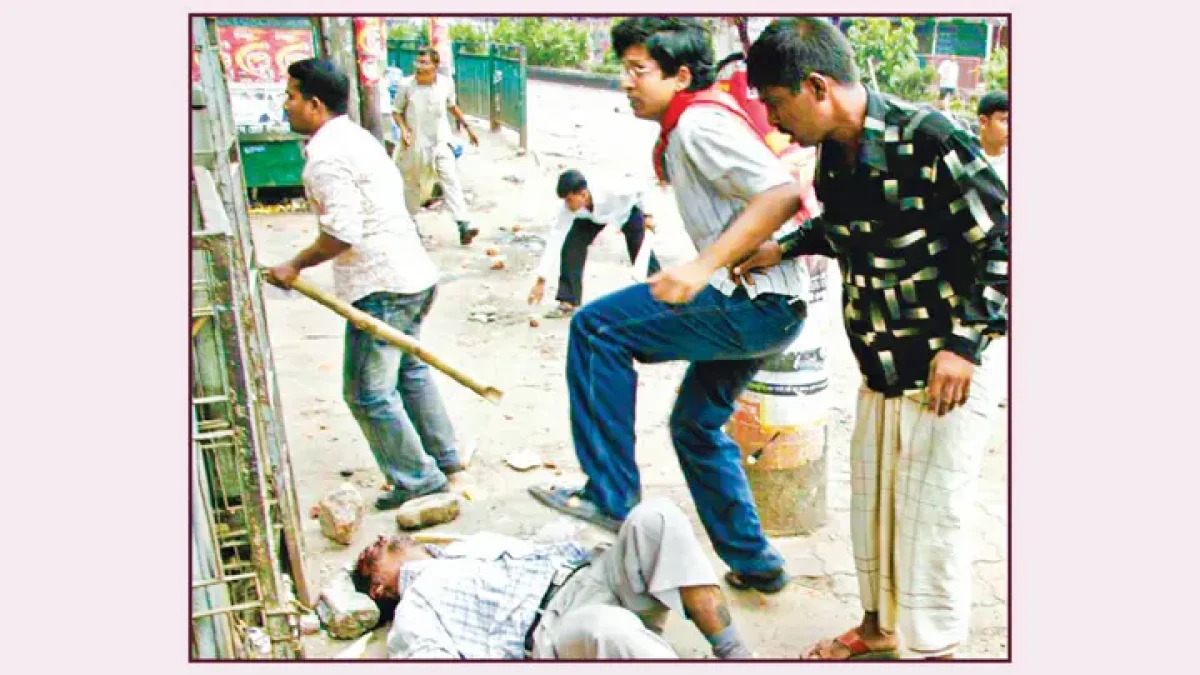
Anniversary of the Awami League’s pole-and-oar killings
Wednesday marks 20 years since the pole-and-oar violence of the ousted Awami League, which the party’s opponents call fascist. On 28 October 2006, Awami League men armed with poles, oars and weapons attacked unarmed leaders and activists of Jamaat-e-Islami and Islami Chhatra Shibir at Paltan in the capital. Six people were beaten to death in public that day, on the orders, Jamaat says, of Sheikh Hasina, who has since been sentenced to death for the mass killings of the July 2024 uprising.
The attackers, from the Awami League whose activities are now banned, then danced on the bodies. Arms and ammunition for the killings were reportedly supplied from Sudha Sadan, Hasina’s residence. The killings drew strong condemnation at home and abroad, including from the United Nations. A case was filed, but after returning to power the Awami League withdrew it by political decision and halted the trial. Far from getting justice, the families of the dead were later persecuted in various ways by the Awami League. Since the 2024 mass uprising they have been speaking out with new hope. The families and Jamaat are demanding that the cases against the killers of 28 October be revived and, if necessary, a separate tribunal be set up to try and punish them. Alongside these demands, the party is marking the anniversary of what it calls the Paltan tragedy with a series of programmes today.
Remembering those killed, the leader of the opposition and Jamaat amir, Dr Shafiqur Rahman, issued a statement to the media on Monday. He said the pole-and-oar violence at Paltan on 28 October was a premeditated massacre and a crime against humanity. The people of the country demand, he said, that the cases filed against the killers of 28 October be revived at once and that they be arrested and punished.
What happened that day
In 2006, as the term of the BNP-led four-party alliance government ended, the Awami League-led 14-party alliance called a pole-and-oar movement for 28 October. On the orders of party chief Hasina, armed leaders and activists of the Awami League, the Jubo League and other wings of the party took up positions in the Muktangan and Paltan area with poles, oars and weapons. The previous evening, 27 October, violence broke out across the country right after Prime Minister Khaleda Zia finished her farewell address to the nation. BNP and Jamaat offices and the homes of their activists were attacked in many places, and many offices and houses were set on fire.
Jamaat had called a rally that afternoon at the north gate of Baitul Mukarram National Mosque to mark the government’s five years in office. At 11am, while the stage was being built, people armed with poles, oars and weapons attacked the rally site. They attacked together from Bijoynagar, Topkhana Road and Muktangan through the Paltan intersection. At one point the Awami League attackers entered the lanes of Paltan and began beating Jamaat and Shibir activists. They beat Shibir leader Mujahidul Islam to death with poles and oars. They then killed Jamaat activist Jashim Uddin and danced on his body.
The Jamaat rally went ahead despite repeated attacks. Four or five minutes after the then Jamaat amir, Maulana Matiur Rahman Nizami, began speaking, tension rose at the Paltan intersection. The attackers threw 10 to 12 bombs at the rally from the roof of the Rangs Tower, then under construction, and fired repeatedly with weapons openly raised. Jamaat activists Habibur Rahman and Jashim Uddin fell after being shot in the head. In all, six Jamaat and Shibir leaders and activists were killed that day and more than a thousand injured. The situation calmed somewhat after the BDR took position at the Paltan intersection after the evening call to prayer. From 27 to 29 October, 54 leaders and activists of the four-party alliance, including Jamaat and Shibir, were killed in Dhaka and across the country, and more than 5,000 injured. Their homes and businesses were attacked. What followed was the illegal 1/11 government, and the country went two years without democracy.
Families still waiting for justice
Two decades on, the families of those killed have not had justice. For his relatives, the death of Shipon, a third-year student at Dhaka College, is still a painful memory. They have long carried the grief of losing a son and the despair of seeing no trial.
Shamsunnahar Ruby, mother of Saifullah Mohammad Masum, who was killed that day, told Amar Desh that the case had not been reopened since the Awami League government stopped it. “We live with a great deal of pain,” she said. “Masum’s father died with that pain. Awami League men took him away and tortured him. I could not keep my job at a school. They tortured my father too. Every day in our lives is 28 October. We want Hasina hanged for this.”
Tajul Islam, father of Hafez Golam Kibria Shipon, said he had never before seen people beaten to death like snakes, as they were on 28 October. “These killings happened on Hasina’s orders. She must be hanged. Otherwise we will have no peace.”
Alongside justice, demands for compensation and rehabilitation for the families of the dead and for the injured have also come up again.
Case at Paltan police station, charges against 46, then the trial stalled
On 29 October, the day after the killings, ATM Sirajul Haque, then Jamaat’s amir for Paltan police station, filed a case at Paltan police station. The first information report named 40 leaders of the Awami League and the 14-party alliance. The accused included the then Awami League general secretary Abdul Jalil, Tofail Ahmed, Mohammad Nasim, Abdur Razzak, Mofazzal Hossain Chowdhury Maya, Sahara Khatun, JSD leader Hasanul Haq Inu and Workers Party leader Rashed Khan Menon, along with more than a thousand unnamed people.
After the investigation, Paltan police submitted a charge sheet to the court on 10 April 2007, adding Hasina as the person who gave the orders. The court accepted it on 11 April. The charge sheet named 46 people, including Hasina, Abdul Jalil, Nasim, Maya, Sahara Khatun, Inu, Menon, Nanak, Iqbal and Haji Selim. The court issued arrest warrants against them. Later that afternoon, for reasons never explained, the charge sheet was put on hold and further investigation ordered. Under the controversial 1/11 government the trial never went ahead.
Case withdrawn after the party took power
After the Awami League came to power, the case was withdrawn in 2009 as politically motivated harassment. That ended proceedings against Hasina and the 45 others. As a result, there was no longer any way to establish through a trial who played what role in the Paltan killings.
Abdur Razzak, lawyer for the families of those killed and senior vice-president of the Dhaka Bar Association, told Amar Desh that the case was withdrawn in 2009 under the Awami League government, which is why nothing more could be done. “Since then we have tried but could not get the case records or certified copies,” he said. “Efforts are now under way to revive the case. We hope that in the changed situation there will be a trial for these heinous killings.”
Calls for a trial again after two decades
Demands for a trial have grown louder since the 2024 mass uprising. Jamaat leaders also called for the case to be revived in 2025. On the eve of the 20th anniversary the party has raised the issue again. Dr Shafiqul Islam Masud, a member of Jamaat’s central executive council, said preparations were being made to file a fresh case.
বাংলায় মূল প্রতিবেদন পড়ুন · Read the original Bengali report