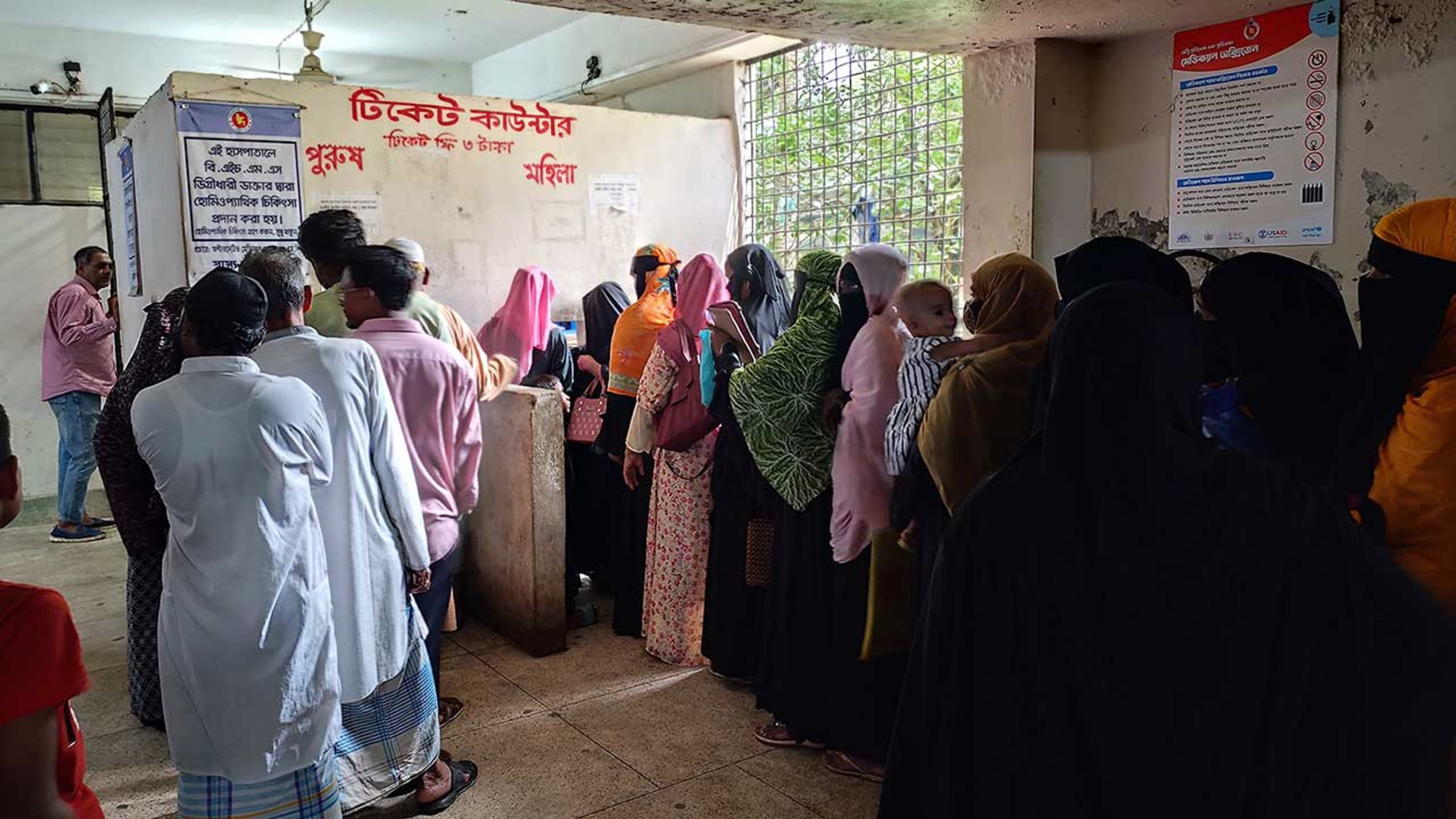
BORHANUDDIN, Bhola — Residents of Borhanuddin upazila in Bhola district have been deprived for decades of adequate medical care, with the area’s 50-bed health complex crippled by shortages of doctors, nurses, diagnostic equipment and modern facilities, officials and residents said.
The shortages hit middle-income and low-income families hardest. Patients and locals say the complex is a hospital in name only.
Many residents who cannot get proper treatment at the government complex turn to private clinics that cost three to four times as much, residents said.
According to the Bangladesh Bureau of Statistics’ Bhola office, the upazila has 265,437 residents. Records from the Borhanuddin Upazila Health Complex show 30 sanctioned positions for doctors and 37 for nurses, but only five doctors, including the upazila health officer, and 14 nurses are on duty. That leaves 25 doctor positions and 23 nurse positions vacant.
The complex sees four to five times more patients than its capacity each day, combining inpatient and outpatient departments. Because of space constraints, the 50-bed complex is operating with only 30 beds. Over the past 15 days, 543 men, women and children received inpatient care and about 2,500 outpatients were treated, most of them women and children suffering from fevers and colds.
A visit to the complex found the emergency department in an old, dilapidated and unsafe building in front of the main gate, where plaster was peeling from the ceiling and steel rods were exposed. The building also houses the offices of the upazila health and family planning officer, the resident medical officer, the emergency duty doctor and several administrative rooms, where staff continue working at considerable risk.
Behind the older structure is a 19-bed building constructed roughly a dozen years ago, with 11 additional beds for a total of 30. Inpatient services operate on the upper floor and outpatient care on the lower floor. Other inpatients are being treated on the floor. The complex has no operating theater, and doctors and nurses are struggling to cope with patient loads four to five times above capacity.
‘We have no choice’
“My husband fishes in the river. We are a family of five with the children,” said Maimuna, the mother of a child patient named Mohammad Osama. “There is no one else to earn. My youngest boy has had fever and cold for five days, so I brought him to Borhanuddin hospital. After admission, a doctor came once, looked briefly and left. Almost 24 hours have passed. The nurses don’t come even when called. We are poor people. We can’t afford to take him anywhere else. What can we do?” she told Dhaka Post.
Patient Rabeya Begum echoed the complaint. “If we had money, we wouldn’t come here for treatment. We would go to Barishal or Dhaka,” she said.
Relatives brought Motahar Hossain, who is in his sixties, to the emergency department after he suddenly fell ill. Staff told them to get an electrocardiogram and said the complex did not have an ECG machine.
“We are permanent residents here. For a long time the Borhanuddin health complex has had no diagnostic equipment,” Motahar’s relatives said. “If the complex had an ECG machine, we wouldn’t have to go to a private clinic. Government tests at low cost are cheaper. The hospital hasn’t had an X-ray machine for a long time either.”
Residents angry
Local residents Mohammad Shafiullah, Mohammad Bashar and Amjad told Dhaka Post that nearly 300,000 people live in the upazila, most of them middle- or low-income. “Many people cannot afford to go elsewhere for advanced treatment if they fall seriously ill,” they said. “They have little choice but to come to the Borhanuddin Upazila Health Complex. On the other hand, patients here are routinely referred to the 250-bed general hospital in Bhola. There is an acute shortage of doctors and nurses. The hospital also lacks the equipment to diagnose patients. We have to spend three to four times more for tests outside. Altogether, medical care at the Borhanuddin complex is in name only.”
Sampa Bepari, a senior staff nurse at the Borhanuddin complex, said relatives of patients often become agitated and behave rudely toward the nurses. “There are shortages of nurses, beds and other resources here,” she told Dhaka Post. “Even with these shortages, we continue to provide care. If the authorities solved the nurse shortage, we could provide better care.”
Dr. Nirupam Sarker Sohag, Borhanuddin upazila health and family planning officer, said the complex faces shortages of doctors, nurses and diagnostic equipment. “Medical care is being provided with only four doctors and 14 nurses,” he told Dhaka Post. “Combining inpatient and outpatient departments, about 300 to 350 patients receive care each day. There is heavy patient pressure. This is a 50-bed complex, but a lack of adequate space means we cannot provide beds for all inpatients. A modern building is also needed. Services are being disrupted somewhat by these problems.”
What Bhola’s civil surgeon says
Bhola Civil Surgeon Dr. M. Monirul Islam said he expected the shortage of doctors and nurses to be resolved within two months. “Doctors will be appointed within two months. The nurse recruitment process is underway. When they join the vacant positions, the shortage of doctors and nurses at the Borhanuddin health complex will be eased,” he told Dhaka Post. “Since the old building is dilapidated, beds cannot be installed there. Care is being provided with 30 beds in the 19-bed building. The X-ray machine is out of order. There is no technologist, and the operating theater cannot be opened without a surgeon and an anesthesiologist. I have informed higher authorities of these issues. I hope these problems will be solved quickly and that residents will receive proper care.”
Patients and residents have called on the interim government to take immediate steps to resolve the problems at the Borhanuddin Upazila Health Complex.
বাংলায় মূল প্রতিবেদন পড়ুন · Read the original Bengali report