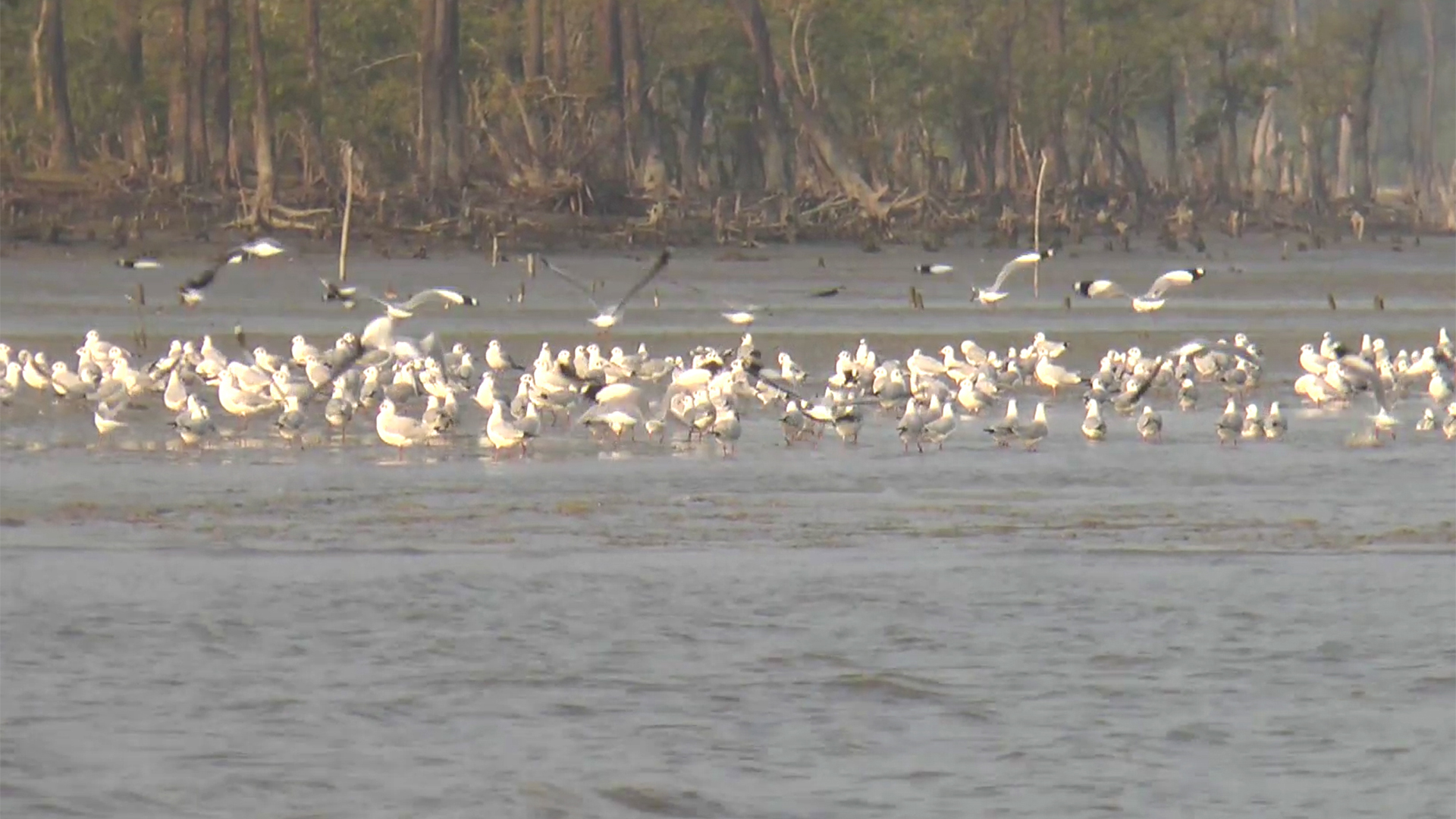
BHOLA — The familiar winter scene is changing across the coastal chars of Bhola district. Char islands that once echoed with the calls of thousands of migratory birds skimming the water are now dominated by the noise of motorized boats and the clamor of people.
The coastal feeding grounds hugging the Bay of Bengal have become deeply unsafe for migratory birds, with their numbers falling at an alarming rate each year and species constantly shifting their habitats, residents and experts said. The result is a coastal winter losing its natural beauty, and an ecological balance under strain.
At chars such as Char Kukri Mukri, Dhalchar and Manpura, and at submerged shoals across the coast, mass flights of migratory birds, group foraging and water play were once an inseparable part of the winter season. Today, those scenes have changed dramatically.
Residents said Char Kukri Mukri, Char Shahjalal, Char Shahjahan, Char Piyal, Ailuddin Char, Char Nizam, Damar Char, Degrar Char and nearly 50 other newly emerged chars between the Meghna and Tetulia rivers were once safe ranging grounds for birds. Migratory birds flying in from as far as Siberia and the Himalayas to escape the cold and find food once filled the broad coastal chars with their calls. But human settlement, expansion of farming, unregulated tourism and the use of chars as grazing land have largely silenced that environment.
Niyamul Majhi, a resident of the coconut grove in Char Kukri Mukri, and trader Mizan Khan of Taruya, along with other locals, said sound pollution from motorized boats and unwanted human intrusion meant the birds no longer gathered at these chars in the numbers they once did.
A seven-member expert team led by Dr. Sayam U. Chowdhury, vice chairman of the research committee of Bangladesh Bird Club, recently conducted a coastal bird census over eight straight days from Jan. 11 to Jan. 18. Team members counted birds at about 53 chars across Bhola, Barishal, Lakshmipur, Noakhali and Patuakhali, Chowdhury said.
According to Chowdhury, this year’s survey recorded 47,157 waterbirds of 63 species at 53 locations in the coastal Meghna estuary. The most frequently sighted species was the Eurasian wigeon, with 6,012 birds counted. The survey also recorded 4,434 black-tailed godwits and 3,962 lesser sand plovers.
The survey found the highest densities of waterbirds at Char Ataur near Bhola’s Manpura, Jaijjar Char near Bhasan Char and Under Char. Counts at those sites were 6,479 at Char Ataur, 5,814 at Jaijjar Char and 4,987 at Under Char. The survey team is now in Dhaka verifying the data and will release detailed figures and a report on the decline of birds soon, Chowdhury said.
M.A. Muhit, a noted mountaineer and member of the census team, expressed deep concern about the changing coastal conditions. He said bar-headed geese and similar species, once numbering more than a thousand along Bhola’s coast, had fallen to just 20 to 25 birds this year. Numbers of ruddy shelducks and Indian skimmers, which once ran into the thousands, have also dropped to the hundreds, he said. Other species in decline include the northern shoveler, northern pintail, Eurasian teal, gadwall and various shorebirds. The lesser adjutant stork, once seen by the hundreds, was not recorded a single time during this year’s survey. The figures show the coastal ecosystem is losing its suitability for birds, he said.
Census team member Nazim Uddin Prince said the survey, jointly organized by Bangladesh Bird Club, Scope Foundation and BirdLife International, covered about 500 kilometers of waterways. The sharp decline in bird numbers at chars near Bhola was driven both by poaching pressure and by the new threat of expansive watermelon farming on the chars, which is shrinking bird habitat, he said.
Another team member, Md. Faysal, said the survey focused on waterbirds and migratory species and that each year the team witnessed habitat destruction and poaching.
Fa-Tu-Jo Khaleq Mila, a wildlife and biodiversity conservation officer with the Forest Department who accompanied the census, said tidal mudflat chars play a critical role as shelter for migratory birds. But increased human movement and commercial activity in those areas were frightening birds away, she said. The Forest Department will soon take effective steps to limit and regulate human access to chars that are essential for ecological balance, Mila said.
বাংলায় মূল প্রতিবেদন পড়ুন · Read the original Bengali report