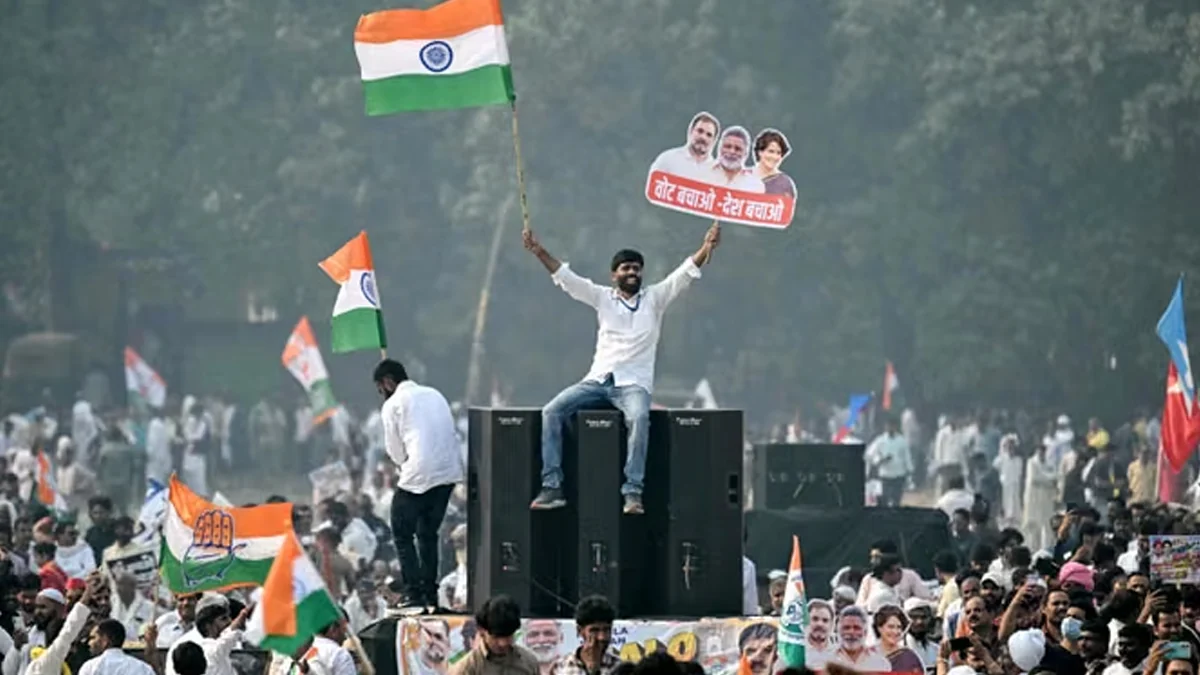
India’s opposition alliance, INDIA, held a rally at Delhi’s Ramlila Maidan demanding the resignation of Chief Election Commissioner Gyanesh Kumar. The Sunday, November 2, event drew Congress leader Rahul Gandhi, Trinamool Congress leader Mamata Banerjee, Congress president Mallikarjun Kharge and Samajwadi Party chief Akhilesh Yadav.
Opposition leaders questioned the Election Commission’s neutrality and the revision of voter lists and criticised the central government led by Narendra Modi. Their speeches focused on the Constitution, democracy and voting rights.
Gandhi said no one, however powerful or wealthy, was above the Constitution. Citing alleged vote-rigging in the 2024 Lok Sabha election and other polls, he demanded Kumar’s removal and legal action against him. Gandhi said removing Kumar would raise the question of legal action against Prime Minister Narendra Modi and Home Minister Amit Shah.
Banerjee accused the Election Commission and BJP of jointly weakening India’s democratic system. She called Kumar “Vanish Kumar” over allegations that large numbers of names had been removed from West Bengal’s voter lists.
Banerjee said the movement was not a bid by any party to seize power but an effort to protect ordinary people’s voting rights. She urged young people to defend democracy.
Kharge, Yadav and other opposition leaders also questioned the Commission’s neutrality and the voter-list revision process. Representatives of 21 opposition parties took part, giving the rally the character of a broader opposition platform rather than a Congress event.
The Election Commission has rejected the opposition’s allegations. It says voter-list revisions are intended to confirm eligible voters and remove false, deceased or duplicate entries.
Student and youth organisations have also joined the debate. The Cockroach Janata Party was one of the first youth movements in Delhi to oppose Kumar and the Special Intensive Revision process.
Its founder Abhijit Dipak met Banerjee on October 31. Banerjee praised young activists and said she supported their movement.
The group did not join the opposition rally the next day. Dipak said it operated independently and would support any organisation protesting alleged vote theft without joining a political alliance.
Neha Bora, a leader of the All India Students Association, had earlier backed the movement. She called for a broader campaign demanding Kumar’s resignation, an end to SIR and withdrawal of the related law.
Business losses linked to the rally also became part of the debate. Brijesh Goyal, chairman of the Chamber of Trade and Industry, said about two hundred fifty thousand shops in 20 to 25 major Delhi markets had closed because of the programme. The group estimated losses of Tk 10,000 crore to Tk 11,000 crore across retail and wholesale trade, transport and tourism. The figures are the trade group’s own estimate and have not been independently verified.
The claims raised questions about the economic effect of political rallies and compensation for traders. Gandhi urged rally participants to shop in local markets, while the BJP criticised the timing and purpose of the event.
Political analysts said the rally was also a test of whether opposition parties with long-standing differences could unite around one issue. Veteran journalist Bhupendra Chaubey told NDTV that the effort to strengthen opposition unity mattered more than the demand to remove Kumar.
The one-day rally does not amount to a lasting electoral agreement. State-level seat-sharing, leadership and each party’s interests remain major challenges for the opposition alliance.
The BJP rejected the event as a democratic movement. Party spokesperson Sambit Patra called it a disorderly political spectacle, highlighting the sharp divide over the rally.
The movement that began with a demand for Kumar’s resignation has now become a wider debate over the Election Commission, voting rights, the central government’s role and opposition unity.
বাংলায় মূল প্রতিবেদন পড়ুন · Read the original Bengali report