Maya Gourdel, a 19-year-old student in Belgium, sits at a desk writing slogans against the country’s rulers. One reads: “If we burn, you burn with us!” Taken from the 2012 film The Hunger Games, the slogan has become a symbol for youth movements around the world. Behind the Gen Z-led protests across Europe lie anger, frustration and a desire for change.
From the suburbs of Paris to the squares of Belgrade, thousands of people have taken to the streets.
Their demands differ but often overlap: crumbling schools, lack of economic opportunity, the rising cost of living, corruption, the housing crisis and a feeling that nobody is listening to them.
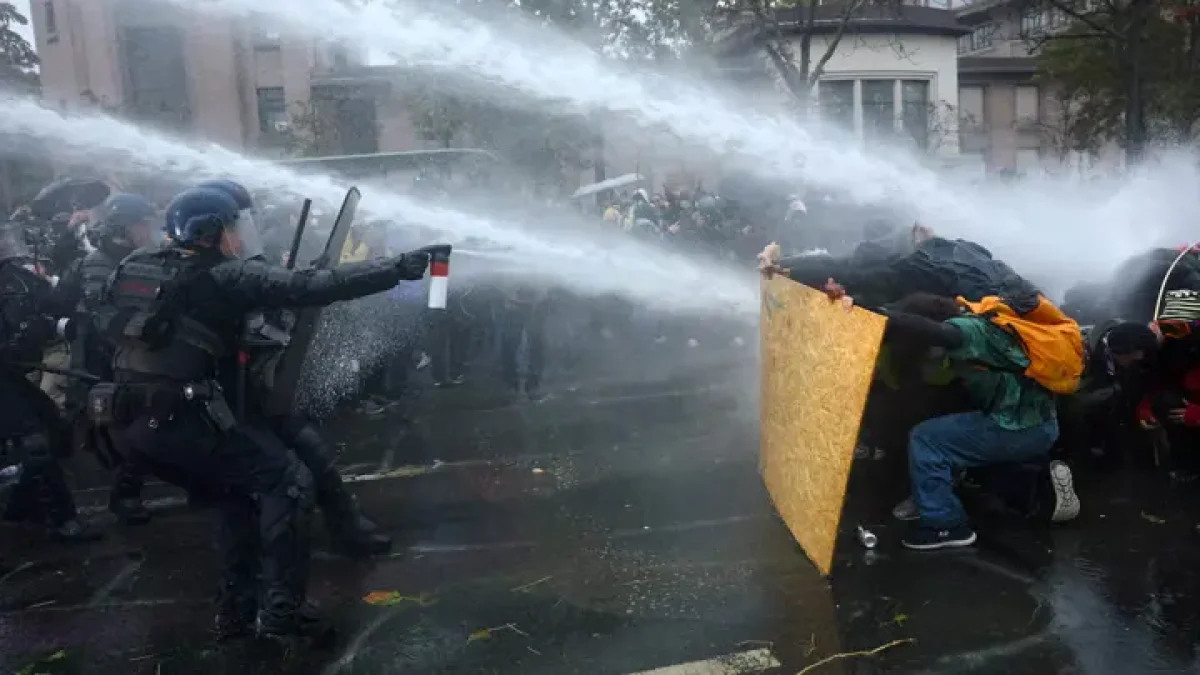
In some cases the protests have turned violent. In recent weeks thousands of shops have been vandalised and looted in France alone, and police have used stun grenades and water cannon to control the situation.
But this weekend they also brought real change. In an election held after nearly two years of protests over corruption and increasingly authoritarian rule, Serbia’s long-time leader Aleksandar Vucic fell.
“When we woke up, the first thing we felt was relief and liberation. Personally I feel a sense of victory. It feels like we have finally moved past the protest stage towards taking responsibility,” said protesting student Stasha Piletic.
An explosion of anger
Chiara, a 21-year-old student at the heart of the protests in Milan, believes “it is very important to take part in people’s spontaneous movements. These movements were born mainly from an explosion of anger, which has opened the way to collective action.”
“The greatest harm the ruling class has done to my generation is to take away even our ability to imagine a future, to dream,” she said. Italian students face a reality in which schools lack enough teachers and buildings are falling apart, she said.
“On top of that, ahead of us are jobs with low pay that we did not train for, and the uncertainty of living in small, overpriced flats, probably outside our home town, in a city we did not want to live in,” she said.
The generation born between 1997 and 2012 is known as Gen Z. In recent years protests led by this generation have spread around the world: youth movements drew attention in Bangladesh in 2024, Nepal in 2025 and India this year. Now Europe has become one of the movement’s centres.
According to a European Union survey published in 2025, the cost of living and rising prices are the main worry for 40 percent of young people aged 16 to 30.
In the same year, 92.7 million people in the EU were at risk of poverty or social exclusion. The risk was highest among 18- to 24-year-olds, at 26.3 percent, against 18.8 percent for those aged 65 or over.
Discontent is also growing among young people over carrying the financial burden of older generations. They complain that older voters turn out in larger numbers, so their interests weigh more in political decisions.
According to the French research institute OFCE, a quarter of France’s population is over 60, yet they own 60 percent of the country’s wealth.
Because of an ageing population and voters’ reluctance to raise the retirement age or cut pension benefits, pensions are the biggest item of public spending in France and could reach 14 percent of gross domestic product (GDP).
Greece and Italy spend even more than France on public pensions relative to GDP. According to 2025 OECD figures, the two countries spend about 16 percent of GDP on pensions, while Australia, Chile, Iceland, Ireland and South Korea spend less than 4 percent.
Europe’s young people united
A 17-year-old high school student from a suburb north of Paris joined the movement in protest at the “dire” conditions and staff shortages at his school.
He said rats used to be seen there, and last year students were evacuated after a roof collapsed in the school courtyard, though nobody was hurt.
In his view, the protests have shown that Europe’s young people are united.
“We all agree on one thing: young people are treated too much like children and are not taken seriously enough,” he said.
A French government report published in October says that between 2000 and 2023 spending on pensions rose by 2.5 percentage points of GDP, while spending on education fell by 0.5 percentage points.
The report also says 32 percent of the education ministry’s budget goes on pensions, squeezing spending on other parts of education.
In Belgium, Gourdel is also campaigning for better conditions in schools.
“We tried to protest peacefully. Nobody listened. But when people started setting fire to rubbish bins, or doing things like that, the media and the cameras turned to us,” she said.
The protests are still spreading. Demonstrations against the cost of living, inequality, war and conditions in schools are planned in Germany this weekend.
Unrest has also spread to Albania. Student-led protests began over anger at corruption allegations against Prime Minister Edi Rama’s government, a lack of jobs and the poor quality of education, and then spread beyond the capital Tirana to other cities.
“The prime minister has spent 130 days without listening to us,” said Zaike Kurti, a 19-year-old architecture student.
“If you ask any student in Albania where they see their future, they will all say abroad. Having talent here is no use. In the end you will lose to someone with political or personal connections,” she said.
After the protests, the challenge of governing
The student-led movement in Serbia has achieved a success that protesters in other European countries can still only dream of.
But after the change of power comes a harder test: running the country. Neither the students nor their chosen candidates have any experience of government.
Another protester, Luka Stojakovic, is not too worried. “We have seen where people with political experience have taken the country,” he said.
বাংলায় মূল প্রতিবেদন পড়ুন · Read the original Bengali report