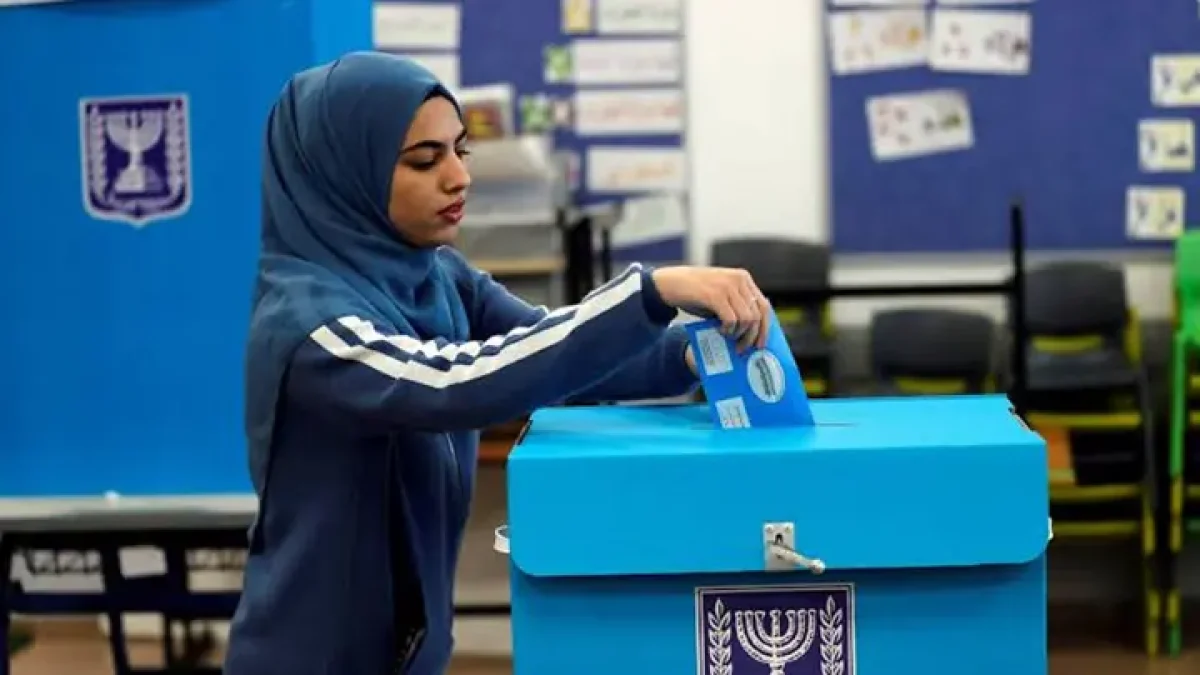
Israel’s Muslim and Arab parties have made history in the country’s parliamentary (Knesset) election. After more than 4 million votes were counted, Arab and Muslim-majority parties together were set to win a record 19 seats.
According to political analysts in the country, the soaring success of the Arab parties in this hard-fought election has completely changed the arithmetic of forming the next government and put them at the centre of politics as potential kingmakers.
In the last election, in 2022, the Arab parties won only 10 seats. This time that number is set to nearly double.
A surge for the Arab parties
According to the latest count published by Israel’s election commission, the Joint List, the main electoral alliance of Arab parties, is set to win 13 seats on its own. Mansour Abbas’s Islamist party, the United Arab List or Ra’am, is set to win 6. Together the two parties would hold 19 of parliament’s 120 seats.
A large turnout of Muslim voters drove the result. According to the election commission, turnout reached a record 77.7 percent, 7.1 points higher than in 2022. Arab communities, including Bedouin areas, saw a strong wave of voting, producing a big surprise in parliament from the parties representing Muslims.
Government formation may depend on Muslim parties
Any coalition needs at least 61 seats to form a government in Israel’s 120-seat parliament. In the count, long-serving Prime Minister Benjamin Netanyahu’s right-wing bloc won 54 seats: Netanyahu’s Likud 27, the religious party United Torah Judaism 7, Shas 7, the far-right Otzma Yehudit 7 and the Religious Zionist Party 6.
The opposition bloc led by former army chief Gadi Eisenkot, which set out to unseat Netanyahu, won only 47 seats: Eisenkot’s Yashar party 21, the Naftali Bennett and Yair Lapid alliance “Be’yachad” 11, Yair Golan’s Democrats 8 and Avigdor Lieberman’s Yisrael Beytenu 7.
So neither the right-wing nor the centrist bloc secured the 61 seats needed to form a government on its own.
Muslim parties as kingmakers, uncertainty remains
The result makes clear that without the support of the Arab-Muslim parties’ 19 seats, no bloc can secure a majority in parliament or govern for long. In other words, the decisions of Muslim lawmakers will be the decisive factor in who becomes the next prime minister.
Even so, deep uncertainty surrounds the formation of a government, because hardline leaders of the opposition bloc led by Gadi Eisenkot and Naftali Bennett strongly oppose forming a formal government with the Arab parties. Only Democrats leader Yair Golan has shown some flexibility on the issue.
Ra’am leader Mansour Abbas said his party would make its final decision on joining a government, or supporting one from outside in a confidence vote, on the basis of specific agreements on development of Arab society, protection of rights and eliminating crime.
If the opposition or the ruling parties ultimately fail to reach agreement and refuse to ally with the Muslim parties, Israeli politics will face a deep deadlock and a new national election will have to be called.
বাংলায় মূল প্রতিবেদন পড়ুন · Read the original Bengali report